

Long hallways get a bad reputation. People treat them like the awkward in-between spaces of a home, just something you rush through to get to the “real” rooms. But honestly? A long hallway is one of the biggest untapped opportunities in your entire house. Done right, it can be the most striking part of your home.
I’ve spent a lot of time styling narrow and long corridor spaces for my home design content, and I’ll tell you straight: these spaces reward creativity like nothing else. So let’s get into 15 ideas that will completely change how you see your hallway.
1. Create a Gallery Wall That Tells Your Story
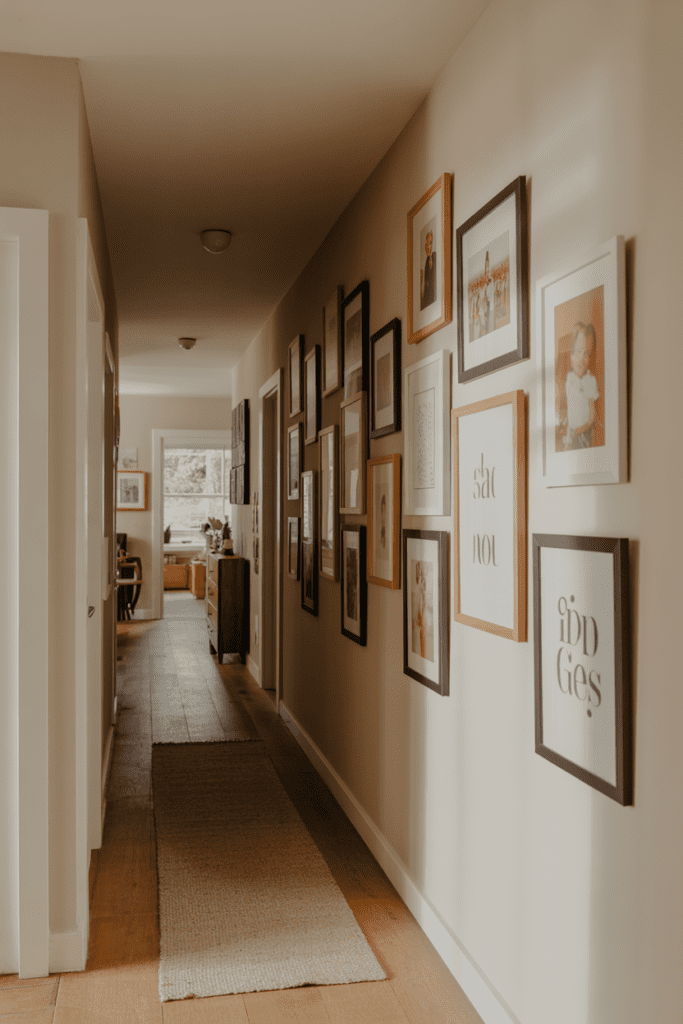
A long hallway basically begs for a gallery wall. You’ve got all that vertical and horizontal real estate — use it.
The trick is cohesion. Pick a consistent frame color (black, white, or natural wood all work beautifully) and mix up the art sizes. Go for a mix of family photos, abstract prints, and maybe a typographic piece or two.
Don’t align everything perfectly along one straight line — that looks corporate. Instead, stagger the frames slightly above and below a central visual axis. It gives the wall energy and movement.
- Use frames in 2–3 complementary finishes max
- Keep at least 2–3 inches of space between each frame
- Add a small shelf mid-wall to break up the flat surface
2. Install Wainscoting for Instant Elegance
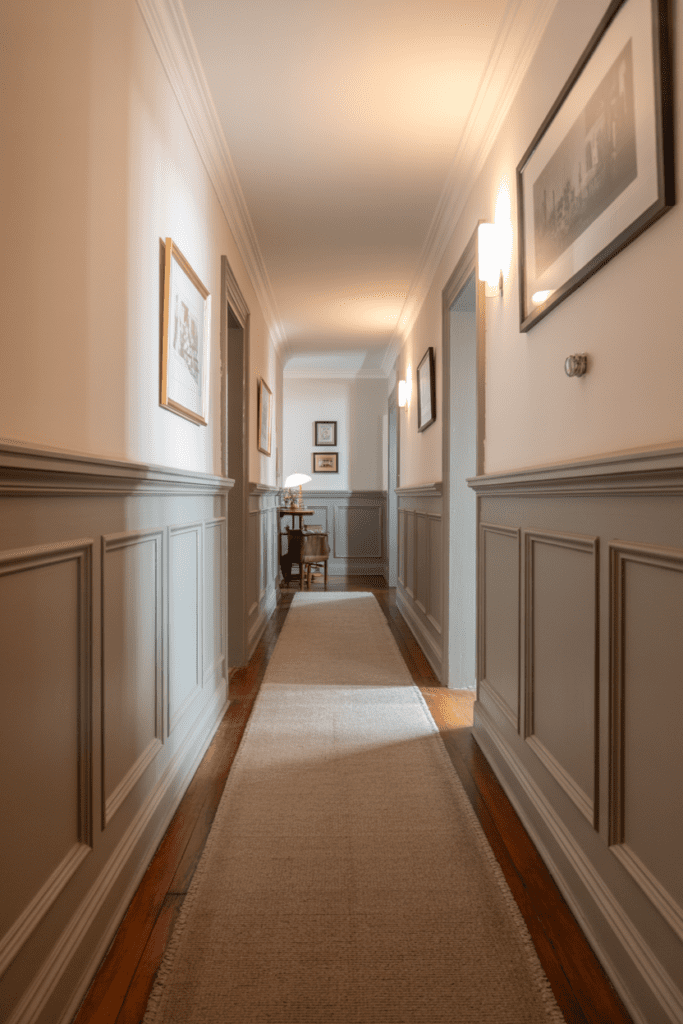
Ever walked into a hallway with wainscoting and thought, this place has class? That’s not an accident. Wainscoting — the paneling that runs along the lower third of a wall — adds architectural detail that plain drywall simply can’t compete with.
Board and batten is the most popular style right now, and IMO, it’s the most versatile. It works in farmhouse, modern, and transitional homes without feeling out of place.
Paint the panels a shade slightly lighter or darker than the upper wall for a subtle two-tone effect. This breaks up the length of the hallway visually and makes it feel intentional rather than stretched.
3. Use a Runner Rug to Define the Space
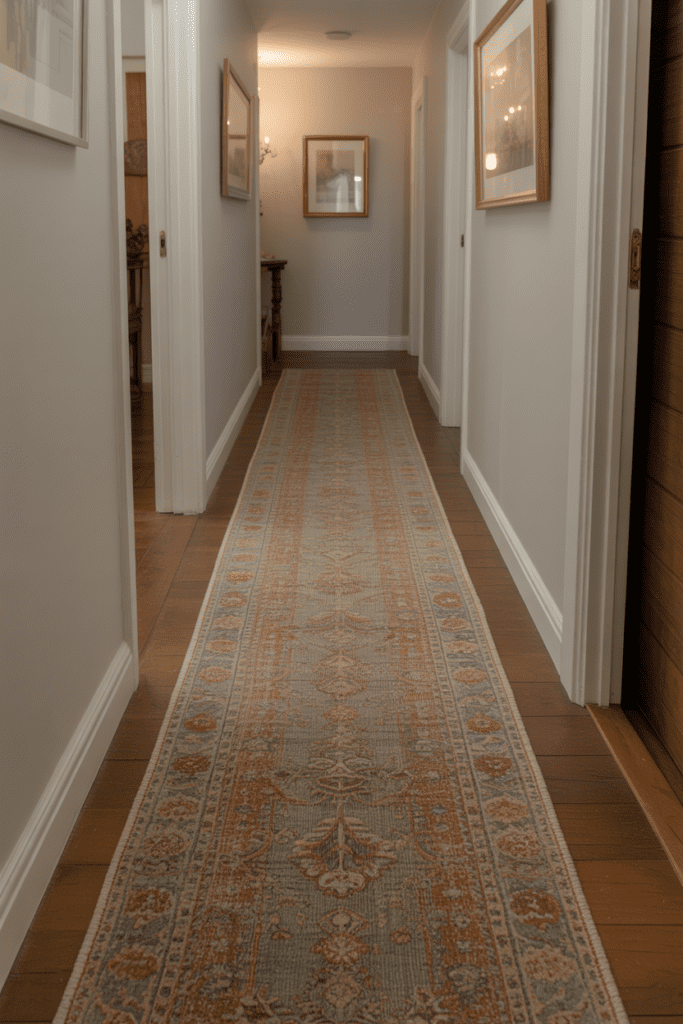
A long hallway without a runner rug is like a living room without a sofa — technically functional, but missing the point entirely.
Runners anchor the space and soften the echo that bare floors create. They also visually guide people through the corridor, which is exactly what you want in a long, narrow passage.
Go bold with pattern here. Since runners are relatively low-commitment compared to area rugs, this is your chance to use a geometric print, a vintage Persian style, or even a bold stripe. Just make sure the rug runs at least two-thirds the length of the hallway — anything shorter looks like a mistake.
- Natural fiber runners (jute, sisal) work well in high-traffic halls
- Wool runners are more durable and stain-resistant
- Non-slip pads are non-negotiable on hardwood or tile floors
4. Go Dramatic with Dark Paint
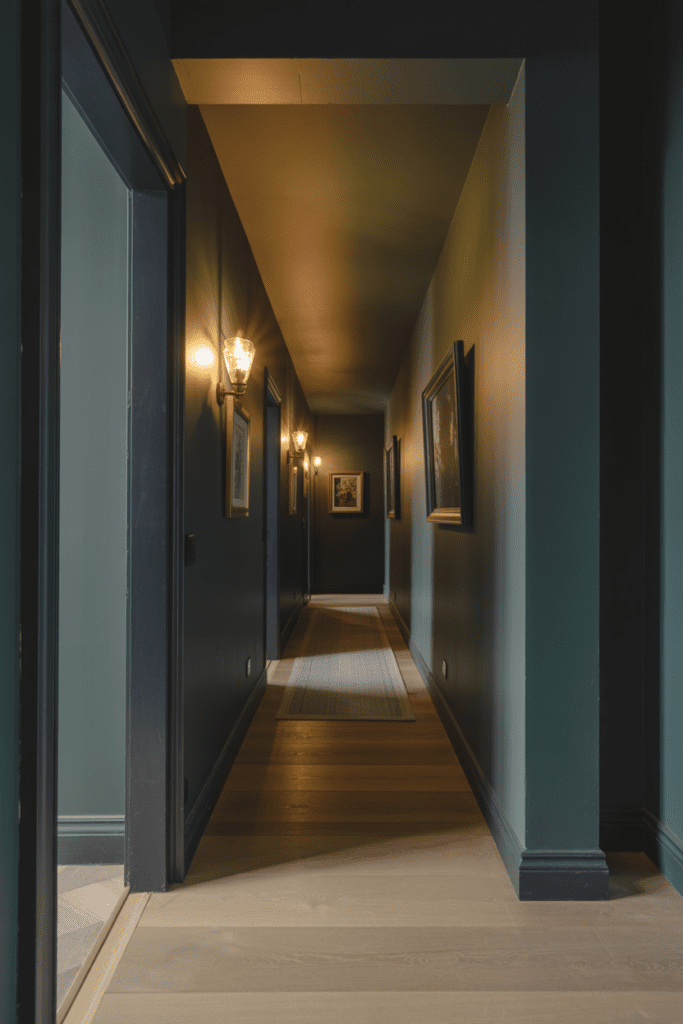
Dark paint in a hallway sounds counterintuitive, right? “Won’t it feel like a cave?” — I get why people hesitate. But here’s the thing: long hallways don’t need to feel bright and airy. They need to feel intentional.
Deep navy, charcoal, forest green, or even black can turn a boring corridor into something that feels like the entrance to a boutique hotel. Pair dark walls with warm lighting and light-colored flooring, and the result is moody in the best way.
The key is contrast. Don’t do dark walls AND dark floors AND dark furniture. Pick one element to go deep and let everything else breathe.
5. Add Built-In Storage Along One Side
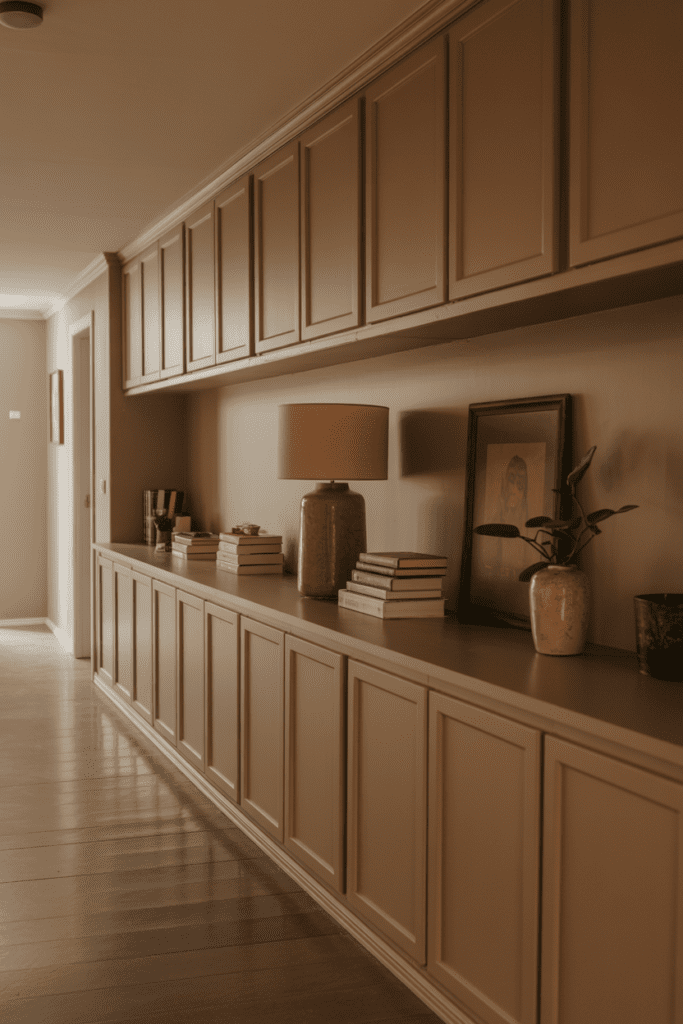
If your hallway is wide enough (ideally 48 inches or more), built-in cabinetry along one wall is a game-changer. You gain serious storage without sacrificing floor space.
Shallow built-ins work best — about 12 to 14 inches deep. You can store shoes, bags, linens, seasonal items, and all the miscellaneous stuff that tends to pile up near entryways.
Top the cabinets with a flat surface to display art, plants, or decorative objects. Add inset lighting underneath the upper cabinets for a warm, layered glow that makes the hallway feel lived-in rather than utilitarian.
6. Play with Lighting Layers
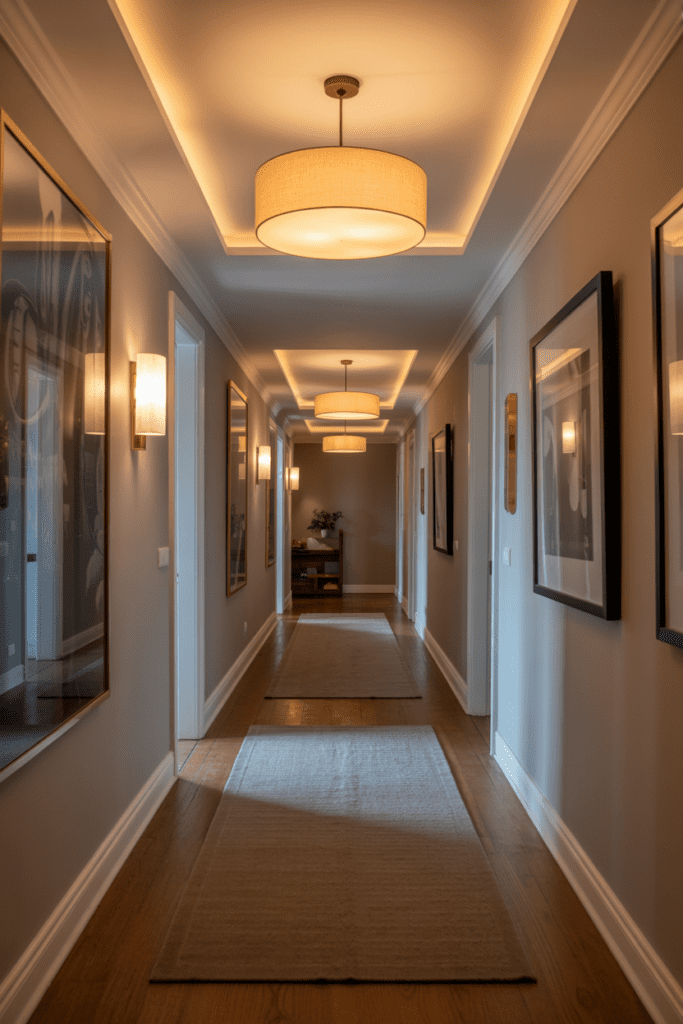
A single overhead light fixture in a long hallway is the design equivalent of eating plain toast for breakfast. It works, but you deserve better. 🙂
Layer your lighting with a combination of:
- Overhead pendants or a linear chandelier for general illumination
- Wall sconces spaced evenly down the hallway for warmth
- Recessed LED strips along the floor or ceiling edge for ambiance
Warm white bulbs (2700K–3000K) make the biggest difference in a hallway. They soften the space and make it feel welcoming rather than institutional.
7. Hang a Large Statement Mirror
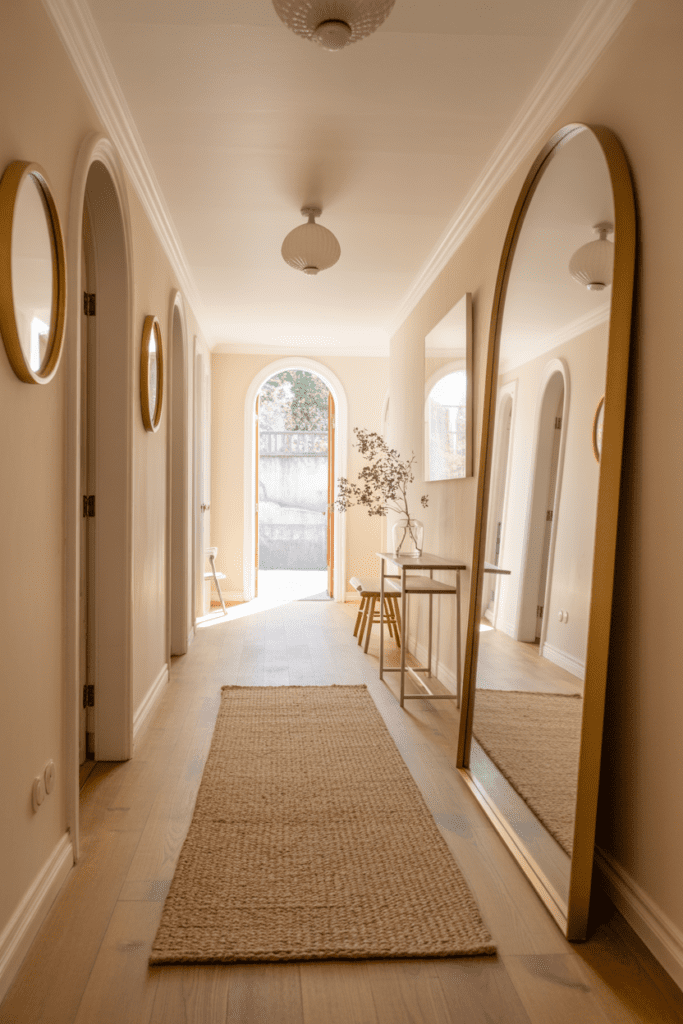
One large mirror — or a series of mirrors — is one of the oldest tricks in the interior design book, and it still works brilliantly.
A full-length or oversized mirror at the end of a hallway creates the illusion that the space continues further than it actually does. It also bounces light around, making the corridor feel less tunnel-like.
If one mirror feels too stark, try a grouping of three mirrors in varying shapes — a round, an arch, and a rectangular. It’s more dynamic and feels more curated than a single mirror.
8. Use Vertical Stripes to Raise the Ceiling
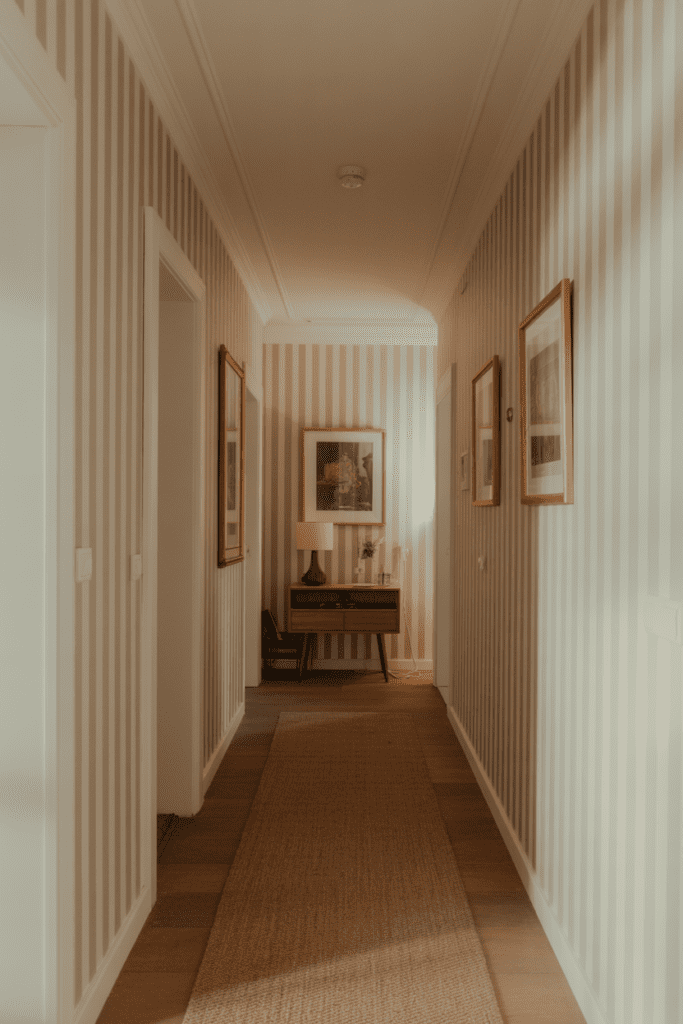
Here’s a classic trick that interior designers have used for decades: vertical stripes make ceilings feel taller. In a long, narrow hallway where the walls feel like they’re closing in, this matters a lot.
You can achieve vertical lines through:
- Striped wallpaper (one of the most impactful options)
- Tall, narrow wall panels painted in alternating tones
- Floor-to-ceiling bookshelves or cabinets
Even the pattern on your runner rug can work — a narrow stripe running lengthwise down the rug pulls the eye forward and stretches the perceived height.
9. Turn the End Wall into a Focal Point
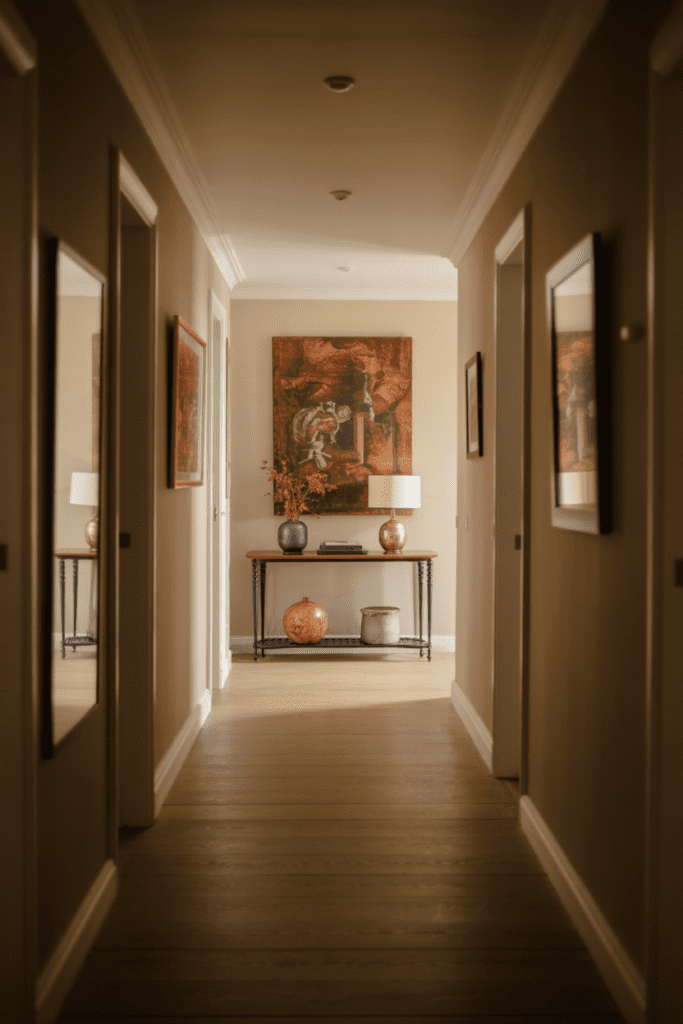
The far end of a long hallway is prime visual real estate. It’s the first thing people see when they enter, and most homeowners completely ignore it. Don’t be that person :/
Make it a destination. Options include:
- A large piece of art or a framed print
- A console table styled with a lamp, vase, and small décor objects
- A floor-to-ceiling bookshelf built into the wall
- A bold wallpaper accent applied only to that end wall
The end wall acts as a visual anchor for the entire corridor. When you give it purpose, the whole hallway feels more intentional.
10. Introduce Plants for Life and Texture
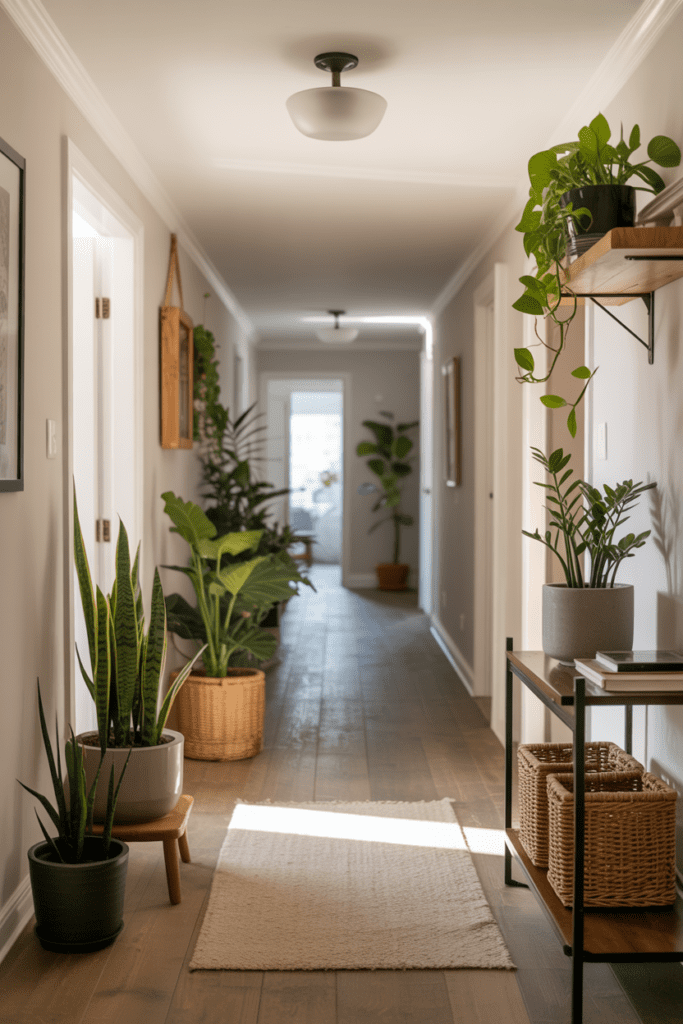
Plants do something for hallways that no décor item can replicate — they bring actual life into the space. And in a long hallway, they soften the hard lines that make corridors feel rigid.
The best plants for hallways tend to be low-light tolerant since these spaces often don’t get much natural light:
- Snake plants (nearly impossible to kill, FYI)
- Pothos in hanging planters
- ZZ plants
- Cast iron plants
A row of small potted plants on a floating shelf, or a single dramatic fiddle leaf fig near the end wall, can completely transform the atmosphere of a corridor.
11. Install Floating Shelves for Display and Storage
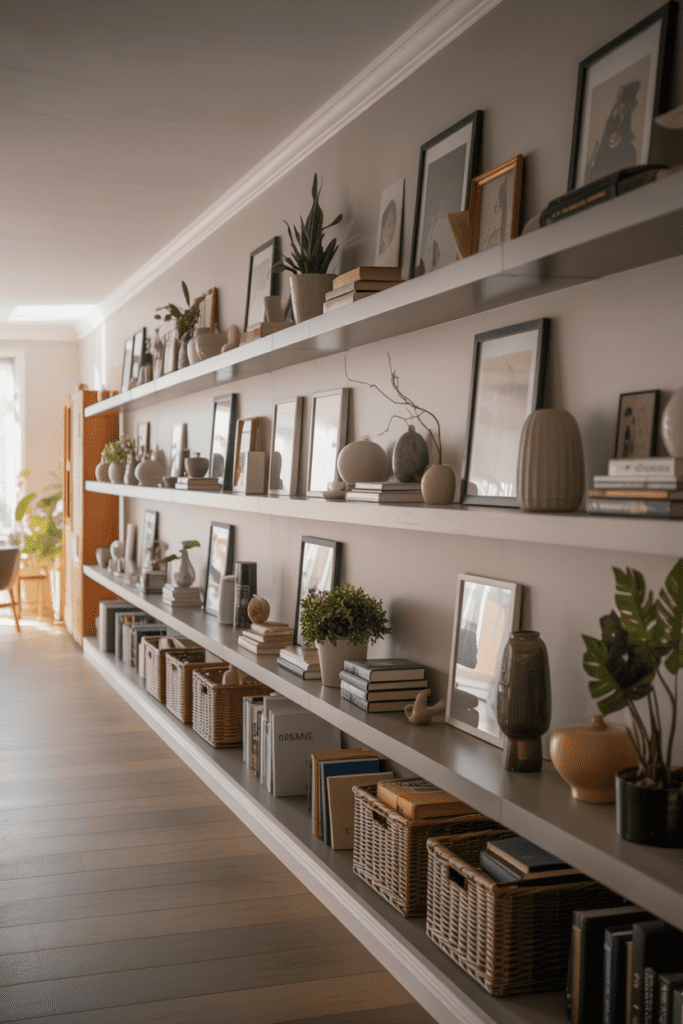
Floating shelves give you the display space of a gallery wall plus the functional storage of cabinetry — without the bulk or cost of built-ins.
Style them with intention. Don’t just pile stuff on them. A good shelf display follows the rule of odd numbers — group items in threes or fives. Mix heights, textures, and materials. A ceramic vase next to a stacked book next to a small plant hits differently than three identical objects in a row.
Keep the shelves spaced consistently down the hallway so they create a rhythmic visual beat rather than a random scatter.
12. Use Consistent Flooring to Unify the Space
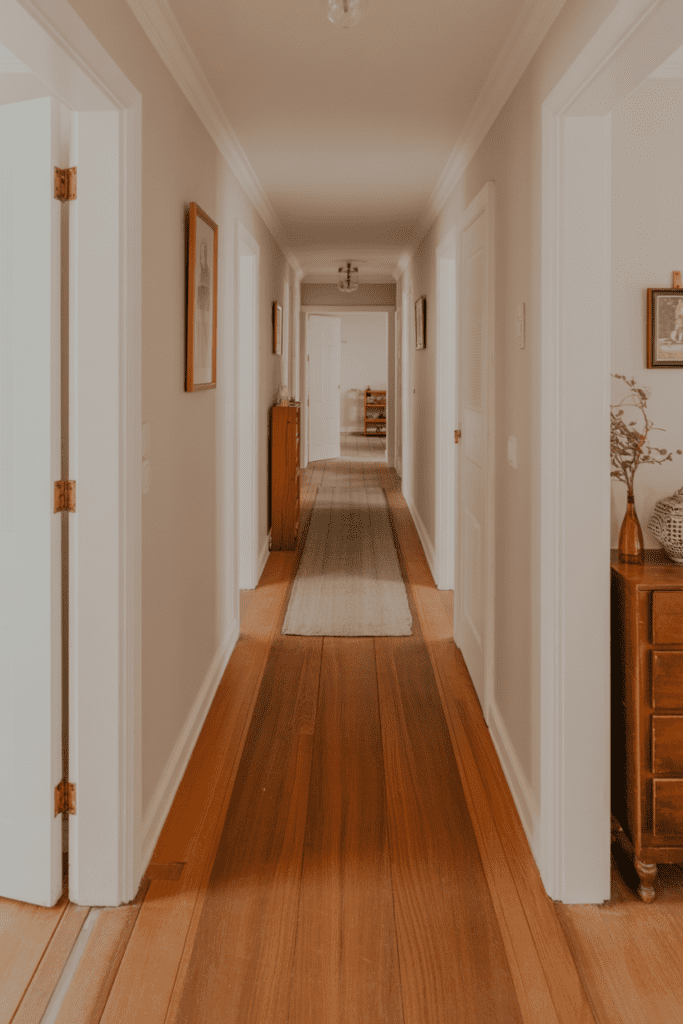
Sometimes the issue with a long hallway isn’t the décor — it’s the flooring. If your hallway has different flooring from the rooms it connects (or worse, multiple flooring types within the hallway itself), the space feels choppy and disjointed.
Consistent flooring — running the same material and direction straight through the hallway — makes the corridor feel purposeful and long in a good way. Wide-plank hardwood laid lengthwise is one of the best options. It emphasizes the length without making it feel stretched.
If you can’t change the flooring, a continuous runner rug does most of the same work.
13. Add Architectural Interest with an Arched Doorway
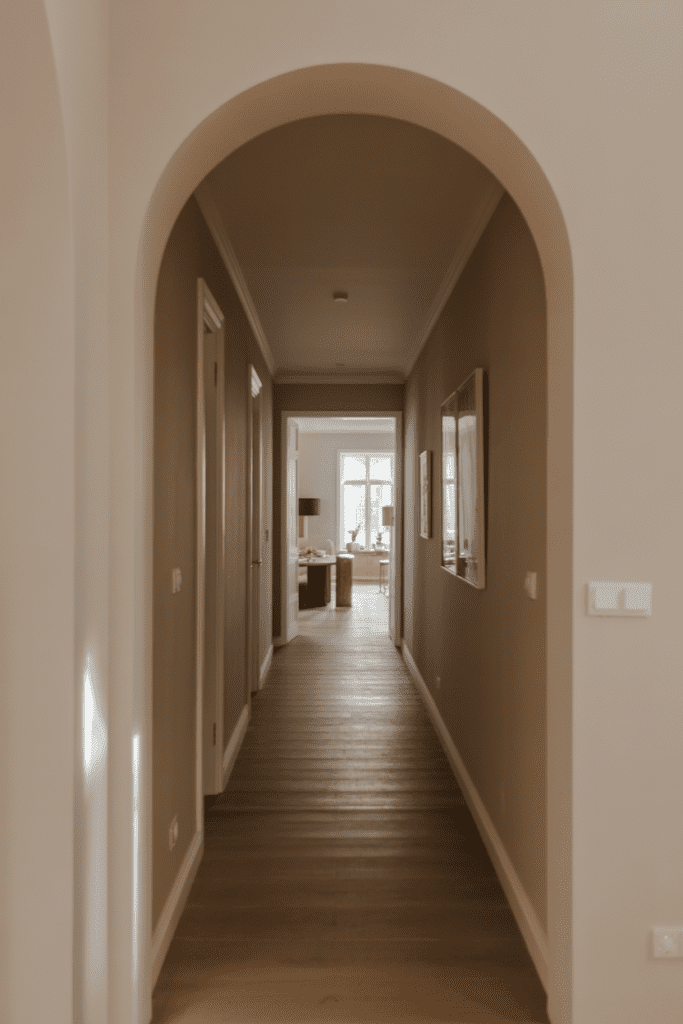
If your hallway connects to other rooms through standard rectangular doorways, consider converting at least one to an arched opening. It sounds major, but it’s often more achievable than people expect — especially if no structural walls are involved.
Arched doorways slow the eye down as it travels through the hallway. They add soft curves to what is otherwise a very linear space, and they photograph beautifully (which matters if you’re documenting your home for Pinterest or a design blog — just saying).
Pair an arched doorway with a bold paint color on the walls, and you’ve got a hallway that people will actually stop to admire.
14. Create Zones with Furniture Groupings
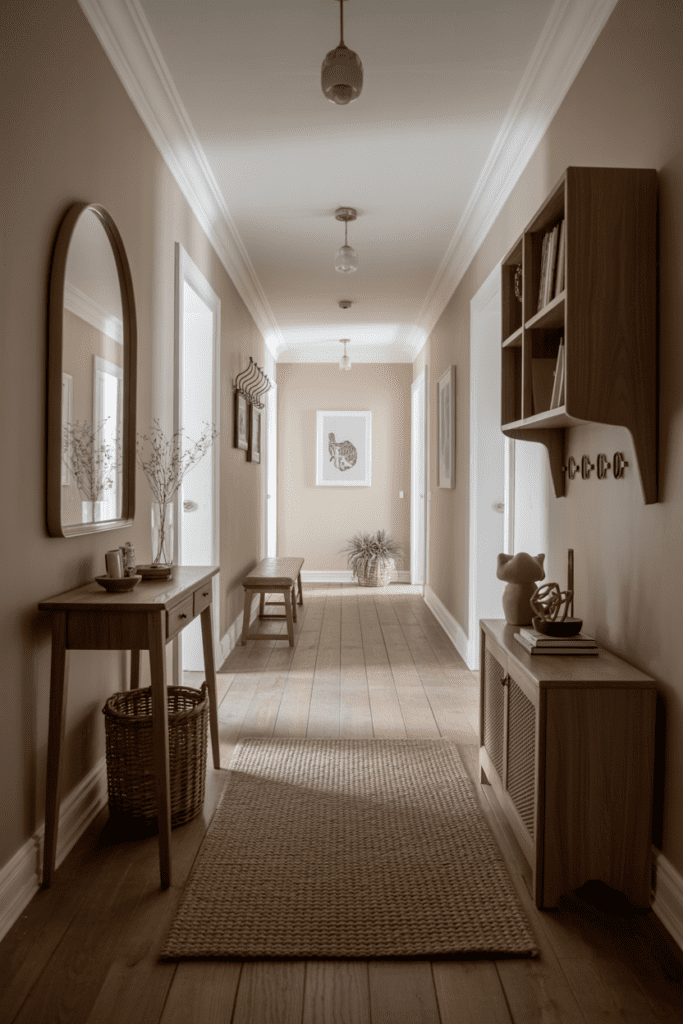
A really long hallway — think 20 feet or more — can actually support small furniture groupings that break the space into zones. This sounds unusual, but it works.
A slim console table with a mirror near the entry zone. A small bench with hooks above it mid-hallway. A reading nook or bookshelf arrangement near the far end. Each “zone” gives the hallway a purpose beyond just passage.
The furniture has to be appropriately scaled — console tables no more than 12–14 inches deep, benches no wider than 18 inches. Anything bulkier will make the hallway feel cluttered rather than styled.
15. Wallpaper the Whole Thing
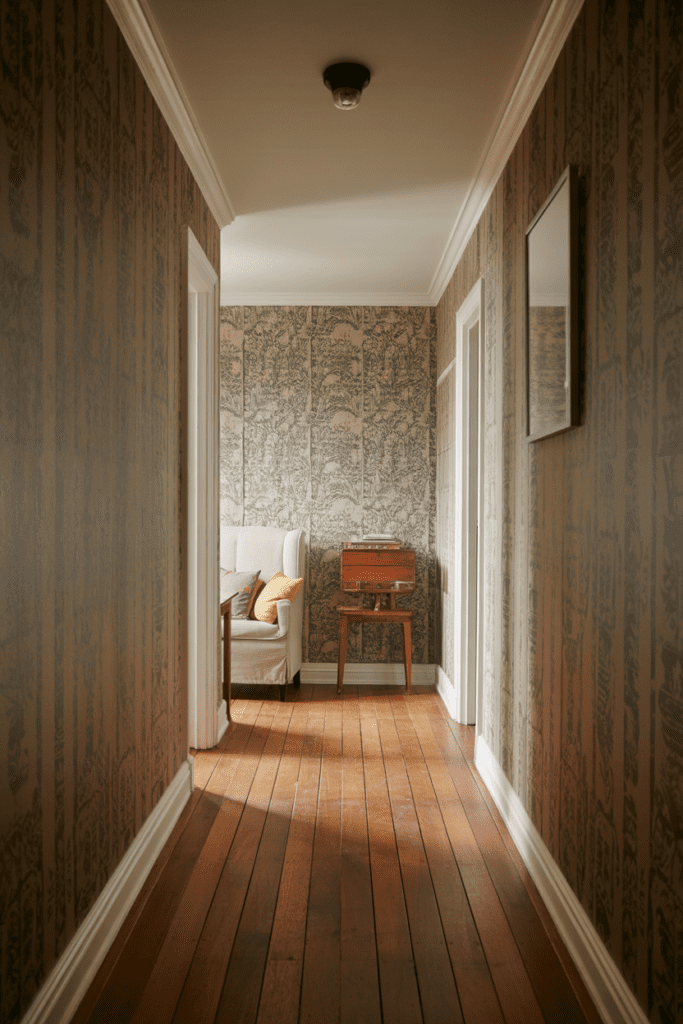
If you want one change that delivers maximum impact with minimum effort, wallpaper the entire hallway. Nothing transforms a corridor faster.
The key is choosing the right pattern for the space:
- Vertical botanical prints feel lush and organic
- Geometric patterns feel modern and graphic
- Grasscloth or textured wallpaper adds warmth without visual busyness
- Mural-style wallpaper on a single wall creates a wow moment
Go bold. Hallways are low-commitment spaces compared to living rooms — you spend less time in them, which means you can handle more visual drama without it becoming overwhelming.
Bringing It All Together
Here’s the honest truth: a long hallway becomes magnificent when you treat it as a room in its own right, not a transition zone. Every idea on this list works on its own, but the real magic happens when you layer a few together.
Start with the bones: flooring, paint, and lighting. Then layer in the personality: art, mirrors, plants, and textiles. Finally, add the functional elements: storage, shelving, and furniture.
You don’t have to do everything at once. Pick two or three ideas that resonate with your style, implement them well, and see how the space transforms. A well-designed hallway sets the tone for every room it leads to, and that’s not something worth leaving to chance.