
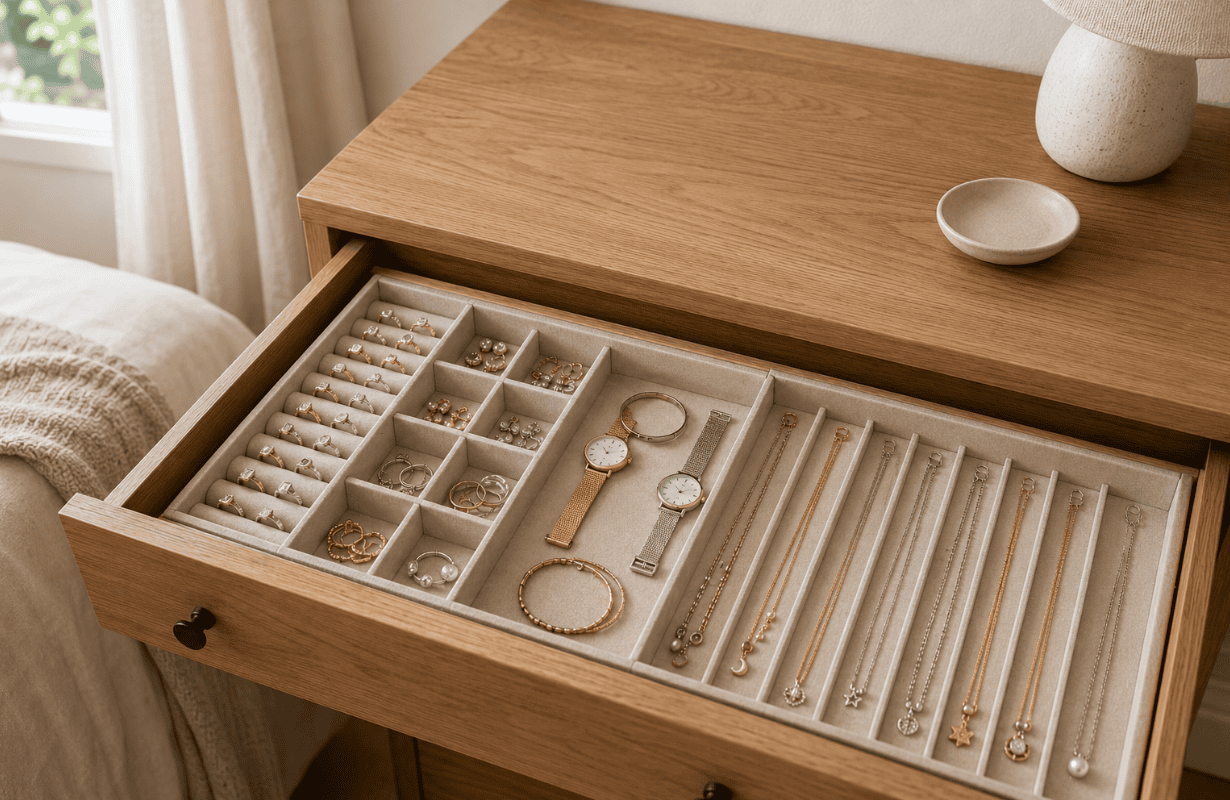
Jewelry has a funny way of taking over a room.
It starts with one pair of earrings left beside the sink. Then a necklace gets dropped on the dresser because you’re planning to wear it again tomorrow. Before long, there’s a little dish overflowing with rings, tangled chains, watches, hair clips, and random pieces you forgot you owned.
And while those pretty jewelry stands look great in perfectly styled photos, they’re not always the best solution. If your goal is a bedroom or bathroom that actually feels calm, covering the countertop with organizers can create a different kind of clutter.
The trick is giving your everyday jewelry easy access without making all of it visible.
If you’re trying to figure out how to organize jewelry without creating countertop clutter, the answer isn’t necessarily buying a bigger jewelry box. It’s creating a simple system based on what you wear, where you get ready, and how much jewelry you realistically need within reach.
Why Jewelry Organization Gets Cluttered So Quickly
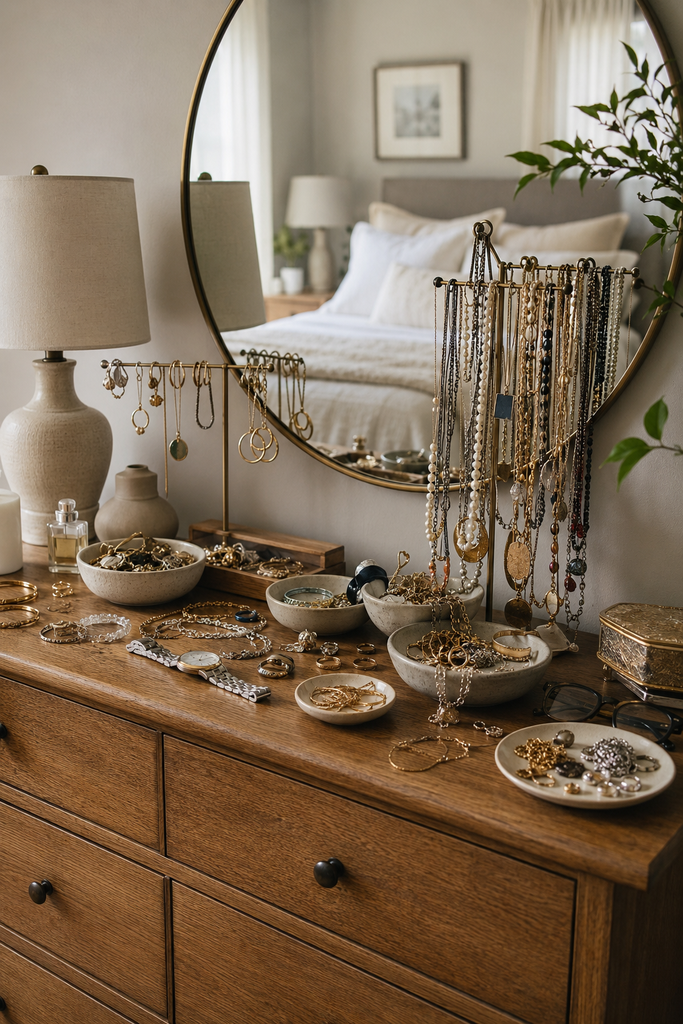
Most people get this wrong because they organize jewelry as one big category.
But a wedding ring you wear every day doesn’t need the same storage as a statement necklace you pull out twice a year.
Too Much Jewelry Is Kept in the “Prime” Zone
The easiest-to-reach storage should be reserved for your most-used pieces.
If you regularly rotate between three necklaces, four pairs of earrings, a watch, and a few rings, those pieces deserve convenient storage. The other 40 pieces don’t need to occupy your dresser.
Trying to keep everything equally accessible usually results in oversized jewelry stands, multiple trays, and crowded surfaces.
Open Displays Slowly Become Visual Noise
A beautiful necklace stand holding three necklaces can look intentional. One holding fifteen necklaces usually doesn’t.
Here’s the thing: jewelry contains lots of tiny shapes, colors, chains, stones, and reflective surfaces. Put enough of those details together and even an organized display starts looking busy.
If your bedroom already has lamps, books, framed photos, candles, and decor, your jewelry doesn’t also need to become part of the display.
Start by Dividing Jewelry by How Often You Wear It
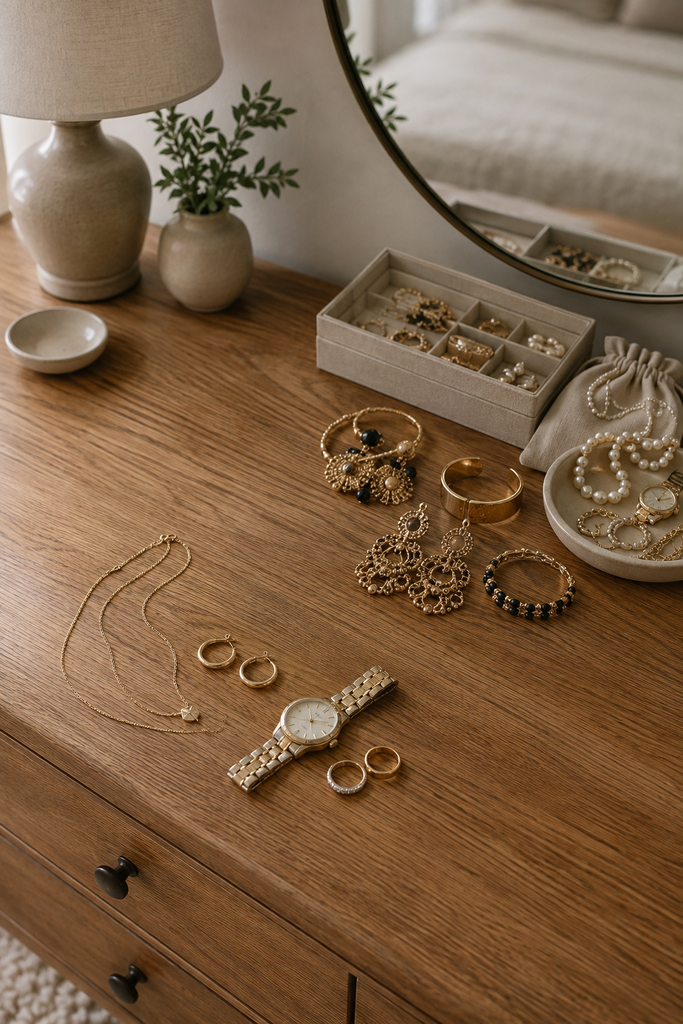
Before buying an organizer, pull your jewelry together and sort it.
Not by color. Not by metal.
Sort it by frequency.
Create Three Simple Groups
I like separating jewelry into:
Everyday pieces: Items worn several times a week.
Occasional pieces: Jewelry worn for dinners, work events, weekends, or particular outfits.
Rarely worn pieces: Formal jewelry, sentimental pieces, seasonal items, and anything you want to keep but rarely reach for.
This immediately tells you how much convenient storage you actually need.
Your everyday collection might fit into one small drawer insert instead of the giant jewelry organizer you thought you needed.
Make a Drawer Your Main Jewelry Station
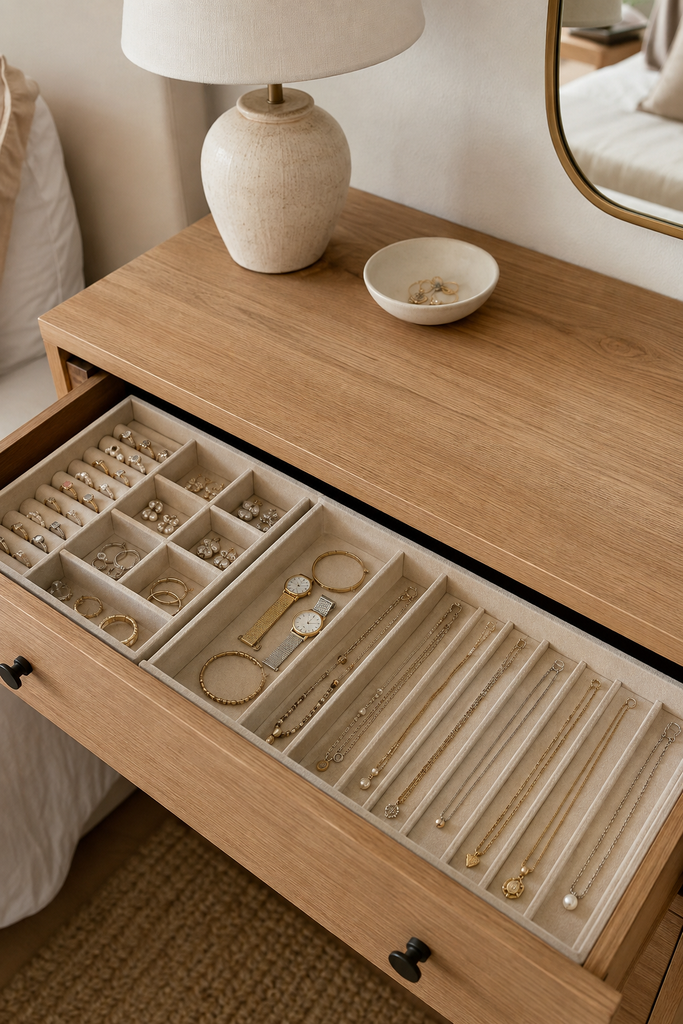
If you have even one available dresser or vanity drawer, this is usually the cleanest solution.
What actually works is treating the drawer like a countertop organizer that happens to disappear when you close it.
Use Shallow Compartments Instead of One Big Box
A large empty drawer isn’t enough. Earrings disappear into corners, bracelets pile together, and necklaces become tangled.
Use shallow divided inserts that keep categories separated.
You might have one section for rings, another for studs, longer compartments for watches and bracelets, and individual spaces for necklaces.
The organizer should fit the collection rather than forcing the collection to fit the organizer.
And avoid stacking jewelry whenever possible. Seeing pieces at a glance makes getting ready faster and prevents forgotten items from collecting underneath everything else.
Store Necklaces Vertically When Drawer Space Is Tight
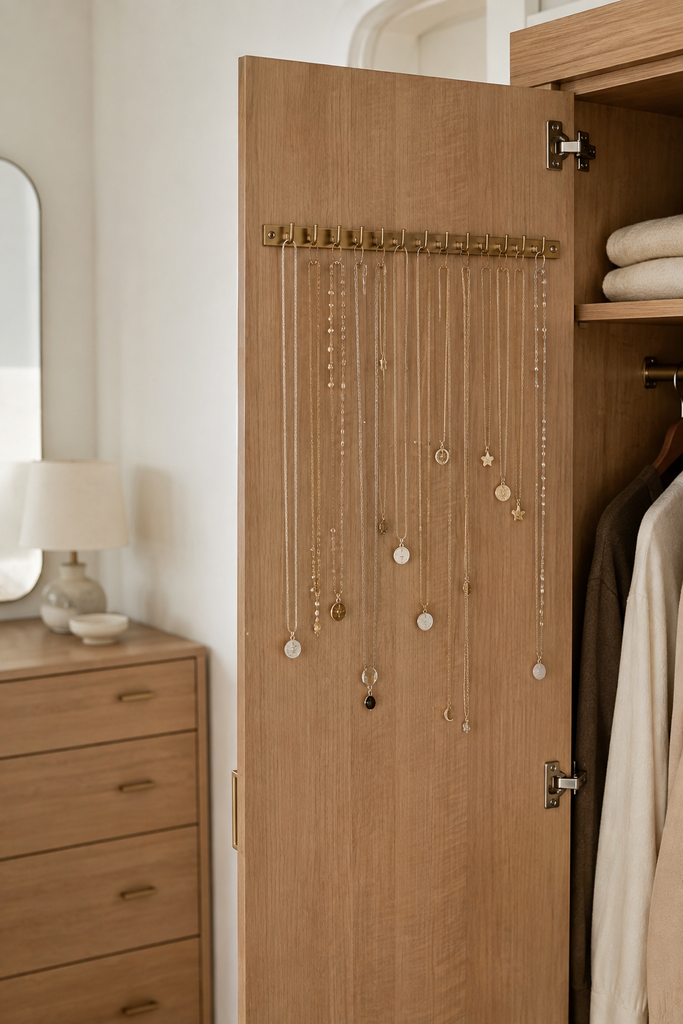
Necklaces are usually the hardest pieces to organize because chains tangle so easily.
If you don’t have enough drawer space, vertical storage can work beautifully—but I wouldn’t automatically hang necklaces on an exposed wall.
Instead, use hidden vertical space.
Try the Inside of a Closet or Cabinet Door
Small hooks installed inside a closet door, wardrobe, or cabinet can hold necklaces individually without using your countertop.
Give longer necklaces enough vertical clearance so they hang naturally rather than bunching at the bottom.
This works particularly well when your dresser is close to your closet. You can see every necklace at once, grab one, close the door, and the visual clutter disappears.
Just make sure hooks are secure and positioned where jewelry won’t get crushed when the door closes.
Give Everyday Jewelry a Tiny Landing Zone
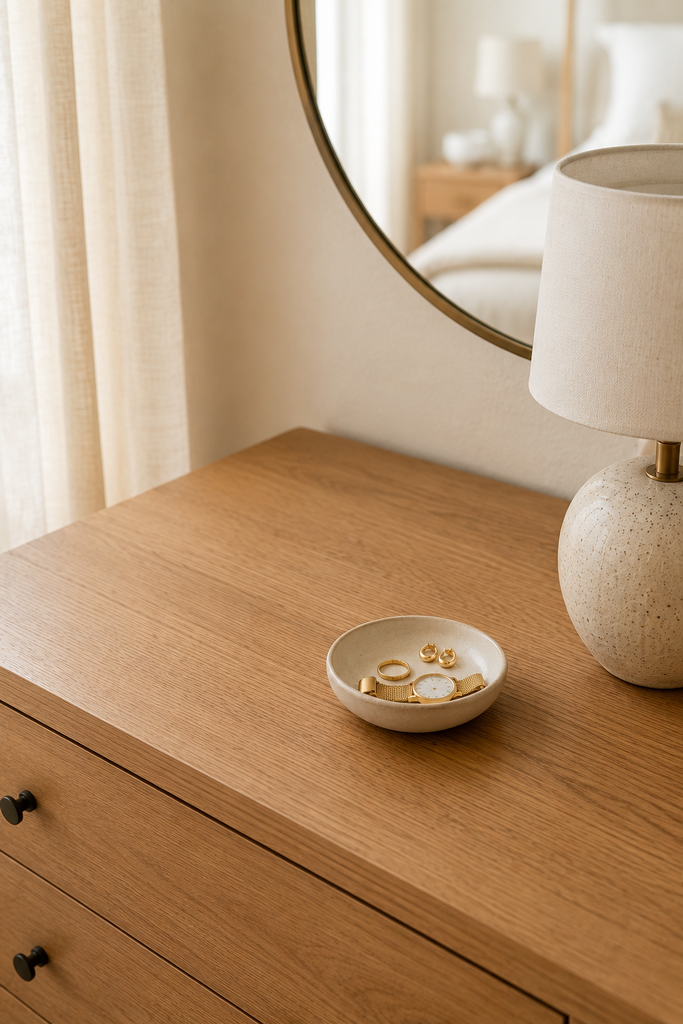
There is one place where I think visible jewelry storage makes sense: the pieces you remove every single day.
You probably aren’t going to open a carefully organized drawer every time you wash your hands or take off your watch before bed.
Keep the Landing Zone Intentionally Small
Use one tiny dish or shallow tray for your current everyday pieces.
The key word is tiny.
A large tray becomes permission to leave more stuff there. A small dish naturally limits what can accumulate.
For example, it might hold your wedding ring, everyday earrings, and watch overnight. Everything else goes back into its permanent storage.
That gives you convenience without turning half the dresser into a jewelry station.
Use Different Storage for Special and Sentimental Jewelry
Your everyday organizer doesn’t need to accommodate every piece you own.
Formal and sentimental jewelry can live somewhere less convenient.
Keep these pieces in protective boxes, soft pouches, or lined compartments inside a deeper dresser drawer or closet shelf.
This is especially useful for delicate pieces that shouldn’t constantly rub against other jewelry.
It also creates a useful boundary: your prime storage remains functional instead of becoming an archive of everything you’ve ever owned.
Build a System Around Where You Actually Get Ready
One mistake I see all the time is choosing the “perfect” storage location instead of the realistic one.
If you put on jewelry at your bedroom mirror every morning, storing it across the room inside the closet probably won’t last.
You’ll eventually start leaving pieces beside the mirror again.
Your primary jewelry storage should be close to the point where you naturally put jewelry on and take it off.
For someone with a dresser mirror, that might mean the top drawer. For someone who gets ready inside a walk-in closet, a wall-mounted organizer inside the closet could make more sense.
Convenience matters because an organization system only works if returning something is almost as easy as leaving it out.
Keep Your Countertop Almost Empty
Once everything has a home, resist the urge to decorate the newly cleared surface with another organizer.
Leave some breathing room.
A dresser with a lamp, a small everyday jewelry dish, and perhaps one decorative object often looks better than a surface filled edge to edge with “organized” belongings.
Every few months, check your jewelry drawer too. If compartments start overflowing, don’t immediately buy more storage. Look at what you actually wear.
That little reset keeps the system from slowly expanding back onto the countertop.
A Simple Jewelry System Is Usually the Best One
Learning how to organize jewelry without creating countertop clutter really comes down to separating convenient storage from visible storage.
Keep your everyday collection close and easy to reach, use divided drawers whenever possible, hang necklaces in hidden vertical spaces, and give rarely worn jewelry its own secondary location.
Then allow yourself one small landing spot for the pieces you genuinely remove every day.
You don’t need a complicated jewelry organization setup. In fact, the simpler the system is, the more likely you are to keep using it.