
A beautifully styled dining table can make the whole dining room feel more finished. But there’s a pretty big difference between a table that looks gorgeous in a photo and one that actually works when Tuesday-night dinner rolls around.
You know the kind of setup I mean. There’s a huge vase in the middle, candles lined up on both sides, a decorative bowl, maybe some greenery weaving its way down the table and somehow there’s barely enough room left for an actual dinner plate. Then every evening, half of that carefully arranged decor gets moved to the kitchen counter so everyone can eat.
That gets old quickly.
Your dining table probably does a lot more than host special dinners, too. It might be where you drink coffee in the morning, open your laptop, help with homework, sort the mail, fold laundry, or put down takeout containers when nobody feels like cooking. It’s working furniture, and I think it should be decorated like working furniture.
The good news is that practical doesn’t have to mean leaving the table completely bare. Learning how to style a dining table without blocking everyday use is really about choosing fewer, smarter pieces and giving them a defined area instead of decorating every available inch.
Why Dining Tables Become Overdecorated So Quickly
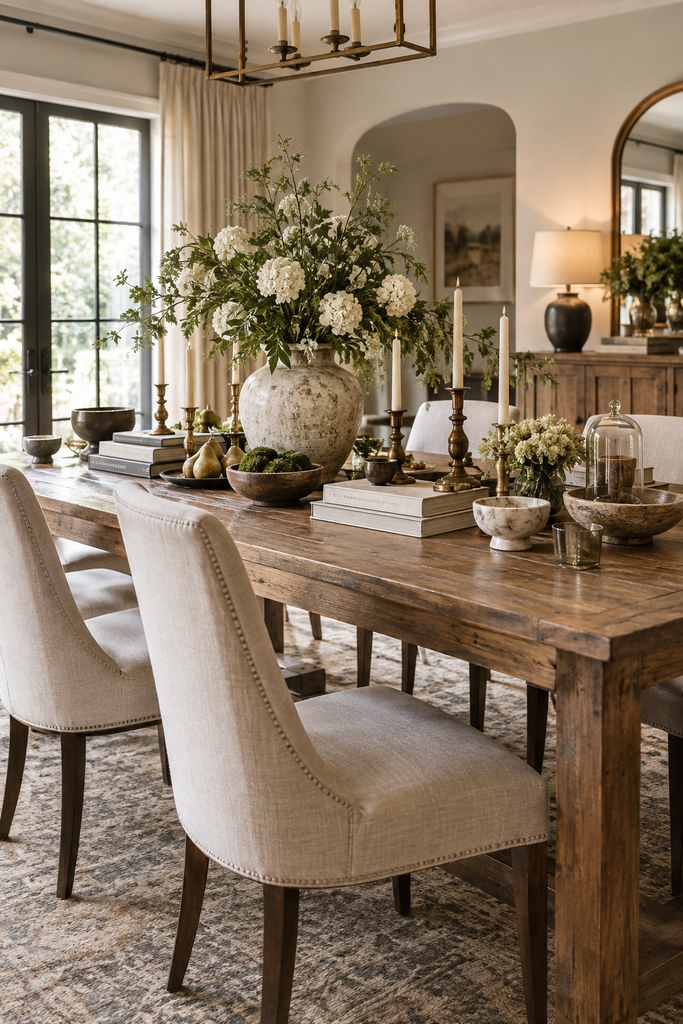
Most people get this wrong because they decorate the entire tabletop instead of choosing one intentional area to style.
A long empty table can feel like it needs several objects to look finished. So you add a vase, then candles, then a bowl, maybe a tray…and suddenly half the usable surface has disappeared.
The better approach is to think about visual impact versus physical footprint. You want enough decoration to make the table feel intentional while using as little actual tabletop space as possible.
A single beautiful arrangement often does that better than five smaller objects scattered around.
Leave the Working Areas Alone
Before buying anything decorative, think about where people actually sit.
Place settings, elbows, serving dishes, water glasses, laptops, and homework all need room. The center of the table is usually the least disruptive location for decor because it isn’t directly competing with those activities.
That means your styling should generally stay within a fairly narrow center zone rather than spreading toward every seat.
Start With One Compact Centerpiece
If you want the easiest solution, start here.
Choose one centerpiece with a relatively small base: a ceramic bowl, low vase, small planter, sculptural vessel, or compact arrangement of branches.
The trick is choosing something that provides enough visual presence vertically without consuming a huge amount of horizontal space.
For example, a medium ceramic vase with a few airy branches can make a six-person table feel styled while taking up roughly the same amount of space as a dinner plate.
That’s much more practical than a sprawling floral arrangement.
Keep Most Decor Below Conversation Height
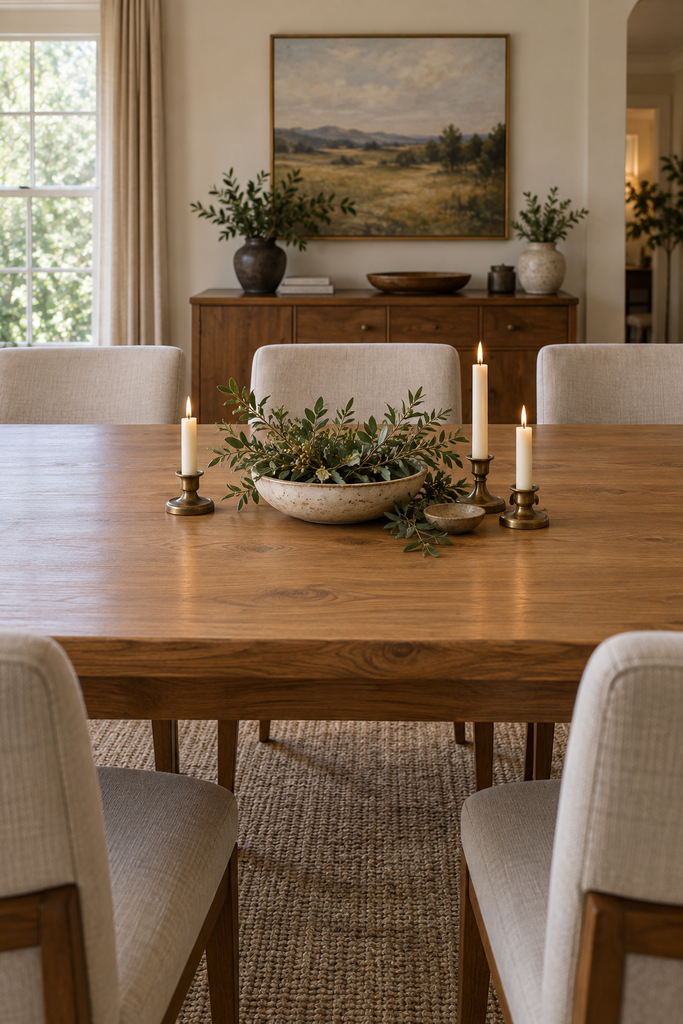
Here’s the thing: a centerpiece shouldn’t make you lean sideways to talk to the person sitting across from you.
Low arrangements are usually safest for tables used every day. Bowls, shallow planters, small floral arrangements, and grouped objects can add interest without creating a visual wall.
If you love taller arrangements, choose something visually open.
A narrow vase with a few delicate branches works better than a dense bouquet because you can still see through and around it. Save those enormous florist-style arrangements for the console table.
Use a Tray to Create a Movable Decorating Zone
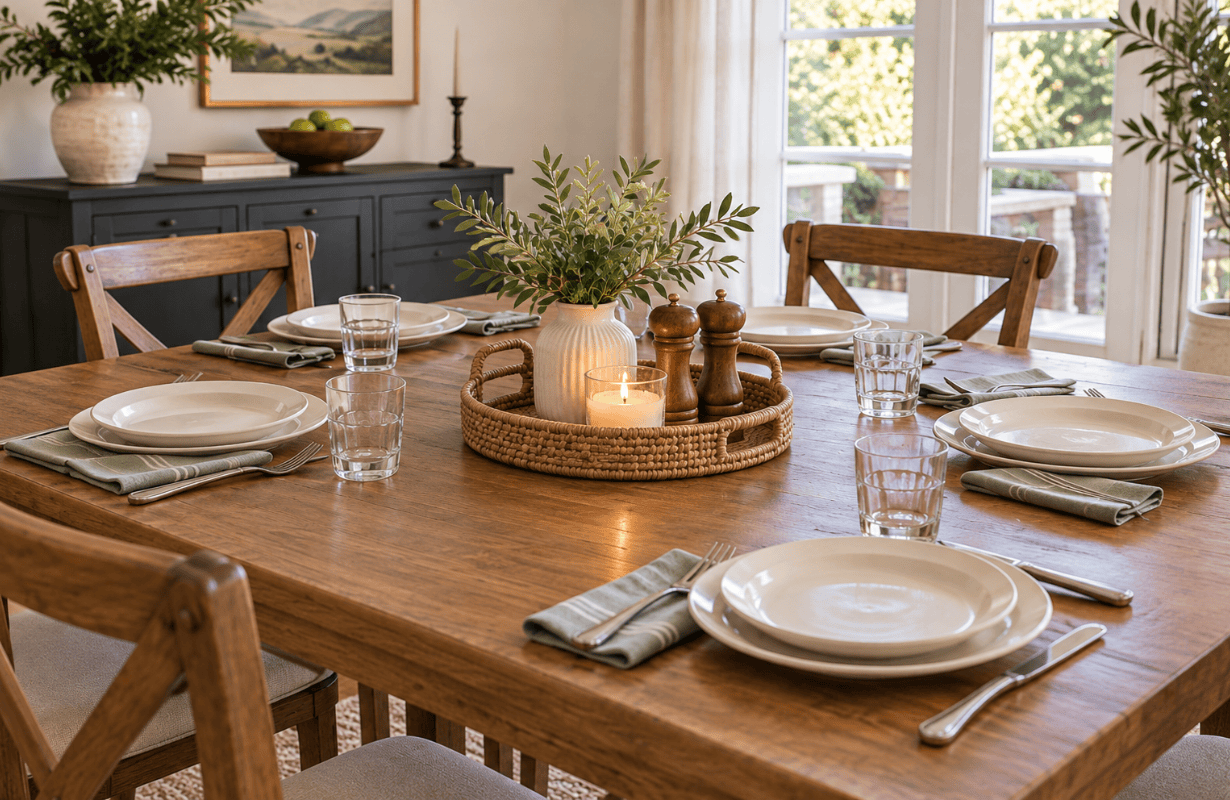
A tray is probably one of the most practical dining table styling tricks because it gives several little objects one defined footprint.
Instead of placing candles, a vase, salt and pepper grinders, and another decorative object individually across the table, group two or three of them on a single tray.
Why does this work?
Visually, the tray makes separate objects read as one arrangement. Practically, you can pick up the entire thing and move it when you need more space.
For an everyday dining table, choose a tray that feels proportional rather than oversized. Wood, woven rattan, marble, or matte ceramic can add texture without making the arrangement overly formal.
Try a Bowl You Can Actually Use
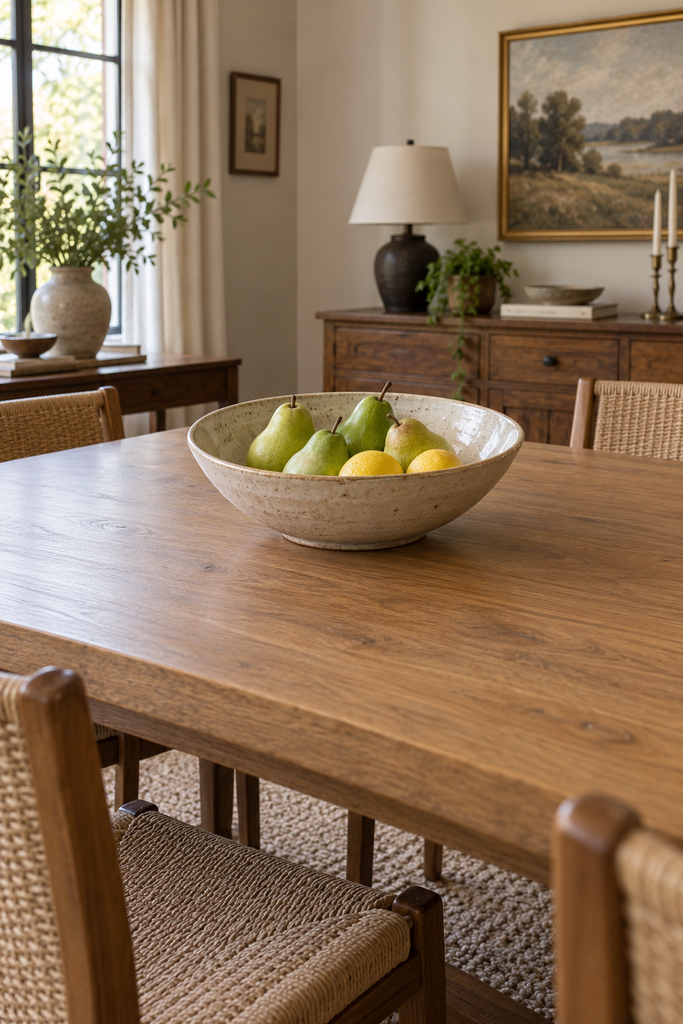
Decorative bowls are useful because they can look intentional without becoming precious.
A wide ceramic or wooden bowl can hold seasonal fruit, napkins, or nothing at all. The shape alone can provide enough visual weight to anchor the middle of the table.
What actually works is choosing a bowl that’s attractive when it’s nearly empty.
Otherwise, you’ll constantly feel like you need to fill it with decorative objects that serve absolutely no purpose. Nobody needs seventeen wooden beads occupying valuable dinner-table territory.
A beautiful bowl with three or four pears? Much easier.
Skip the Full-Length Runner for Busy Tables
Table runners look lovely, but they aren’t always practical.
If your dining table doubles as a workspace or homework station, a full-length runner can become another thing that needs straightening, cleaning, or moving.
Instead, try a short runner placed across the center section of the table. It creates a visual foundation for your centerpiece without covering the areas people actually use.
You could also skip fabric completely and let the tabletop itself become part of the design—especially if you have attractive wood grain or a beautiful stone surface.
Use Odd-Numbered Groupings—But Keep Them Tight
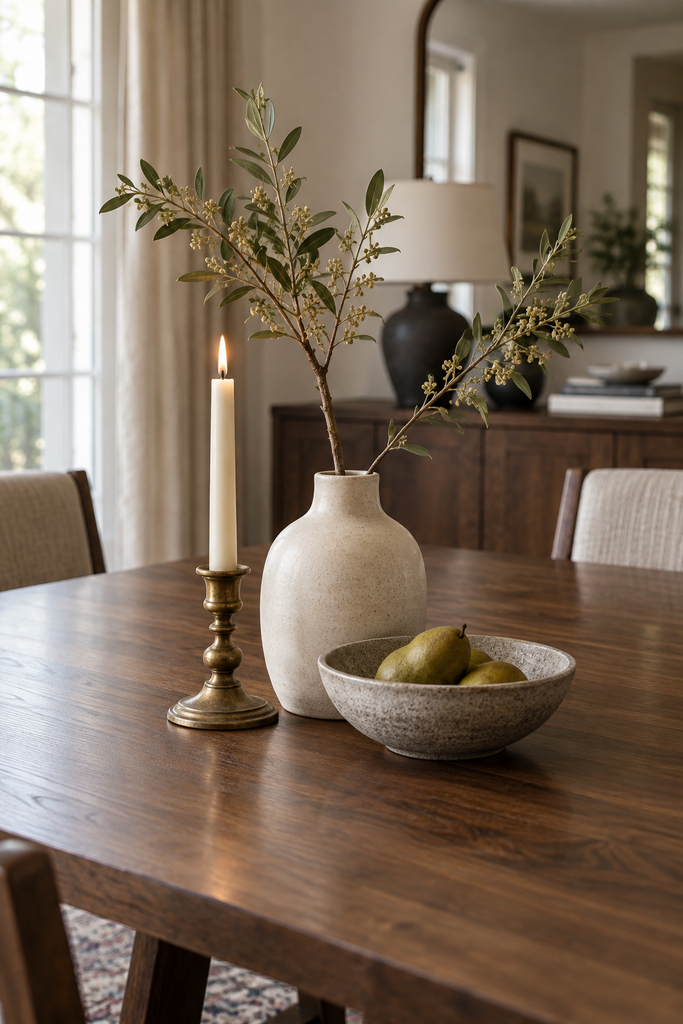
Three objects usually feel more relaxed and natural than two identical pieces sitting side by side.
For example, combine a small vase, one candleholder, and a shallow bowl.
The important part is keeping them close together.
Three items spread across four feet of table become clutter. The same three objects clustered within a compact area become a centerpiece.
Varying their heights slightly helps too. You might have one taller vase, a medium-height candle, and a low bowl. That creates dimension without requiring more stuff.
Choose Everyday Objects That Also Look Good
One of my favorite approaches is letting useful items do some of the decorating.
A beautiful pepper mill, linen napkins in a small basket, a ceramic water pitcher, or a fruit bowl can all contribute to the overall look of the table.
This is especially helpful in smaller homes where decorative objects need to earn their space.
Rather than adding decor around functional items, choose functional pieces you wouldn’t mind leaving out.
Suddenly the table looks styled without actually becoming more crowded.
Don’t Decorate Every Inch of a Long Table
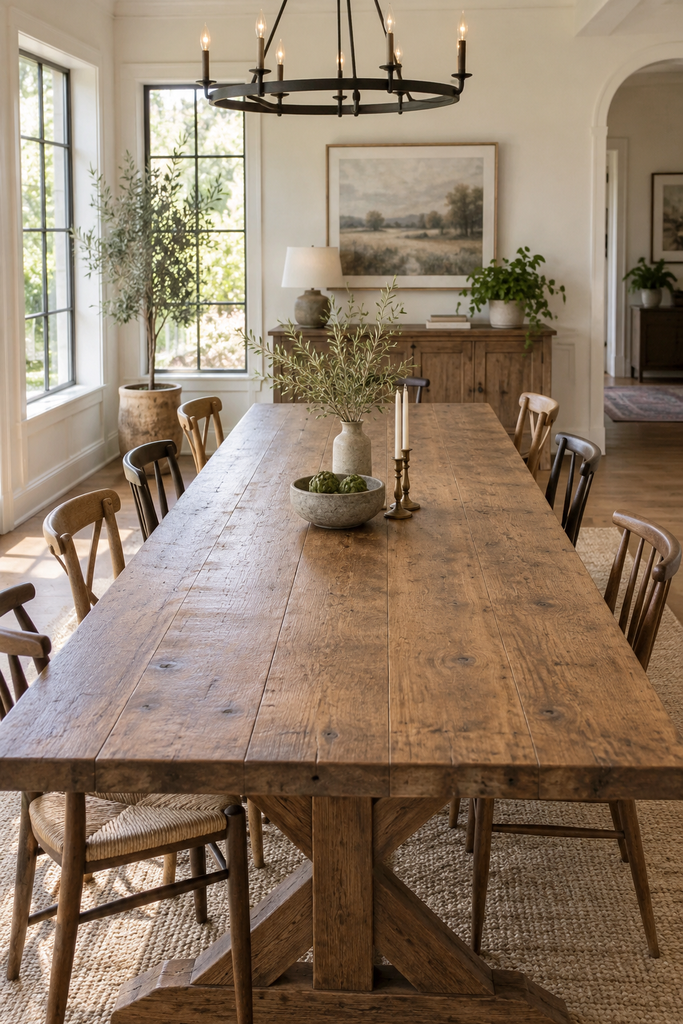
Long farmhouse-style dining tables are where people tend to get carried away.
There’s a temptation to create an arrangement stretching from one end to the other because the empty surface looks enormous.
Resist it.
Empty space is part of the design.
A compact centerpiece in the middle allows the length and material of the table to become visually important. If the table still feels bare, add one subtle element near each end—perhaps two small candleholders—but keep the majority of the surface open.
The goal isn’t to fill the table. It’s to make the emptiness look intentional.
Adjust the Scale for a Small Dining Table
Small round and apartment-size dining tables require even more restraint.
On a 36- to 42-inch round table, even a medium arrangement can steal a surprising amount of usable space.
Try one narrow vase, a small potted herb, or a compact bowl instead.
Another good option is a single candle in a substantial holder. It adds height and character while barely occupying any surface area.
When the table itself is small, one good object almost always looks better than a collection.
Create an Easy “Dinner Mode”
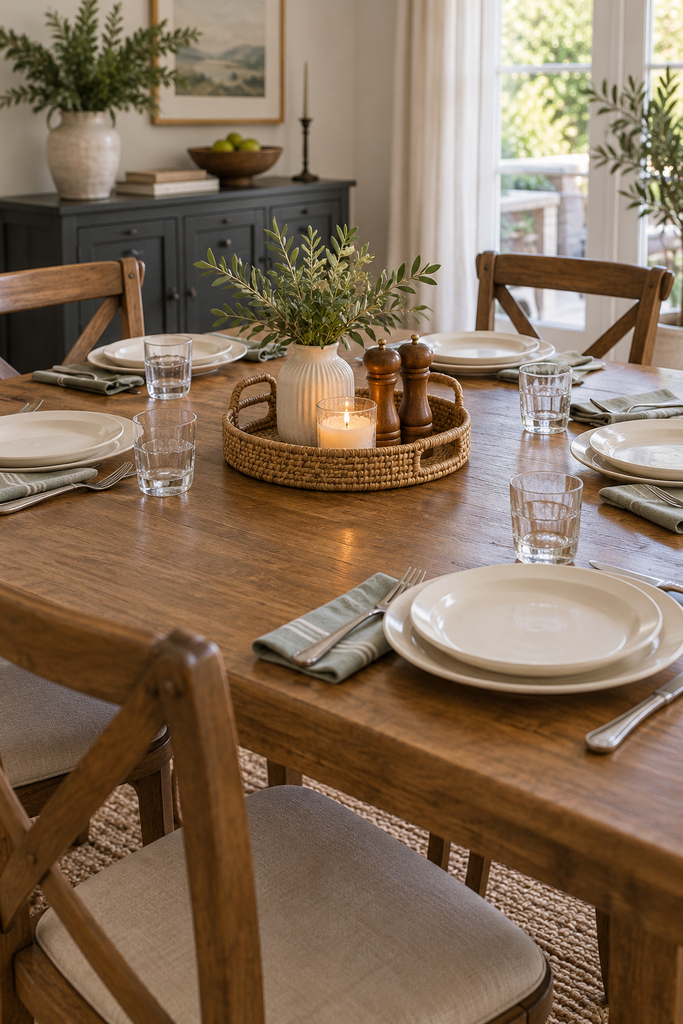
If you regularly need the entire tabletop, make your centerpiece removable in one movement.
This is where trays, handled baskets, or a single substantial vase are incredibly useful.
During the day, the arrangement stays in the center and makes the dining area feel finished. At dinner, you move one thing to a nearby console, kitchen counter, or sideboard.
Done.
If you have to relocate seven individual decorations before every meal, your styling system isn’t practical enough.
Change Seasons Without Adding More Stuff
Seasonal dining table decor doesn’t need to mean piling decorations onto the table.
Instead, change one component of your existing arrangement.
In fall, your everyday ceramic bowl might hold pears or small pumpkins. Around Christmas, the same vase can hold cedar or pine branches. Spring might mean clipped flowering branches, while summer could be simple greenery.
You’re changing the mood rather than increasing the amount of decor.
This keeps the dining area seasonal without turning the table into a holiday display shelf.
Common Dining Table Styling Mistakes
The biggest mistake is prioritizing how the table looks when nobody is using it.
Your dining table should still function comfortably when everyone sits down.
Avoid oversized arrangements that block sightlines, decorative objects positioned directly in front of place settings, excessive candles that require constant moving, and textiles that make cleaning unnecessarily difficult.
Another common mistake is using too many tiny objects.
Small decor can seem harmless because each piece occupies very little room. But six small pieces scattered around often create more visual clutter than one medium centerpiece.
Fewer, slightly larger pieces usually look calmer.
Do the Everyday-Use Test
Once you’ve styled your table, actually use it.
Sit in your normal chair.
Put down a dinner plate, glass, phone, and whatever else normally ends up there. Imagine serving a couple of shared dishes in the center.
Can you reach everything comfortably? Can you see the person across from you? Is there somewhere to place a serving bowl without rearranging the entire table?
If not, remove something.
This simple test matters more than any decorating rule because every household uses its dining table differently.
A Dining Table Should Still Feel Like a Dining Table
Figuring out how to style a dining table without blocking everyday use isn’t really about finding the perfect centerpiece. It’s about knowing when you’ve added enough.
Keep the decoration concentrated, protect the areas where people actually sit, choose objects with small footprints, and make anything larger easy to move.
Most importantly, don’t be afraid of empty tabletop space. A little breathing room makes the pieces you do display look more intentional.
Start with one centerpiece and live with it for a few days. If the table works comfortably and still looks finished when you walk past it, you’ve probably got the balance right.