

Curved kitchen islands do something straight designs just can’t they make a kitchen feel softer, more inviting, and a whole lot more custom. If you want your space to look stylish but still feel easy to live in, a curved island can completely change the mood of the room.
I’ve always liked kitchens that feel warm and welcoming instead of stiff and overly planned, and curved islands hit that sweet spot perfectly. They add movement, improve flow, and give the whole kitchen a more thoughtful look without trying too hard. And honestly, who doesn’t want a kitchen that feels a little less boxy and a lot more interesting?
Why Curved Kitchen Islands Are Worth the Hype
Before we jump into the ideas, you might be wondering — why curved? What’s wrong with a good old rectangle?
Nothing’s wrong with it. But curved islands bring something different to the table (pun absolutely intended). They soften the overall look of a kitchen, break the monotony of straight cabinet lines, and honestly just feel more welcoming. When you walk into a kitchen with a curved island, it pulls you in rather than blocking your path.
From a practical standpoint, curved edges are safer especially if you have kids who love to sprint through the kitchen at full speed. No sharp corners means fewer bruised hips. And IMO, the aesthetic payoff is huge for what is often a simple design tweak.
1. The Classic Oval Island
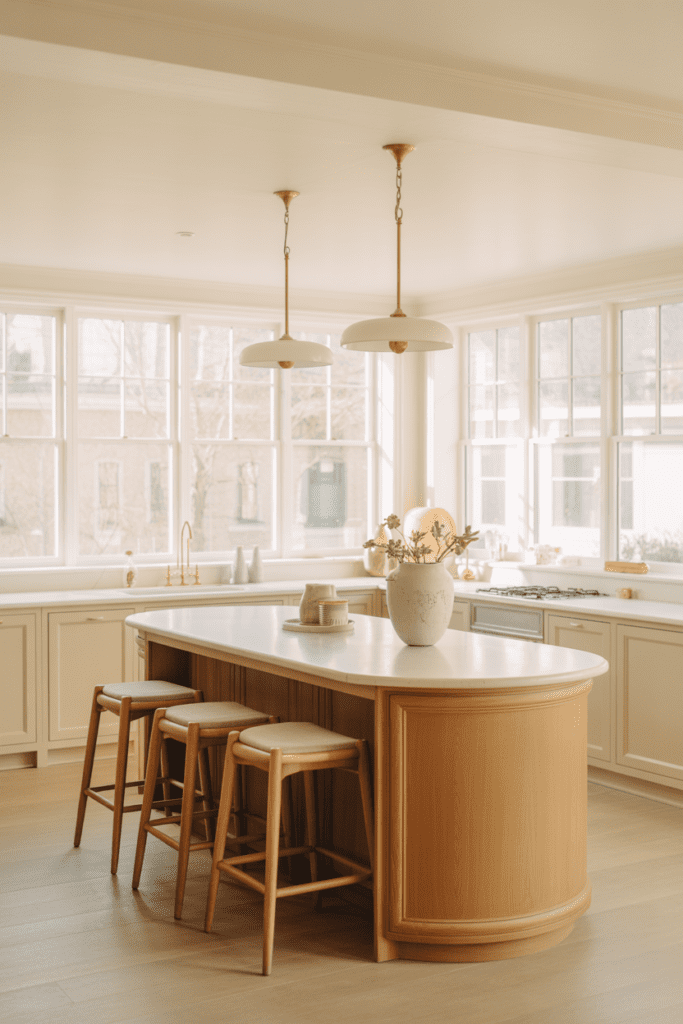
The oval island is the OG of curved kitchen islands. It works in almost any kitchen size and pairs beautifully with both modern and traditional styles.
An oval island creates a natural flow around it — people can move around both ends without feeling cramped. It’s especially great for kitchens that serve as social hubs, where you want guests to gather comfortably.
What makes it work:
- Symmetrical shape suits most kitchen layouts
- Pairs well with pendant lighting centered above
- Great for seating on the long sides
If you want a curved island but aren’t sure where to start, the oval is your safest bet. Classic never goes out of style.
2. The Waterfall Curved Island with a Rounded Edge
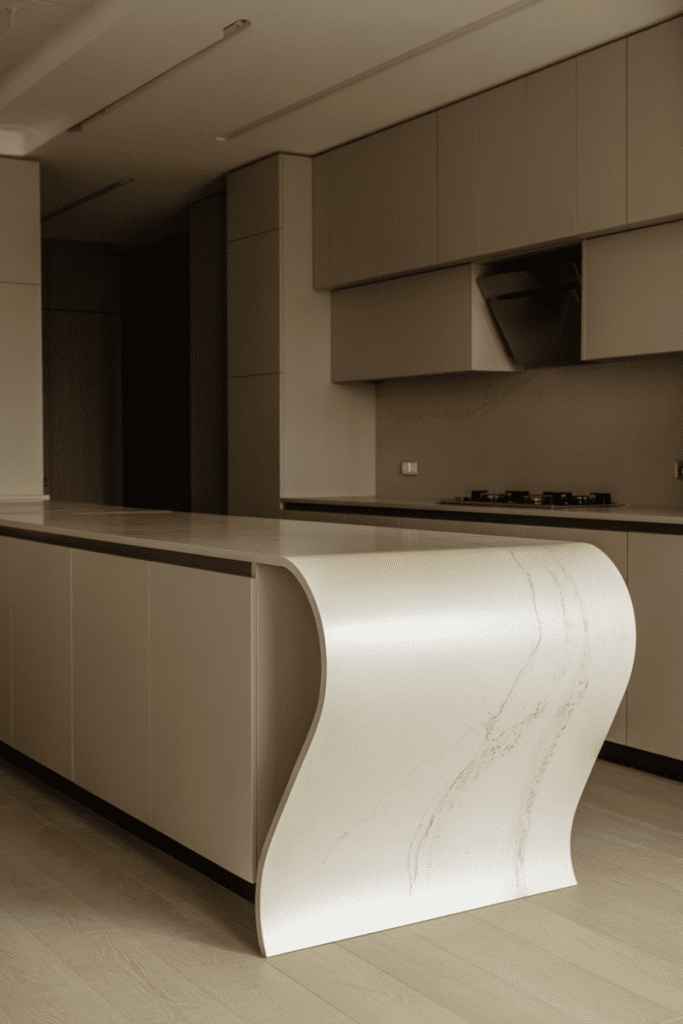
Picture this: a sleek island where the countertop material — marble, quartz, or butcher block — cascades down one side in a gentle curve rather than stopping abruptly at a sharp corner. That’s the waterfall curved island, and it is absolutely gorgeous.
The rounded waterfall edge gives the island a sculptural quality. It looks intentional, elevated, and like you spent way more money on it than you actually did (always a win :)).
Best countertop materials for this look:
- Quartz (durable and seamless)
- Marble (classic luxury feel)
- Concrete (industrial-meets-organic vibe)
Pair this with handleless lower cabinets and you’ve got a kitchen that feels like a boutique hotel lobby.
3. The Kidney-Shaped Island
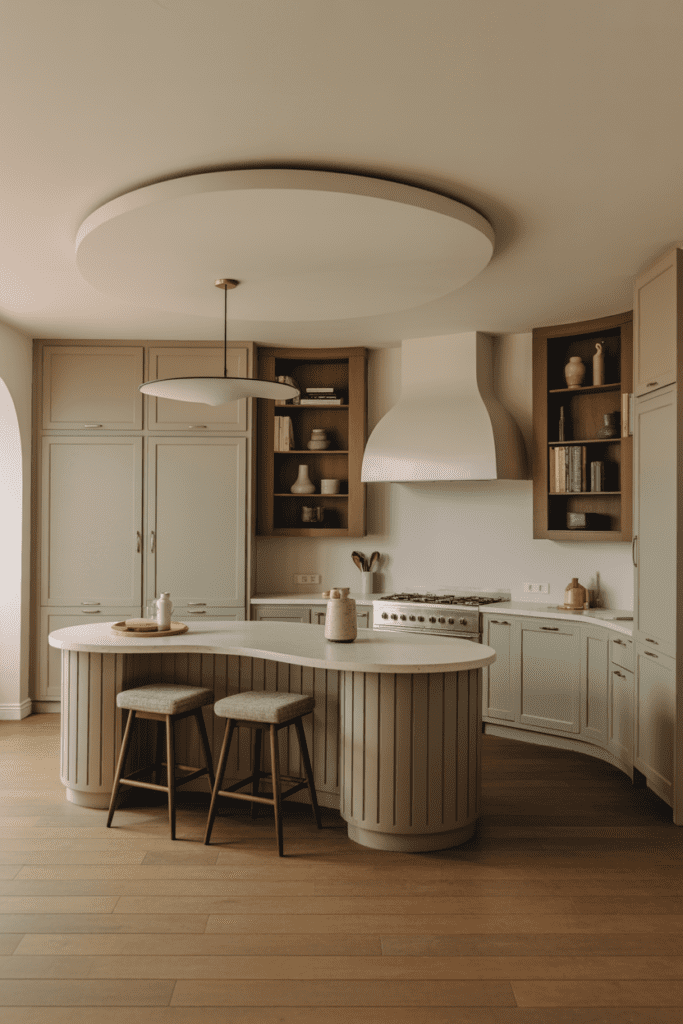
The kidney shape — yes, like the bean — is one of the most functional curved island designs out there. It has a concave side that creates a built-in workspace or seating nook, which feels incredibly intentional.
I love this design for home cooks who like to have a designated prep zone. The curved-in section naturally becomes your prep area while the outer curve works for casual seating or plating.
The kidney shape also works brilliantly in open-plan kitchens because it defines the kitchen zone without acting like a wall. It separates spaces while keeping everything visually connected.
4. The Semicircular Breakfast Bar Island
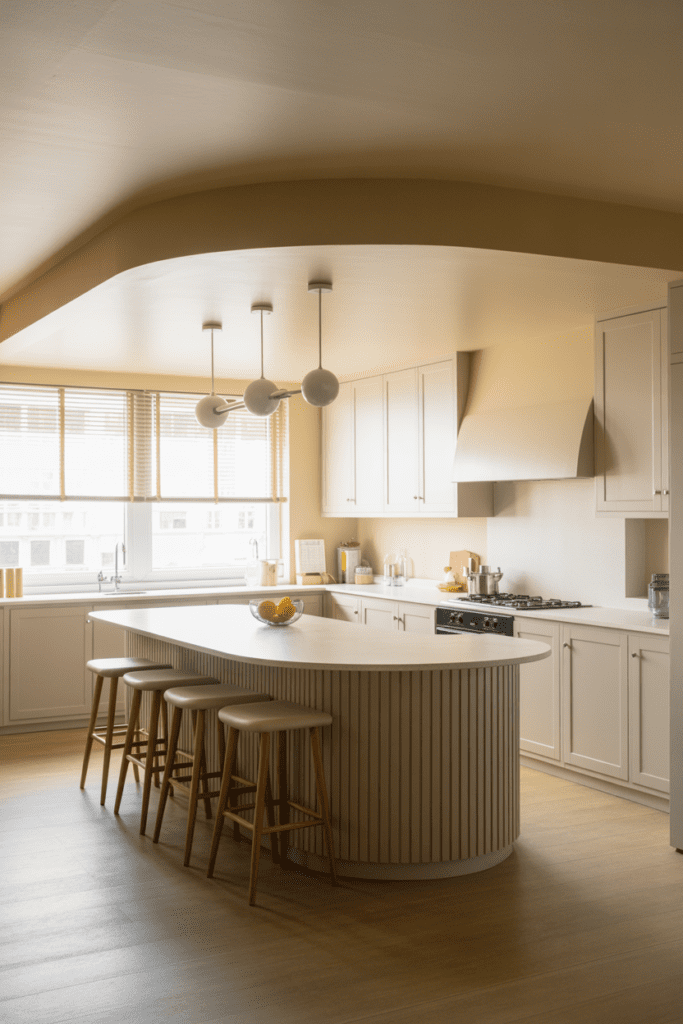
Want a curved island that doubles as a proper breakfast bar? The semicircle layout is made for that. One flat side pushes against — or aligns with — the kitchen perimeter while the curved side faces the living or dining area with bar stools lined up along it.
This is honestly one of the most space-efficient curved island ideas. You get seating, you get counter space, and the curved edge makes the whole arrangement feel intentional rather than just “we threw some stools here.”
Works best in:
- Galley kitchens opening into a dining room
- Apartments with limited square footage
- Kitchens adjacent to living areas
5. Curved Island with Built-In Sink
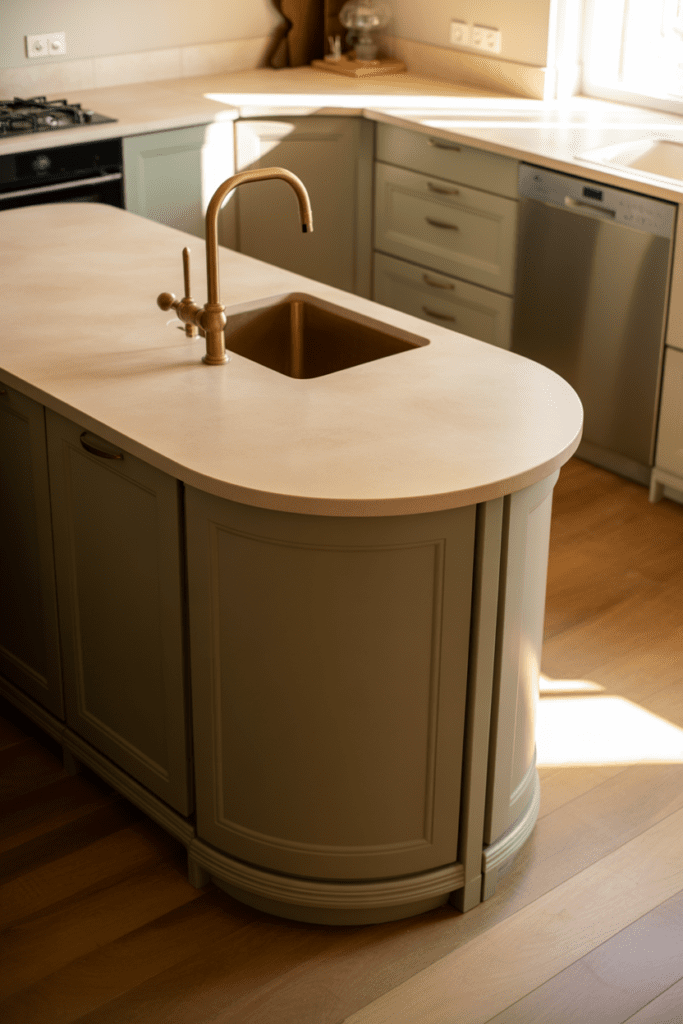
Here’s where curved islands really flex their practical muscles. A built-in sink on a curved island — particularly when the sink sits at the rounded end — creates a prep and clean-up zone that feels totally organic to the island’s shape.
The curve around the sink area gives the person washing up more elbow room without eating into the rest of the island’s counter space. It’s a small ergonomic win that makes everyday use so much more comfortable.
Pro tip: Pair an undermount sink at the curved end with a statement faucet — a gooseneck or an articulating style — and you’ve got a focal point that’s both functional and beautiful.
6. Two-Tiered Curved Island
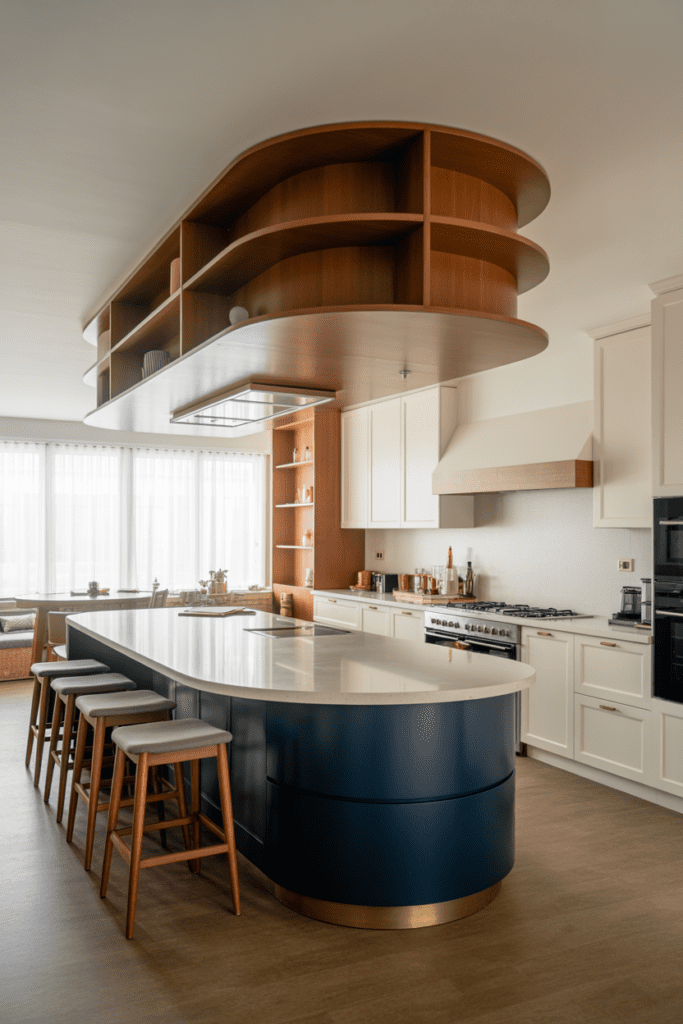
Ever wondered why two-tier islands fell out of fashion for a while and then came roaring back? Because they’re genuinely useful, that’s why.
A two-tiered curved island uses the height difference to separate tasks. The lower tier works as prep and cooking space while the raised curved section acts as a breakfast bar or visual divider between the kitchen and living area.
The curved edge on the raised tier softens what could otherwise be a chunky, boxy look. It makes the whole structure feel lighter and more considered.
Design tip: Use the same countertop material on both tiers but vary the cabinet color below for a layered, intentional look.
7. The Organic Freeform Island
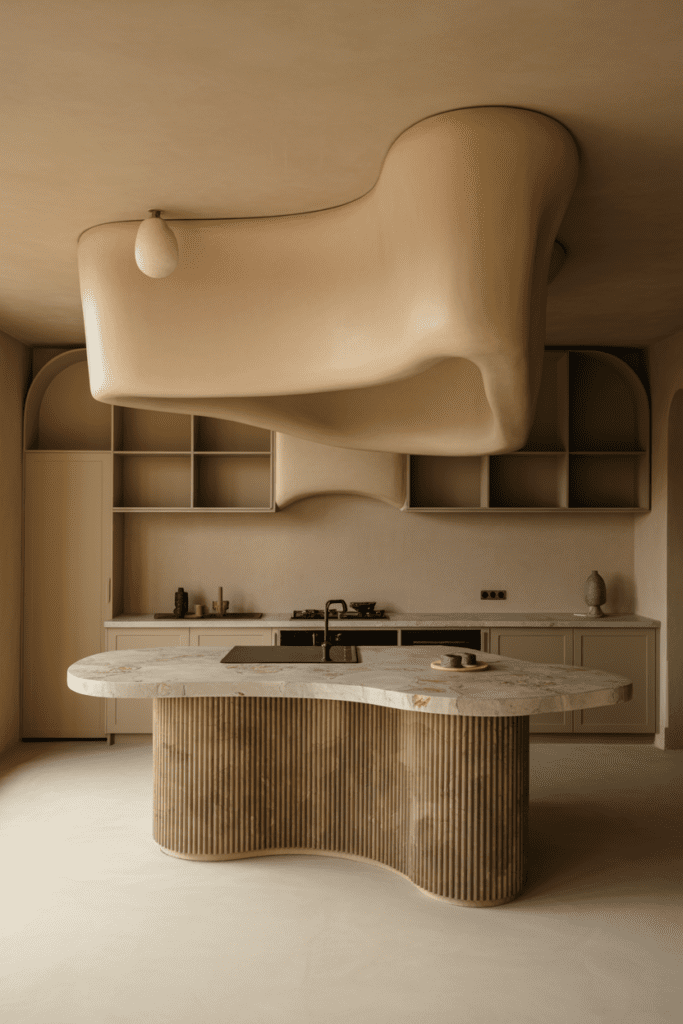
If you’ve ever been inside a kitchen that felt like it was alive — like the cabinetry grew there naturally — you’ve probably encountered a freeform organic-shaped island. These islands don’t follow a strict geometric curve. They’re irregular, flowing, and totally unique.
This is the island for someone who wants their kitchen to feel like art. FYI, these are custom-built pieces, so budget accordingly. But the results are genuinely breathtaking.
Organic islands pair especially well with natural stone countertops, live-edge wood accents, and earthy color palettes. Think warm greens, terracotta, and creamy whites.
8. Curved Island in White Marble
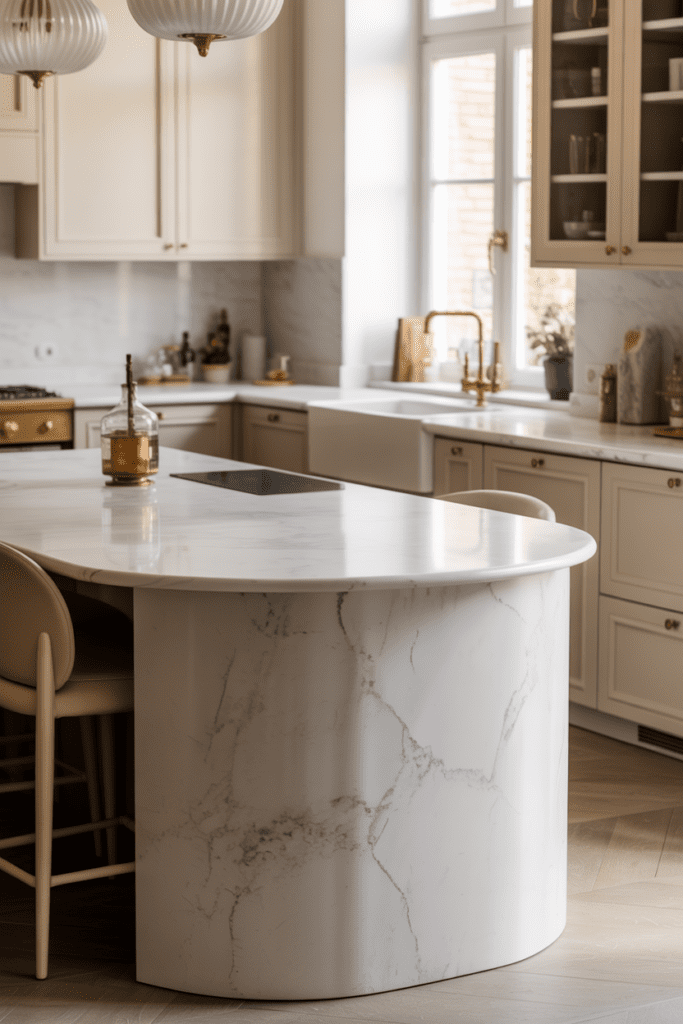
Let’s talk materials for a second — because a curved island in white marble is on a completely different level. The gentle curve of the island combined with the dramatic veining of white marble creates a look that’s simultaneously soft and bold.
White marble on a curved island reads as luxurious without being cold. The shape adds warmth; the marble adds drama. It’s a pairing that just works, and you’ll see it across high-end kitchen design consistently for good reason.
Styling tips for white marble curved islands:
- Use warm white or cream cabinet colors underneath to soften the contrast
- Add brass or gold hardware to complement the warm veining in the marble
- Hang two or three warm-toned pendant lights above to tie it all together
9. Curved Island with Wraparound Seating
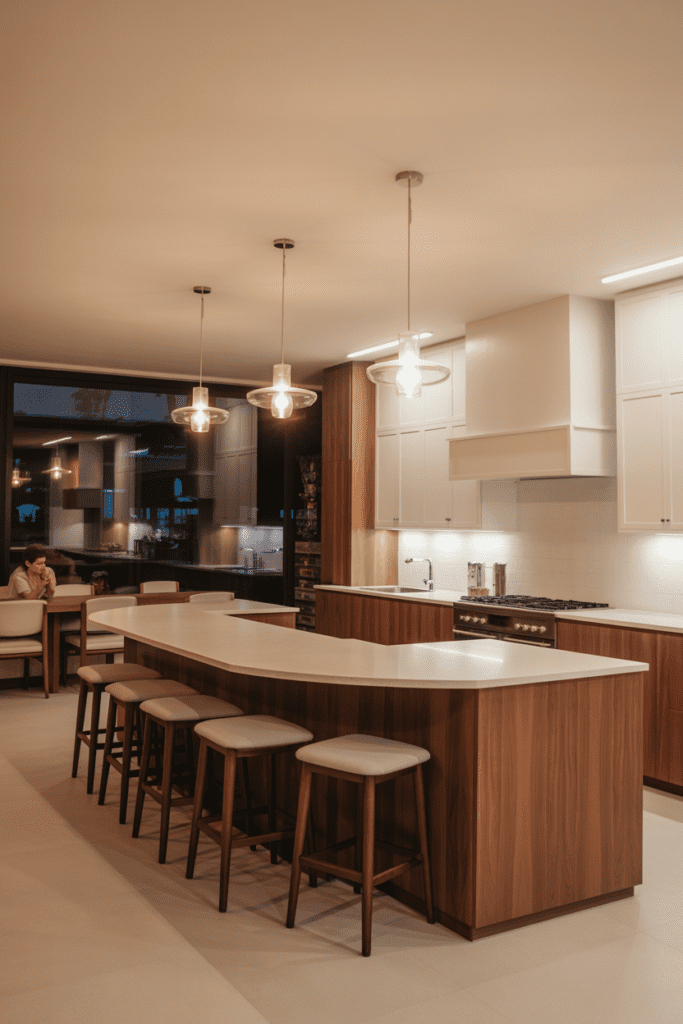
What if your kitchen island wasn’t just a prep space but also a genuine gathering spot? A curved island with wraparound seating — where bar stools line a generous curved outer edge — turns your island into the social heart of the home.
This works especially well in larger kitchens where you can afford the footprint. The key is making the curved seating edge at least 12–15 inches deep with a comfortable overhang so people actually have knee room.
Choose backless counter stools for a sleek, uncluttered look or curved-back stools that echo the island’s own shape. The latter creates a really cohesive, thoughtful design.
10. Navy Blue Curved Island
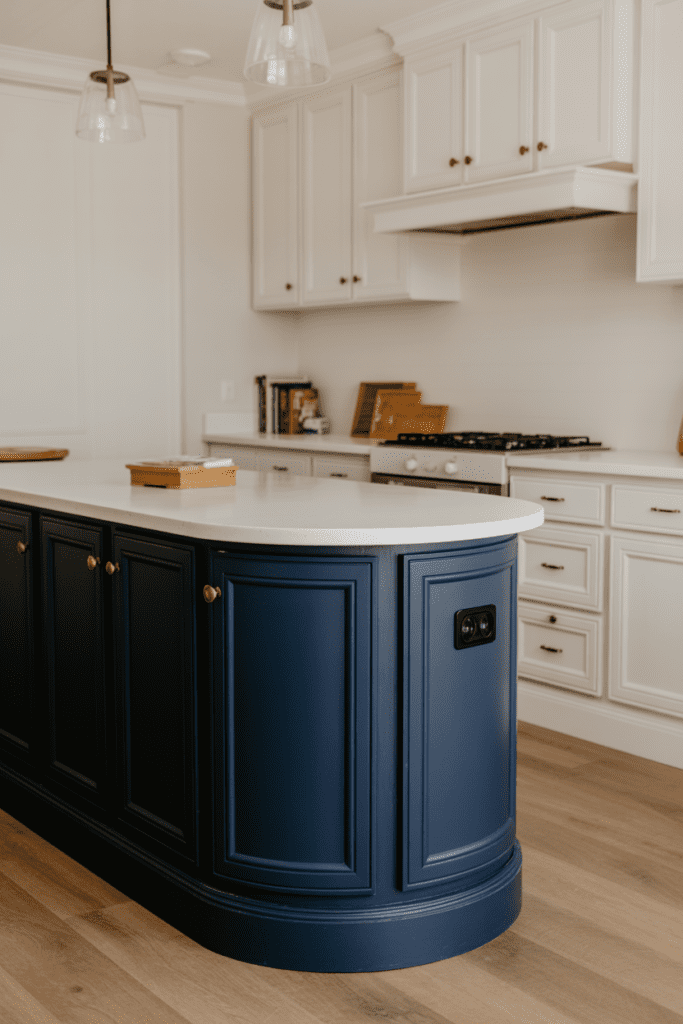
Color is an underrated tool in kitchen design, and navy blue on a curved island is one of those combinations that punches way above its weight. The deep, rich color adds personality while the curved silhouette keeps it from feeling too heavy or formal.
Navy blue curved islands work in both contemporary kitchens and transitional styles. Pair it with brass hardware, light wood flooring, and white upper cabinets and you’ve got a kitchen that feels pulled-together and confident.
This is a great option if your kitchen currently feels a little blah :/. A curved navy island doesn’t just update the space — it transforms it.
11. Curved Island with Open Shelving on One End
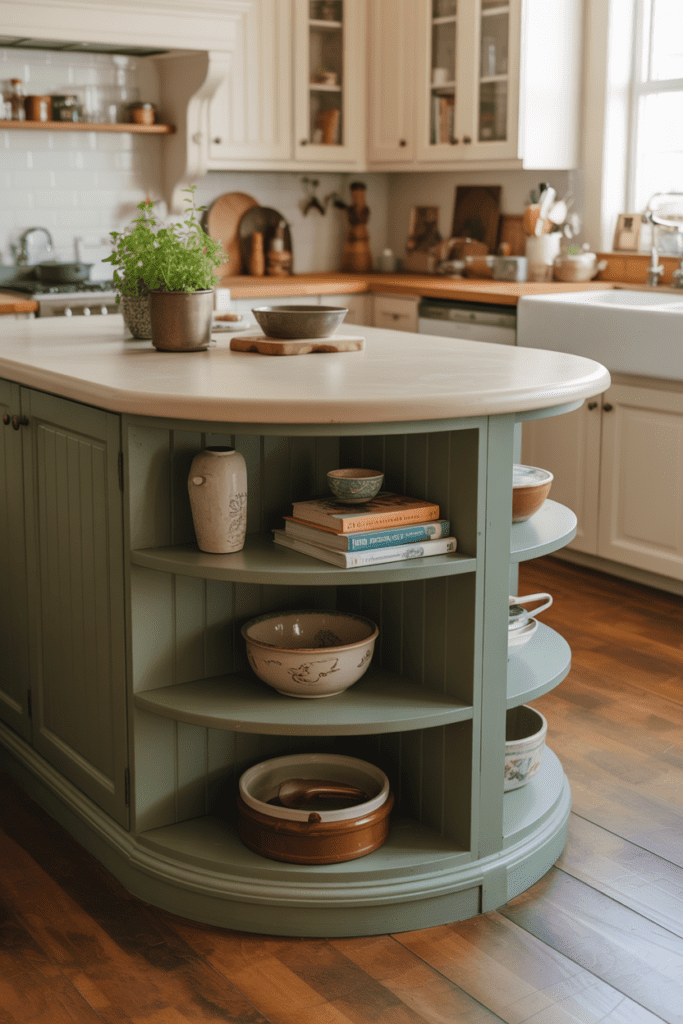
Here’s an idea that’s both practical and visually interesting: a curved island where one end curves out into open shelving rather than closed cabinetry. The shelves can hold cookbooks, a fruit bowl, small plants, or curated kitchen accessories.
This design trick makes the island feel less monolithic. Instead of a solid block of cabinets, you get a piece of furniture that has some breathing room. It also gives you a spot to display items you love, which adds serious personality to the space.
What to style on open island shelves:
- A stack of cookbooks (the more colorful, the better)
- A small potted herb in a terracotta pot
- A wooden fruit bowl with seasonal fruit
- A few beautifully mismatched ceramic bowls
12. The Curved Island with Statement Range Hood Overhead
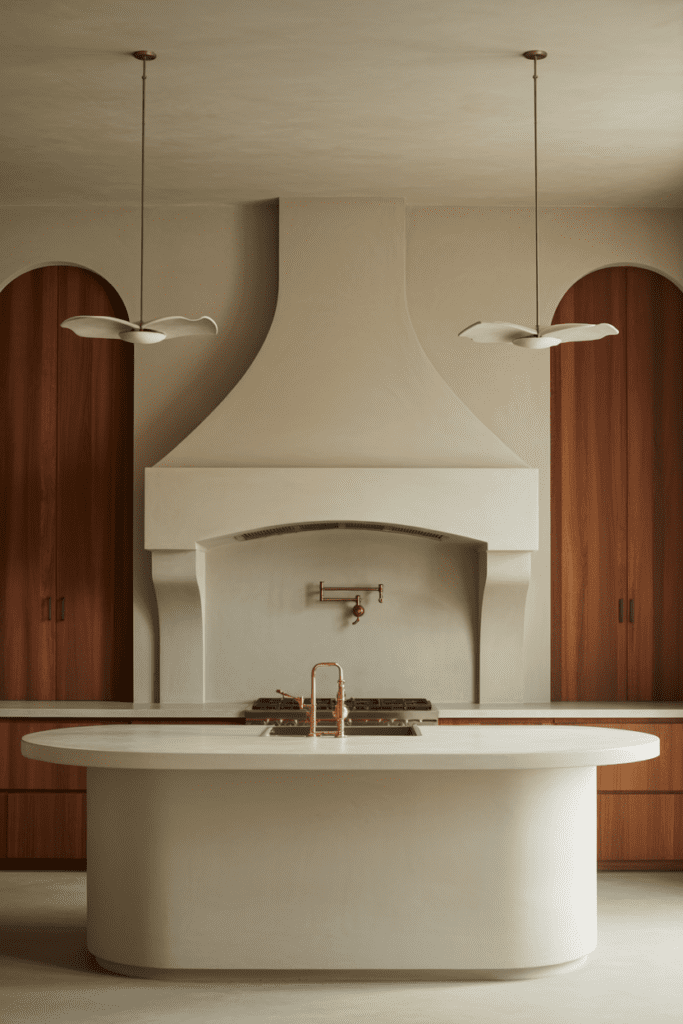
Design is all about relationships between elements, and one of the most powerful kitchen design relationships is the curved island + statement range hood pairing. When the island curves gently below and a dramatic arched or sculptural hood hovers above, the two elements create a visual anchor for the entire kitchen.
The range hood doesn’t have to be directly above the island — it can be positioned over a nearby cooktop — but the visual axis between the two creates rhythm in the room. It draws the eye up and makes the ceiling feel taller.
Arched plaster hoods, fluted wood hoods, and blackened steel hoods all work beautifully above a curved island.
13. Curved Island in a Small Kitchen
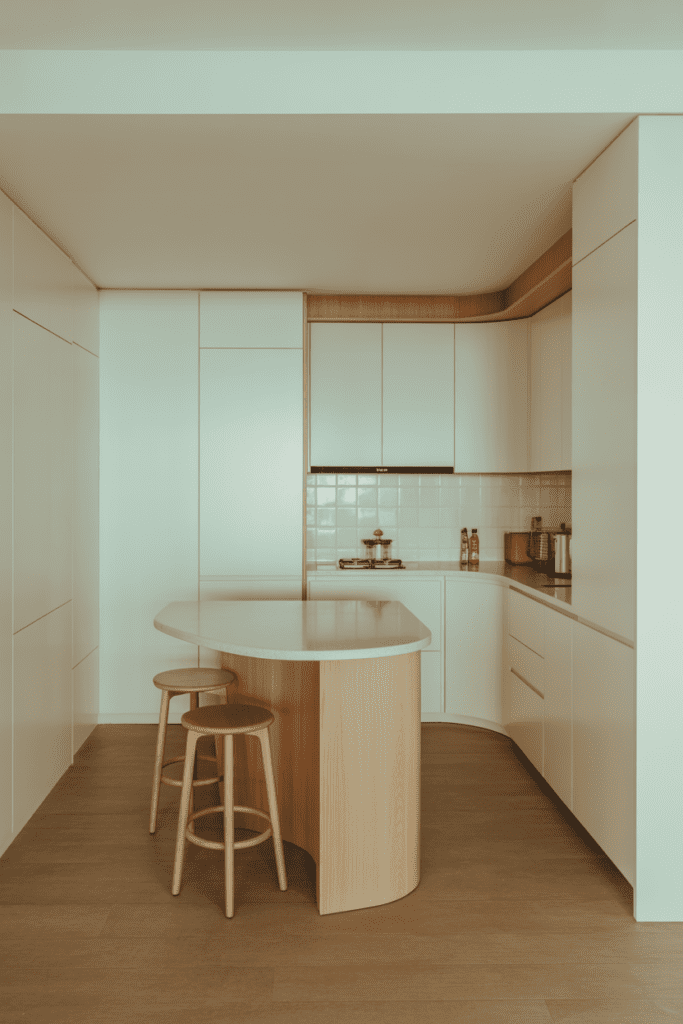
“But I have a small kitchen — curved islands aren’t for me.” Wrong! A small curved island can actually make a compact kitchen feel bigger and more open than a rectangular one would.
Here’s the logic: a rectangular island in a small kitchen creates tight, corridor-like walkways on both sides. A curved or oval island takes up similar floor space but opens up the traffic lanes visually because there are no hard corners cutting into the space.
Keep the small curved island simple — minimal hardware, a clean countertop, one or two stools on the curved end — and it’ll feel like a feature, not a squeeze.
Recommended sizes for small kitchens:
- Length: 36–48 inches
- Width: 24–30 inches
- Height: Standard 36 inches or bar height 42 inches for seating
14. Curved Island with Contrasting Countertop and Base Color
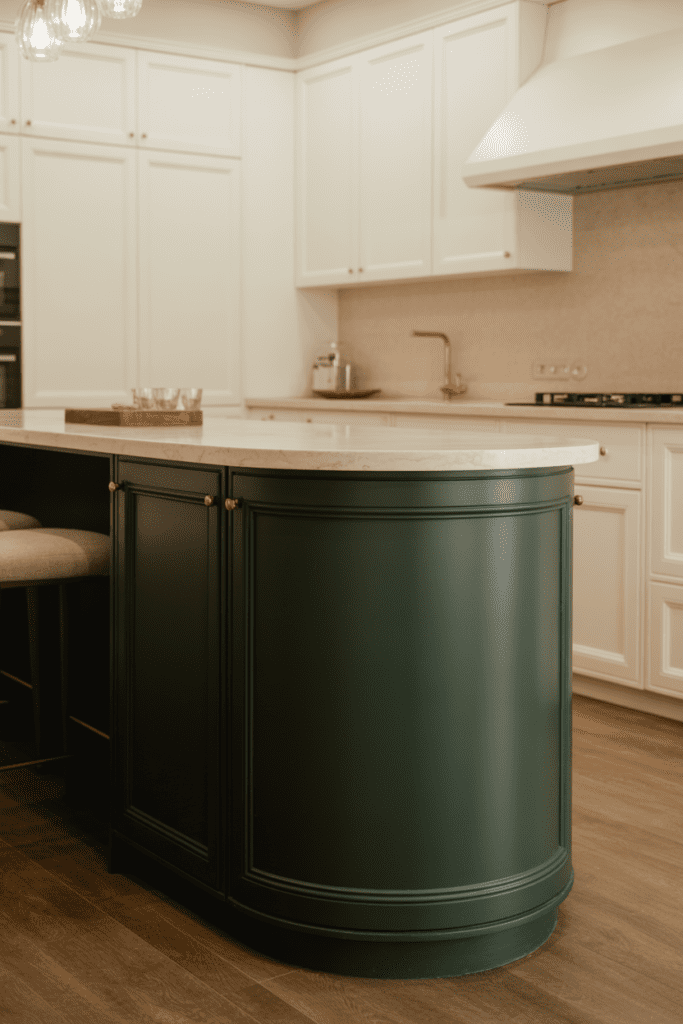
One of my favorite design moves is using two different tones on a curved island — a rich dark base (think deep forest green, charcoal, or espresso) topped with a light, veined countertop. The curved silhouette makes the contrast feel intentional rather than jarring.
This two-tone approach adds depth to the island without requiring any additional architectural work. It’s a simple paint or finish choice that delivers huge visual impact.
Classic two-tone combos:
- Charcoal base + white quartz top
- Forest green base + cream marble top
- Deep navy base + light wood butcher block top
- Warm walnut base + black granite top
15. The Curved Island That Extends into a Peninsula
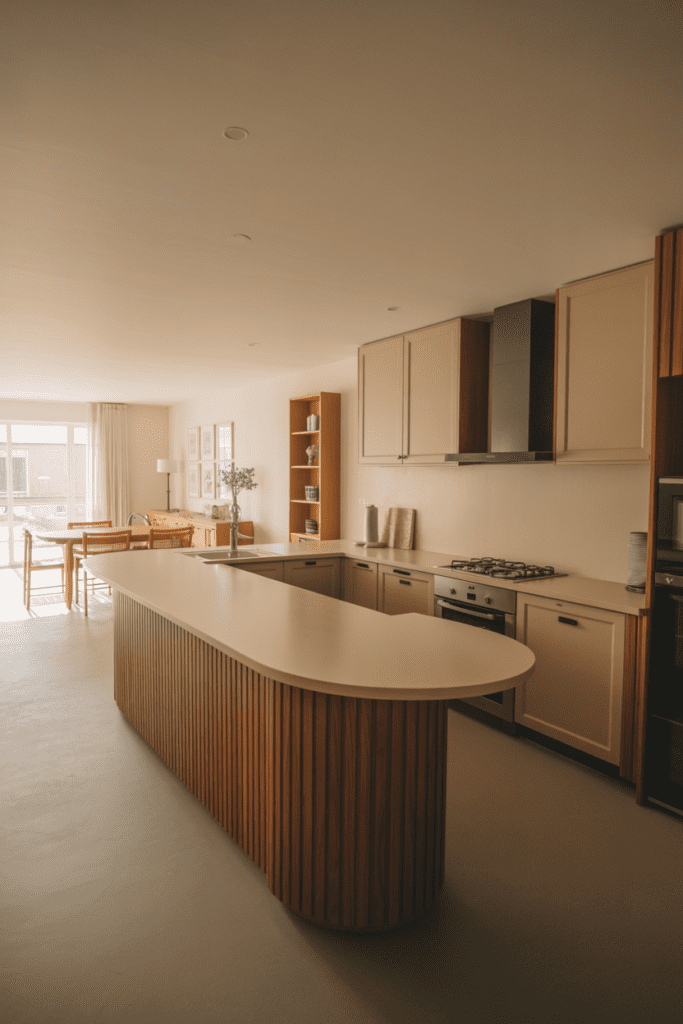
Last but absolutely not least — the curved island-peninsula hybrid. This design connects the island to the main cabinetry run at one end while the opposite end curves outward freely, often creating a generous seating zone.
It’s the best of both worlds: the storage and counter space of a peninsula combined with the openness and flow of a freestanding island. The curved free end softens what would otherwise be a very utilitarian layout.
This works brilliantly in L-shaped kitchens where one leg of the L can extend into the curved peninsula structure. It defines the kitchen space while keeping it connected to the adjacent living area.
How to Choose the Right Curved Island for Your Kitchen
Okay, 15 ideas later — how do you actually pick? Let’s break it down quickly.
Ask yourself these questions:
- What’s my primary need? Seating, prep space, storage, or all three?
- What’s my kitchen’s square footage? Smaller kitchens need smaller, simpler curved islands; larger kitchens can handle bold organic shapes.
- What’s my existing style? Modern kitchens suit sleek oval or kidney islands; farmhouse and transitional kitchens work better with painted curved islands with open shelving.
- What’s my budget? Freeform organic islands are custom (expensive); semicircular or oval islands are easier to source from manufacturers.
The golden rule: The island should improve the flow of your kitchen, not fight it. If you can walk comfortably around it with arms slightly extended, the size is right.
Final Thoughts
Curved kitchen islands aren’t just a trend, they’re a genuine design evolution. They make kitchens more functional, more social, and a whole lot more beautiful. Whether you go bold with an organic freeform island or keep it simple with a classic oval, you’re making a choice that elevates your entire kitchen.
The best part? You don’t need a massive renovation budget to pull it off. Sometimes all it takes is a skilled carpenter, a clear vision, and one of these 15 ideas as your starting point.
So, which one is calling your name? Whatever you choose, your kitchen is about to get a serious upgrade, and honestly, it deserves it.