
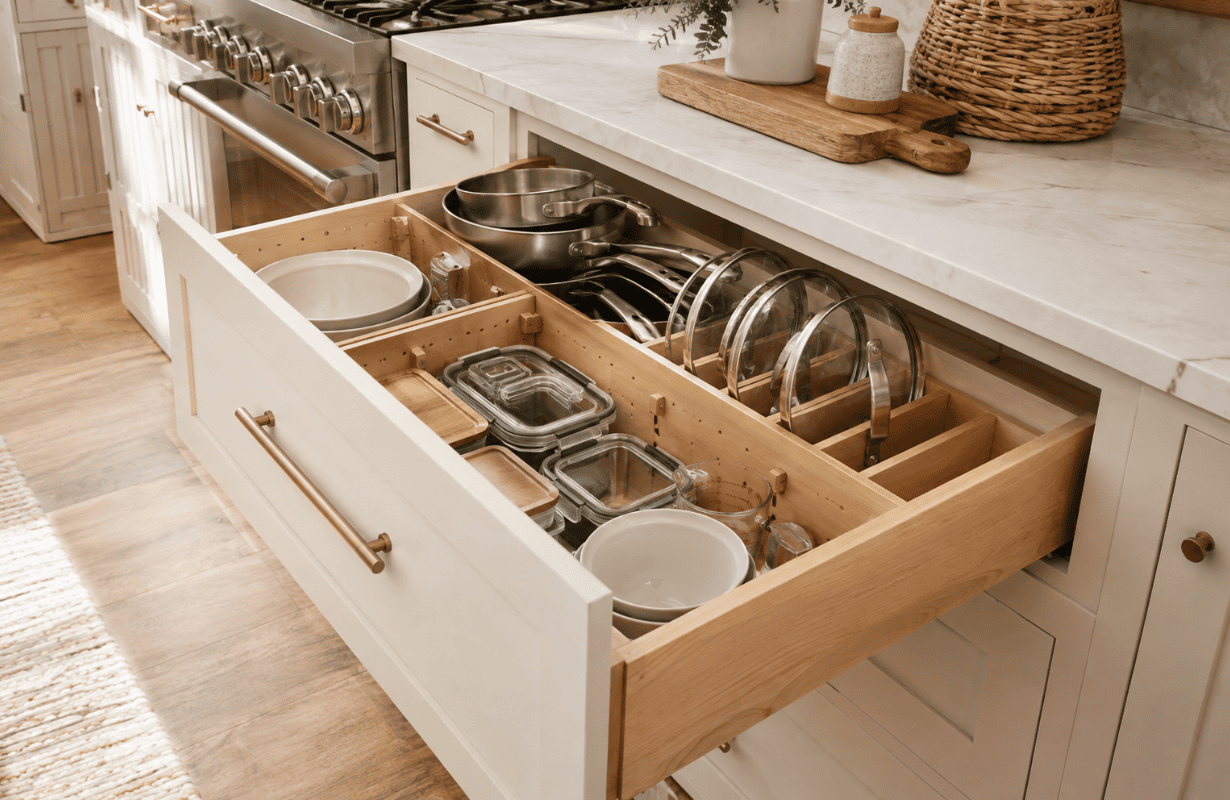
Deep kitchen drawers sound like a dream until you actually start using them.
At first, all that space feels amazing. You can fit pots, mixing bowls, food containers, baking supplies, and half your kitchen gadgets into one drawer. Then a few months pass, and somehow you’re digging underneath three lids, a colander, and a stack of containers just to find the saucepan you use every morning.
That’s the problem with deep drawers: having more space doesn’t automatically mean having better storage.
In fact, deep drawers can become some of the messiest spots in a kitchen because they encourage you to pile things vertically instead of actually organizing them.
If you’re wondering how to organize deep kitchen drawers, the solution isn’t necessarily buying a bunch of matching organizers. What actually works is deciding what each drawer should do, creating boundaries inside that big open space, and storing things so you can reach them without moving five other items first.
Here’s how I would tackle it.
Why Deep Kitchen Drawers Become Messy So Quickly
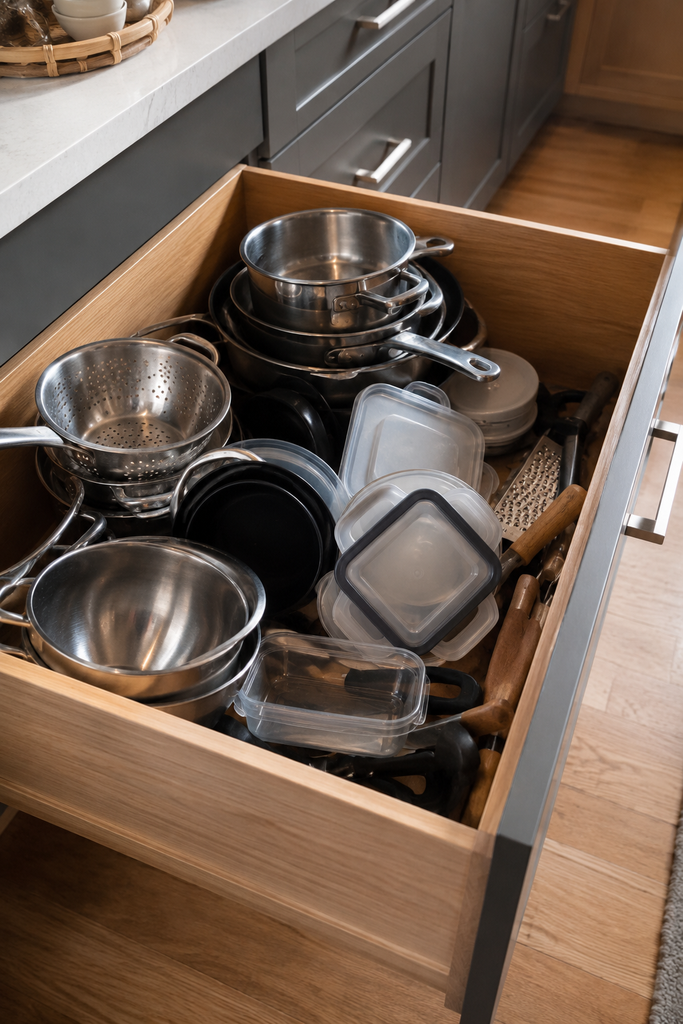
Here’s the thing: most deep drawers aren’t badly organized because they’re too small.
They’re badly organized because they’re too open.
A large drawer basically gives everything permission to move around. Containers slide toward the back. Lids fall over. Small utensils disappear underneath larger ones. Pots get stacked six pieces high because technically they fit.
And that’s where things go wrong.
A good kitchen drawer isn’t one that holds the maximum possible number of items. It’s one where you can open it, immediately see what you need, grab it, and close the drawer again.
That’s the standard I’d use when reorganizing yours.
Start by Emptying the Drawer Completely
I know. Nobody wants to hear this part.
But trying to organize a deep drawer while everything is still inside it usually turns into rearranging the same clutter.
Take everything out.
Put it on the counter or kitchen table and clean the empty drawer before putting anything back.
Now look at what was actually living in there.
You’ll probably discover things you forgot you owned, duplicates you rarely use, random items that belong somewhere else, and a few awkward pieces responsible for most of the mess.
Sort by How You Actually Cook
Instead of making generic categories like “kitchen stuff,” think about activities.
For example:
Cooking: pots, pans, strainers and cooking utensils.
Food prep: mixing bowls, measuring cups, graters and cutting accessories.
Food storage: containers, lids, wraps and reusable bags.
Baking: measuring tools, baking accessories and specialty equipment.
This matters because items used together should ideally live together.
If you’re constantly walking across the kitchen to grab something halfway through cooking, your storage system isn’t really helping you.
Give Every Deep Drawer One Main Job
Most people get this wrong.
They see a huge drawer and think, “Look how much stuff I can fit in here.”
I’d rather ask:
What should this drawer be responsible for?
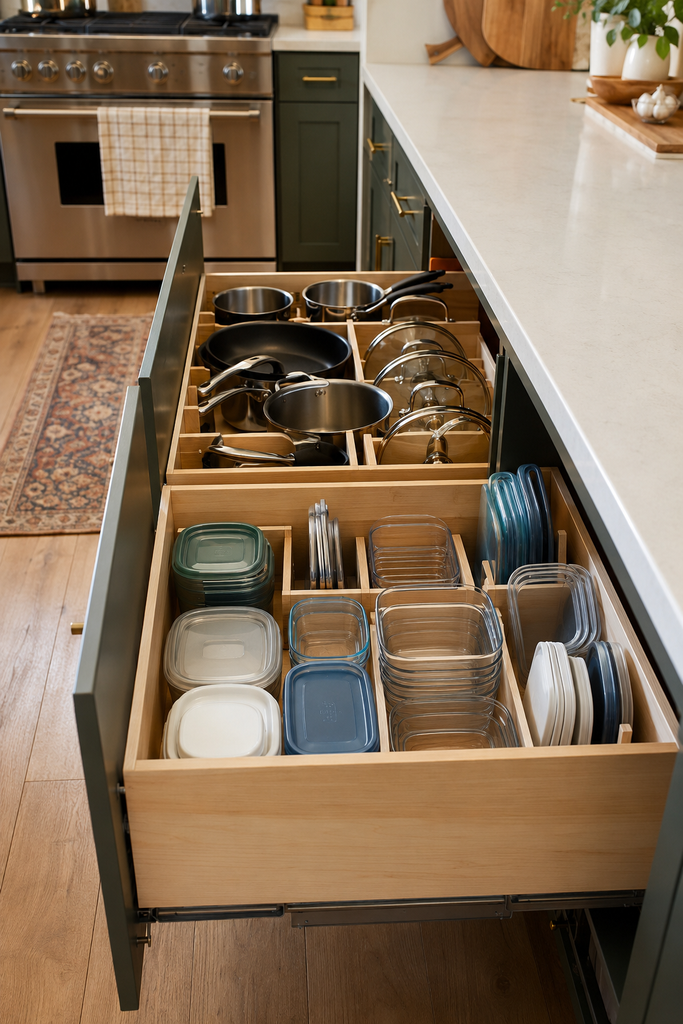
One deep drawer might become your cookware drawer. Another handles food storage. Another holds mixing bowls and prep tools.
You can absolutely have smaller subcategories within the drawer, but there should be one overall purpose.
Imagine opening a drawer containing a stockpot, sandwich bags, blender attachments, oven mitts, food-storage lids, and a cheese grater.
Everything technically belongs in the kitchen.
That doesn’t mean it belongs together.
Giving the drawer a clear job makes maintaining it much easier because you never have to wonder where something should go.
Stop Stacking Everything on Top of Everything Else
This is probably the biggest change you can make when learning how to organize deep drawers in a kitchen.
Stacking feels efficient because you’re using the drawer’s height.
But there’s a point where stacking becomes annoying.
If you have to remove three pans every time you want the one underneath, eventually you’ll stop putting everything back properly.
Store Frequently Used Items Vertically When Possible
Vertical storage can completely change a deep drawer.
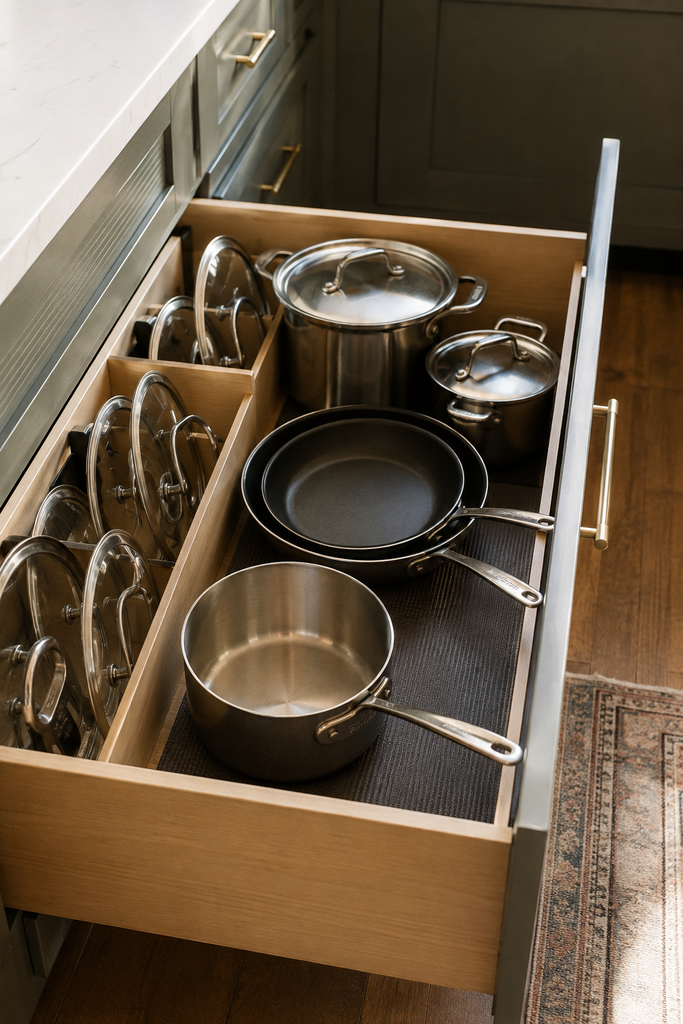
Instead of stacking cutting boards, baking sheets, pot lids, or shallow pans horizontally, use dividers to keep them upright.
You can flip through them almost like files.
The same idea works surprisingly well for food-storage lids.
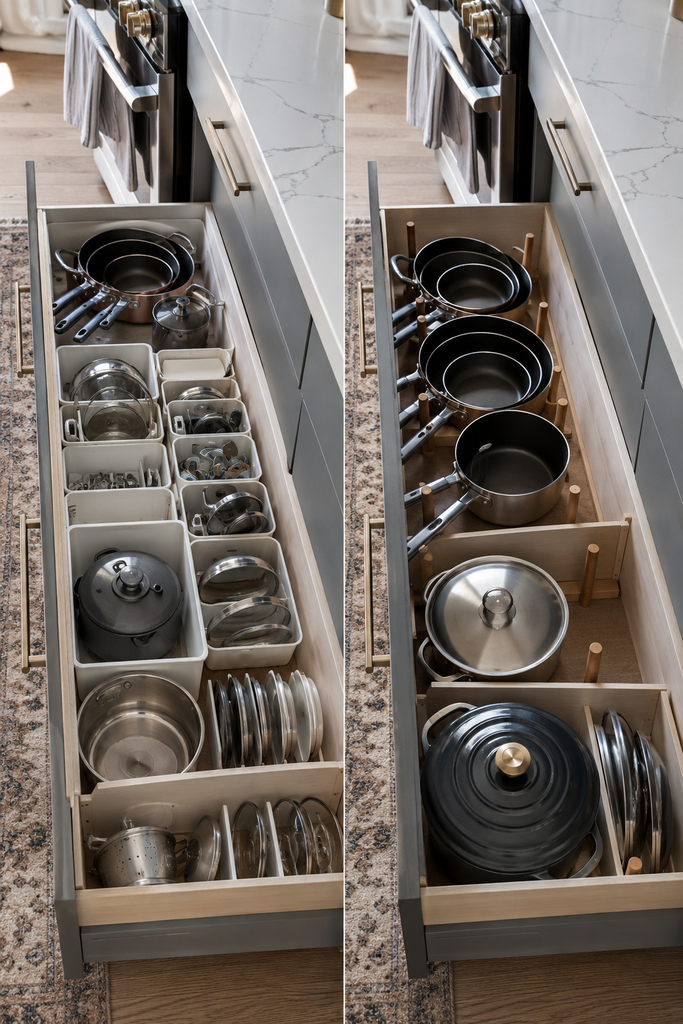
Rather than creating one giant lid pile, stand them upright and group similar sizes together.
The goal is simple: pull out one item without disturbing everything around it.
That’s one of the best tests for whether an organization system will actually last.
Use Dividers to Create Smaller Zones
A giant empty drawer isn’t particularly useful.
A giant drawer divided into four intentional sections is.
What actually works is creating boundaries.
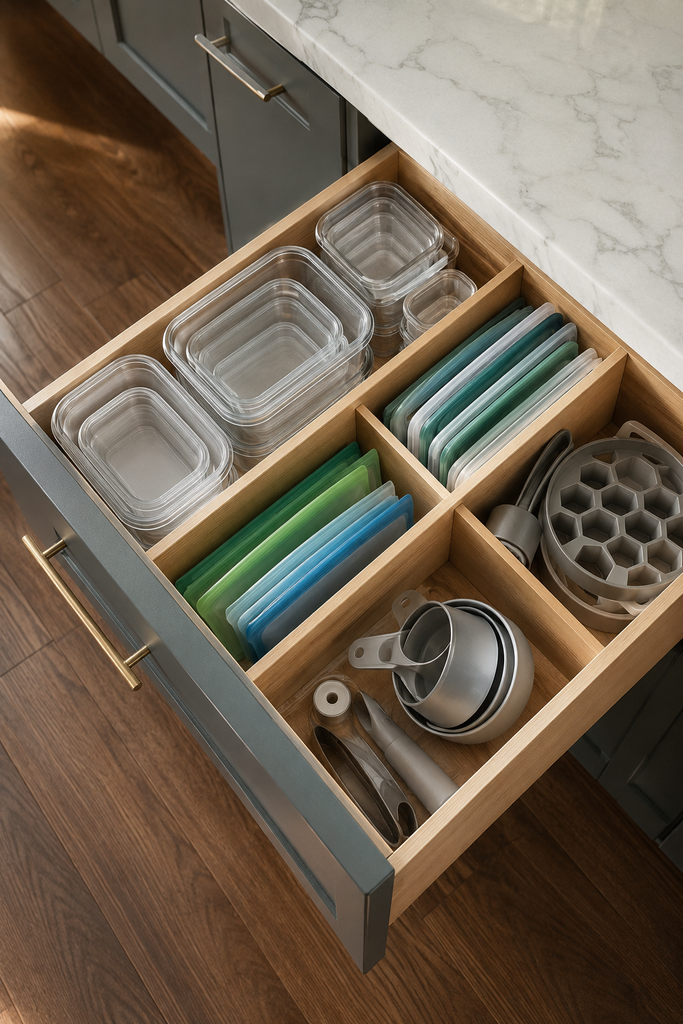
Adjustable drawer dividers are useful because you can customize the sections around what you already own rather than forcing your kitchen supplies into predetermined organizer sizes.
For example, a deep food-storage drawer could have one section for larger containers, another for small containers, a narrow section for lids, and a small area for reusable bags.
Now everything has somewhere to return.
You don’t necessarily need expensive organizers, either. Sturdy bins, boxes, or existing containers can accomplish the same thing.
Before buying anything, experiment with the layout.
You may realize you need fewer organizers than you expected.
Match the Storage Method to What’s Inside
One organizer isn’t going to solve every drawer.
Different items behave differently, so they need different storage strategies.
Pots and Pans
Keep your most-used cookware easiest to reach.
If you regularly use one skillet and one saucepan, don’t bury them beneath cookware that comes out twice a year.
Nesting pots can save space, but avoid creating enormous stacks.
For lids, vertical storage usually works better than tossing them on top of the pots.
Food Storage Containers
This is where deep drawers can either be fantastic or absolutely chaotic.
Nest containers by shape and size, but store the lids separately within the same drawer.
A narrow divider or bin for lids works well.
You still keep containers and lids close together without creating the dreaded pile where every container has a lid except the one you’re holding.
Mixing Bowls and Colanders
These are good candidates for nesting because you usually don’t mind lifting one or two lightweight bowls.
Just avoid mixing unrelated items into the stack.
A colander nested with mixing bowls makes sense. A salad spinner, three measuring jugs, and a waffle maker stacked on top probably doesn’t.
Don’t Waste the Height of Extra-Deep Drawers
Deep drawers often have a strange problem: plenty of vertical space, but not much usable surface area.
That doesn’t mean you should automatically pile things higher.
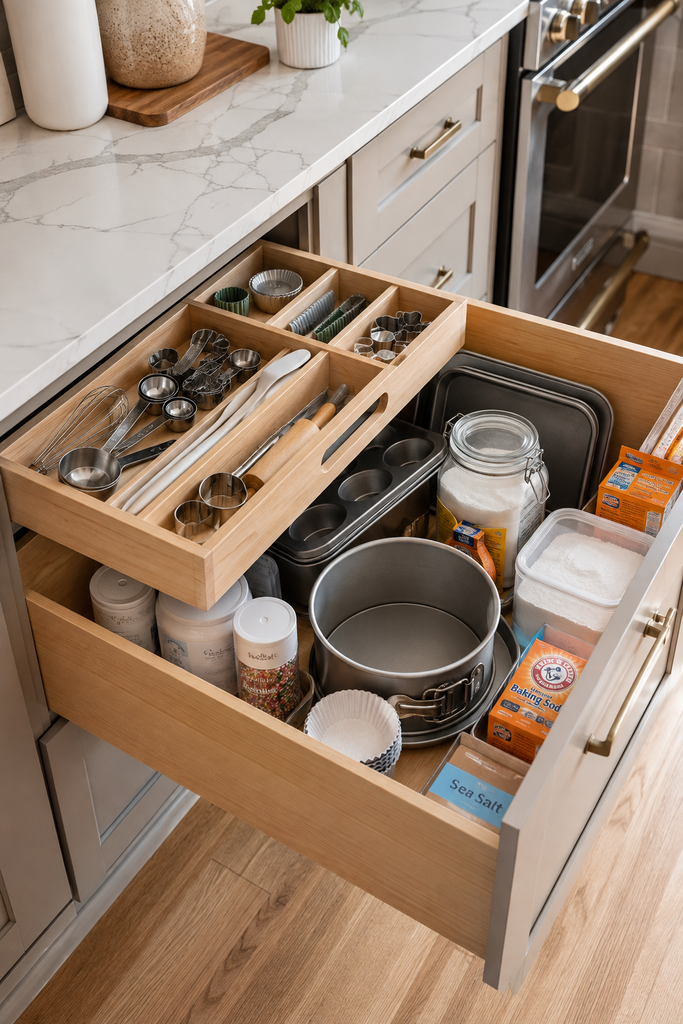
Instead, look for opportunities to create a second level.
A shallow removable tray can sit above less frequently used items while holding smaller everyday tools.
For example, baking equipment might live at the bottom while measuring spoons, cookie cutt
ers, and smaller accessories sit in a removable tray above.
The important part is accessibility.
If using the lower section requires dismantling an elaborate organizer every time, you’re probably not going to maintain it.
Put Everyday Items in the Best Drawer Locations
Drawer organization isn’t only about what goes inside each drawer.
Location matters too.
Think about where you naturally use something.
Pots and pans make sense near the stove.
Food-storage containers often work well near your food-prep area, refrigerator, or dishwasher.
Baking tools might belong closer to the section of counter where you normally bake.
And everyday dishes can work beautifully in deep drawers near the dishwasher, especially if reaching overhead cabinets is inconvenient.
You want your kitchen to support the way you move through it.
A beautifully organized drawer in the wrong location can still make cooking frustrating.
Use the “One-Move” Rule
Here’s a little rule I really like:
Try to organize everyday items so they can be accessed in one move.
Open drawer.
Grab item.
Done.
Not:
Open drawer.
Move colander.
Lift frying pan.
Move two lids.
Grab saucepan.
Put everything back.
That second system might look perfectly organized in a photo, but it’s annoying in real life.
Less frequently used items can require an extra step or two. Your everyday cookware shouldn’t.
Don’t Fill Every Inch of the Drawer
This might be the most unpopular organization advice: leave some empty space.
You do not need to maximize every cubic inch.
In fact, I’d rather have a drawer that’s 80% full and easy to use than one that’s 100% full and constantly becoming messy.
A little breathing room allows you to remove things easily and put them back without playing kitchen Tetris.
It also gives your storage system flexibility.
Eventually you’ll replace a pan, buy another container, or add a kitchen tool. If your drawers are already packed perfectly to the millimeter, one new item can wreck the entire setup.
Common Deep Drawer Organization Mistakes
One mistake is buying organizers before deciding what actually belongs in the drawer. You end up organizing clutter instead of fixing the reason the drawer doesn’t work.
Another is creating too many tiny categories. You don’t need a separate compartment for every object. The system should be obvious enough that everyone in the house understands where things go.
And finally, don’t prioritize appearance over function.
Matching bamboo bins can look gorgeous, but if they waste half the available space or don’t fit your cookware, they’re not helping.
A slightly less Pinterest-perfect drawer that works every morning is the better drawer.
How to Keep Deep Kitchen Drawers Organized
The best system shouldn’t require a weekly reorganization session.
If your drawers constantly fall apart, that’s usually a sign that the system has too much friction.
Pay attention to where clutter starts accumulating.
If lids are constantly ending up outside their organizer, maybe the section is too small. If nobody returns a heavy pan to the bottom of a stack, maybe that pan needs a more accessible spot.
Don’t blame yourself and reorganize everything from scratch.
Fix the annoying part.
Small adjustments are usually enough.
Putting It All Together
Learning how to organize deep kitchen drawers isn’t really about fitting more into them. It’s about making the space you already have easier to use.
Start with one drawer. Empty it, decide what its main job should be, and put back only the things that support that purpose. Then create simple zones, use vertical storage where it makes sense, and keep your everyday items accessible in one move whenever possible.
And don’t worry if there’s empty space left over. That’s actually a good thing.
The best kitchen organization doesn’t look impressive only when the drawer is open for a photo. It makes cooking, unloading the dishwasher, and putting things away noticeably easier every single day.