

Choosing a coffee table seems easy until you actually start shopping for one. You find a table you love, bring it into the living room, and suddenly something feels… off. Maybe it looks tiny next to your sectional. Maybe you’re constantly walking around sharp corners. Or maybe the table is perfectly nice on its own but somehow makes the entire seating area feel awkward.
I’ve found that the problem usually isn’t the style of the coffee table. It’s the shape and proportion in relation to the sofa.
That’s why learning how to choose the right coffee table shape for your sofa matters more than deciding between walnut, oak, glass, or marble first.
A rectangular sofa doesn’t automatically need a rectangular table. A sectional doesn’t always need a giant square one. And sometimes the shape that looks least obvious on paper is exactly what makes the room work.
Here’s how to figure it out without relying on guesswork.
Start With Your Sofa, Not the Coffee Table
Here’s the thing: most people shop backward.
They see a beautiful coffee table online and start imagining it in their living room. What actually works is looking at your existing seating arrangement first and asking what kind of space the table needs to fill.
Pay attention to three things:
- The overall length of your sofa
- The shape created by your seating arrangement
- The amount of open walking space around it
Your sofa creates the visual boundaries of the seating area. The coffee table should sit comfortably inside those boundaries rather than competing with them.
For example, a long three-seat sofa creates a horizontal visual line. A rectangular or oval coffee table usually follows that line naturally.
An L-shaped sectional creates something closer to a square or enclosed zone. That often makes a square, round, or generously sized rectangular table feel more balanced.
Think of the coffee table as the piece connecting your seats together rather than simply something sitting in front of the couch.
Get the Coffee Table Size Right First
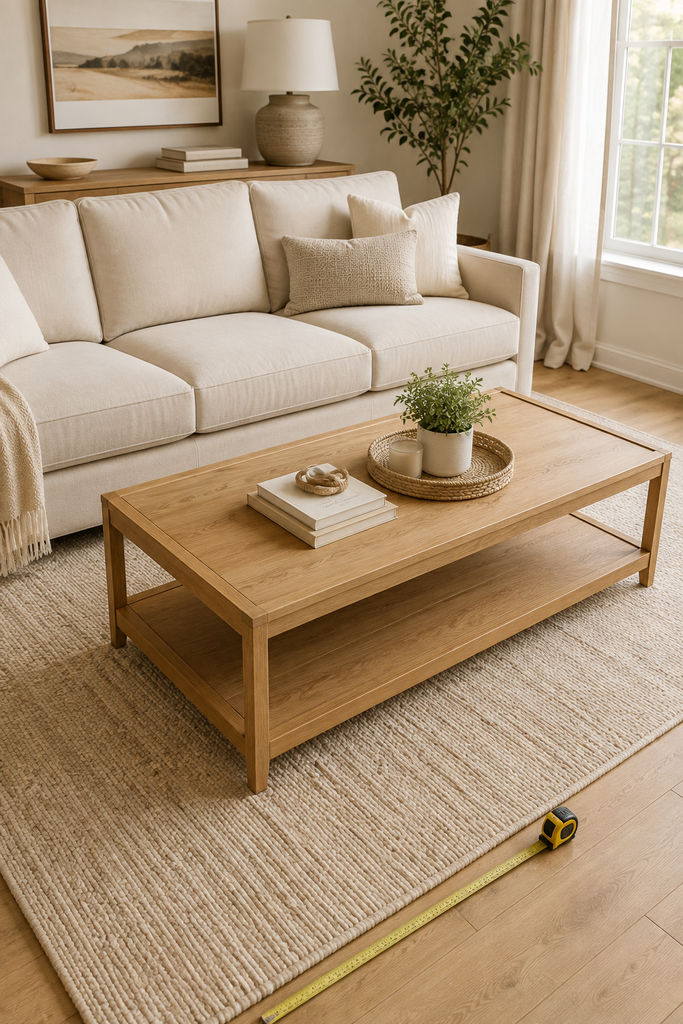
Before worrying too much about shape, eliminate tables that are simply the wrong size.
Aim for About Two-Thirds of Your Sofa Length
A useful starting point is choosing a coffee table approximately two-thirds the length of your sofa.
So if your sofa is 84 inches long, something around 54–56 inches long will often feel nicely proportioned.
This isn’t a strict mathematical rule. A 50-inch table could still work beautifully. The point is avoiding extremes.
A tiny 30-inch coffee table floating in front of a large 90-inch sofa will usually look disconnected. On the other hand, a table nearly as long as the sofa can make the seating arrangement feel crowded and heavy.
Leave Enough Space Between Sofa and Table
Try to maintain roughly 14–18 inches between the sofa and coffee table.
This gives you enough room to walk through while keeping drinks, books, and remotes within comfortable reach.
Most people get this wrong because they judge spacing while standing outside the seating area. Actually sit on the sofa.
Can you comfortably reach the table?
Can someone walk between the pieces without turning sideways?
Those questions matter more than whether your layout perfectly follows a design rule.
Pay Attention to Height
Your coffee table should generally be around the same height as your sofa seat or slightly lower.
Most coffee tables fall somewhere around 16–18 inches high, although your sofa ultimately determines what feels comfortable.
A very tall coffee table can visually block the sofa and feel awkward to use. An extremely low table may look stylish in photos but become annoying when you’re constantly bending down for your coffee.
Practicality wins here.
Rectangular Coffee Tables Work Best With Longer Sofas
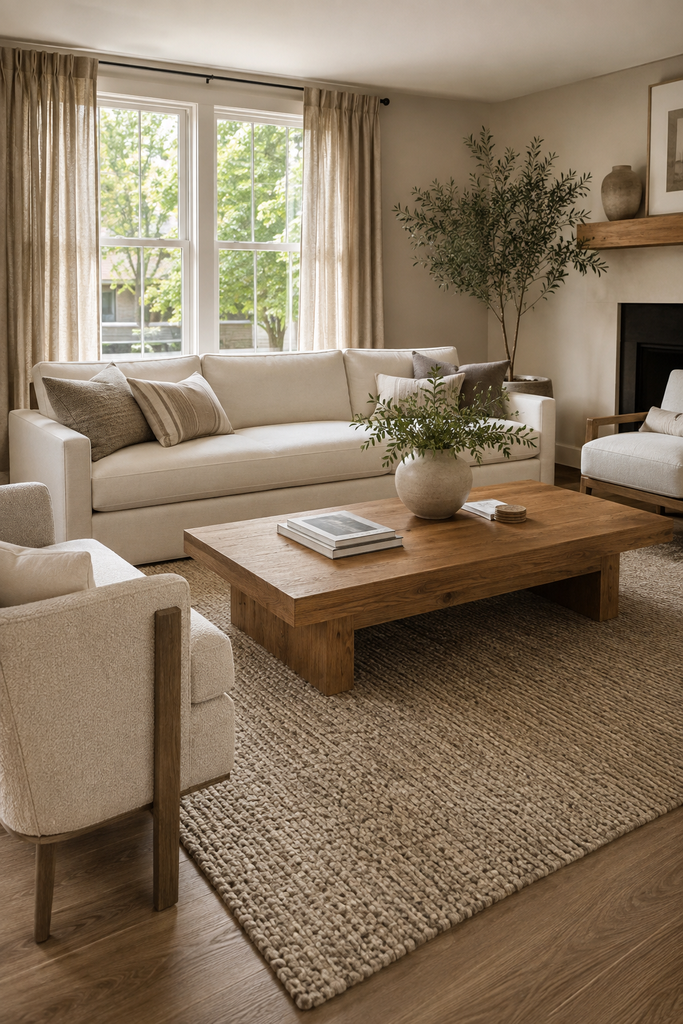
The rectangular coffee table is popular for a reason. It works particularly well with standard three-seat sofas and long seating arrangements.
Its proportions naturally echo the horizontal shape of the sofa.
Imagine an 86-inch sofa against a wall with two occasional chairs nearby. A rectangular table around 52–58 inches long helps visually anchor the entire arrangement without overwhelming it.
Rectangular tables are also practical because several people sitting along the sofa can reach them.
But there is one situation where I’d be cautious: tight living rooms with narrow walkways.
Those four projecting corners can make an already-small circulation path feel even tighter.
That’s when an oval table becomes interesting.
Oval Coffee Tables Are Great for Tight Spaces
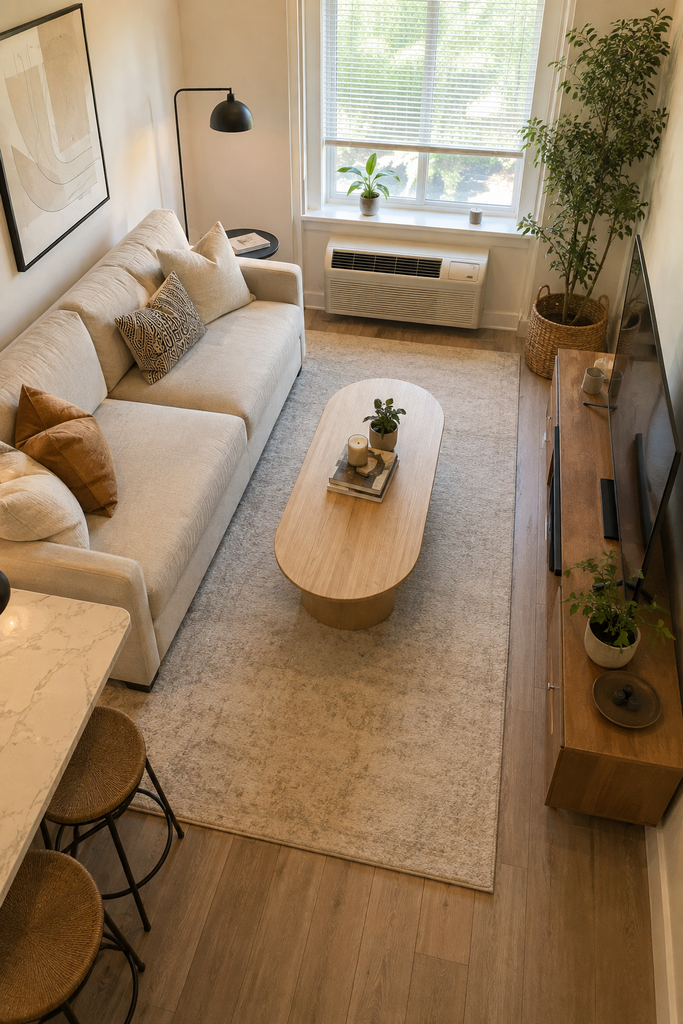
An oval coffee table gives you many of the benefits of a rectangular table without the sharp corners.
You still get that elongated shape, which works nicely with a long sofa, but movement around the table feels easier.
This is especially useful in:
- Small living rooms
- Apartments
- Rooms where people frequently walk around the coffee table
- Homes with young children
- Seating arrangements close to doorways
There’s also a visual advantage.
Rooms often contain a ridiculous number of rectangles without us realizing it: rectangular sofas, rugs, windows, TV consoles, artwork, doors.
Adding an oval coffee table introduces curves and softens all those straight lines.
If your living room feels boxy even though the individual pieces look good, changing the coffee table shape can make a surprisingly big difference.
Round Coffee Tables Work Beautifully With Sectionals
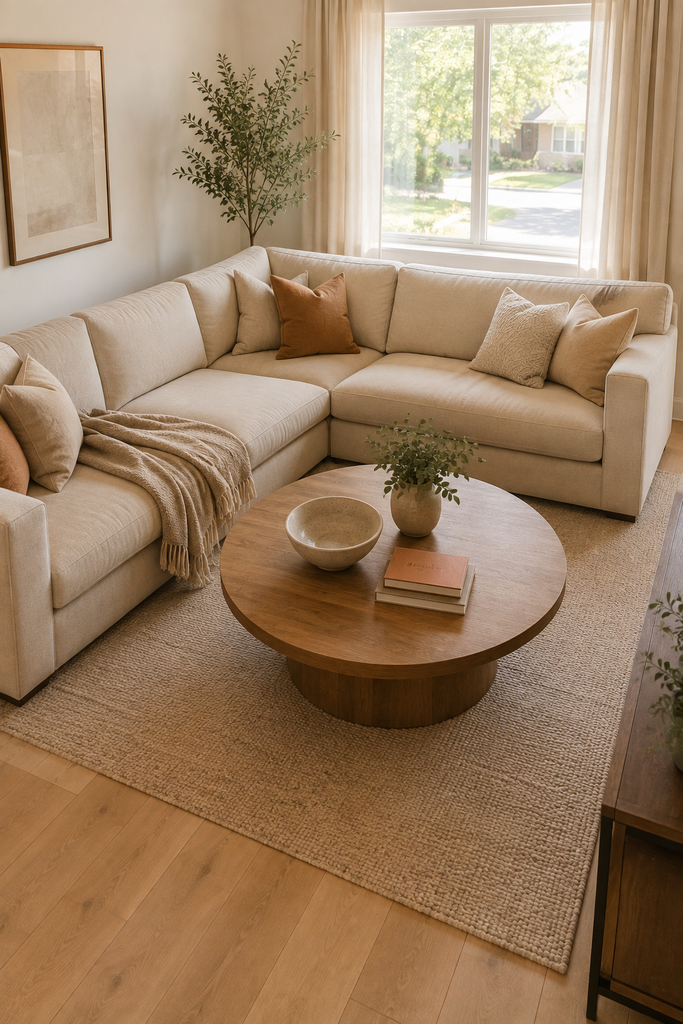
Round tables are one of my favorite options for certain sectional layouts.
With an L-shaped sectional, you often end up with an open area tucked between the two sides of the sofa. A round table can sit naturally inside that space.
It also creates easier circulation because there aren’t corners pointing toward either section of seating.
Round Tables Also Work With Conversational Seating
Don’t assume you need a sectional to use one.
If you have a sofa with two chairs positioned around it, a round coffee table can become a central point that connects all three seating positions.
Everyone gets relatively equal access to the table.
The downside?
Round coffee tables can feel undersized in front of very long sofas.
If you’ve got a 96-inch sofa and place a small 30-inch round table in front of it, the table may look like it’s floating in the middle of nowhere.
In that situation, either go larger or consider an oval shape instead.
Square Coffee Tables Suit Large Sectionals
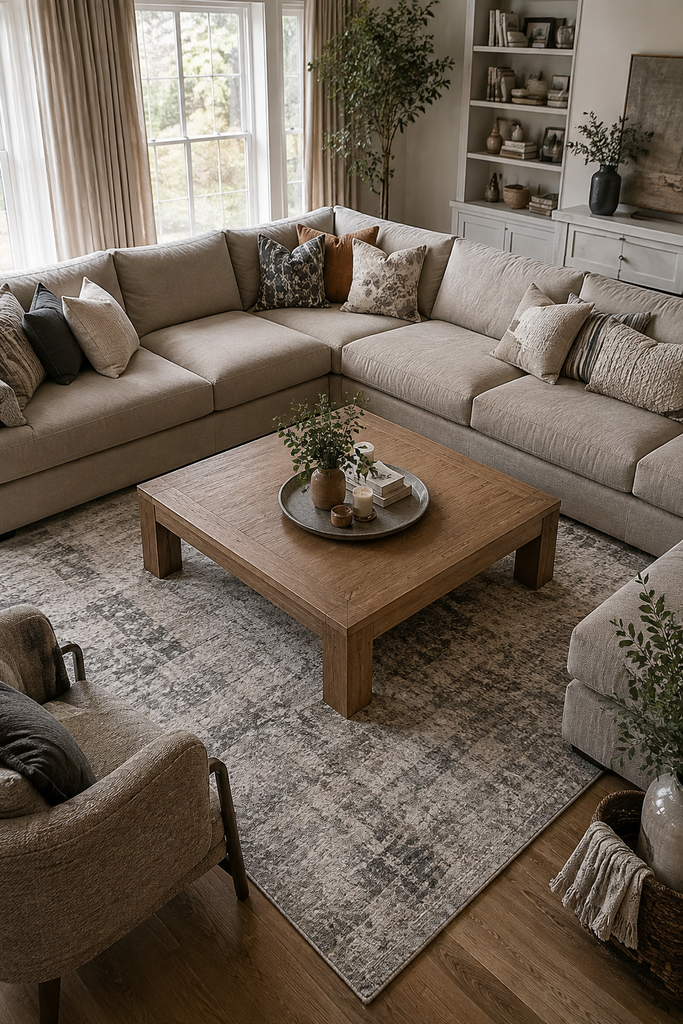
Square coffee tables tend to make the most sense when the seating arrangement itself creates a wide, substantial footprint.
Think large L-shaped or U-shaped sectionals.
A long skinny rectangular table can sometimes look strange inside the deep opening of a large sectional. A square table fills that central space more evenly.
For example, if your sectional extends significantly in both directions, a 36–44 inch square coffee table may create better visual balance than a narrow rectangular design.
But measure before buying.
Square tables consume more floor area than people expect. In a smaller room, they can quickly become an obstacle course.
I wouldn’t choose one simply because you have a sectional. Choose it because your sectional leaves a genuinely wide central opening.
Match the Coffee Table to the Entire Seating Layout
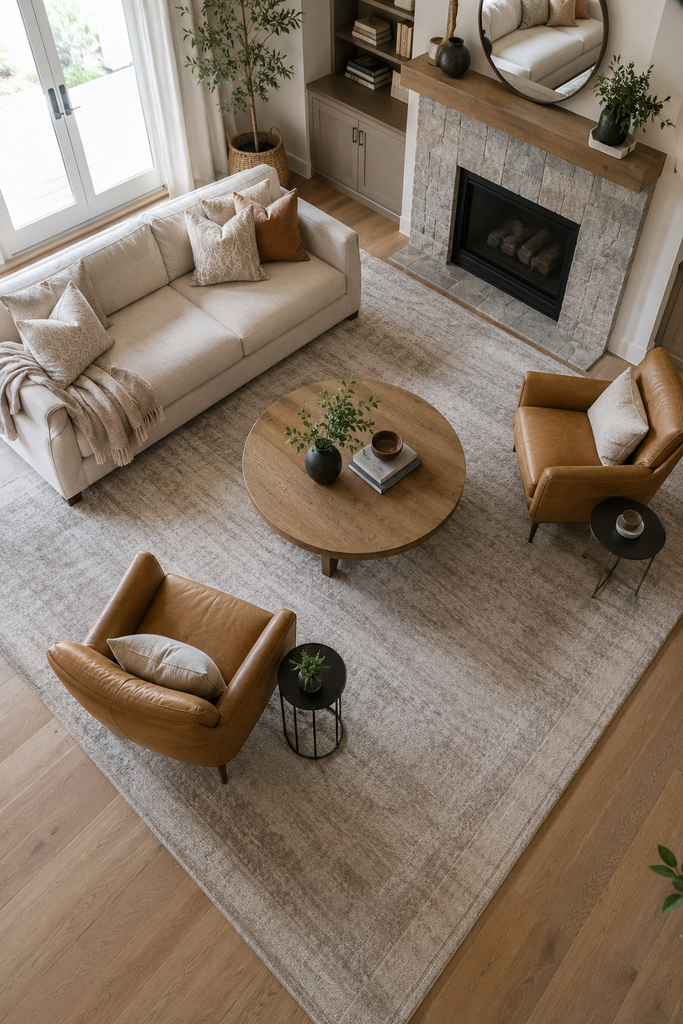
This is where choosing the right coffee table gets more interesting.
Your sofa matters, but your whole furniture arrangement matters even more.
Suppose you have a standard sofa facing two armchairs.
Looking only at the sofa might suggest a rectangular coffee table. But if those chairs create a compact, almost square conversation area, a round table may connect everything more successfully.
Similarly, a sectional may technically look good with a square table, but if the room itself is long and narrow, an oval table might preserve much better traffic flow.
So instead of asking:
“What coffee table goes with this sofa?”
Ask:
“What shape fits naturally inside the open space created by all my seating?”
That small change in thinking solves a lot of layout problems.
Common Coffee Table Mistakes to Avoid
Buying Too Small
This is probably the mistake I see most often.
People worry about making the room feel crowded, so they buy a tiny coffee table.
Unfortunately, undersized furniture doesn’t necessarily make a small room look larger. Sometimes it just makes the furniture arrangement look disconnected.
A properly scaled coffee table can actually make the room feel more intentional.
Ignoring Traffic Flow
You shouldn’t have to perform a sideways shuffle every time you walk through your living room.
Before ordering anything, identify the main walking routes through the room.
If one corner of a rectangular table would sit directly in that path, consider an oval or round table instead.
Matching Every Shape
Your furniture doesn’t need to form a collection of identical rectangles.
In fact, contrast often makes a room more interesting.
A boxy sofa paired with a round or oval coffee table can feel softer and more layered than another rigid rectangular piece.
Choosing Style Before Function
That sculptural stone coffee table may look incredible online.
But if you eat dinner on your sofa three nights a week, need storage for blankets, and have kids running through the room, your actual needs should probably influence the decision.
Beautiful furniture that constantly annoys you isn’t good design.
Use Painter’s Tape Before You Buy Anything
This is one of those ridiculously simple tricks that can prevent an expensive mistake.
Once you find a coffee table you’re considering, look at its dimensions and mark the footprint directly on your floor using painter’s tape.
Then live with it for a little while.
Walk around it.
Sit on every seat.
Reach toward where the tabletop would be.
Check whether drawers, recliners, or nearby furniture can still open properly.
For a round table, you can roughly outline the diameter or place objects around its expected perimeter.
What looks like a minor difference on a product page—say, 42 inches versus 48 inches—can feel completely different once it’s sitting in your actual living room.
A Simple Coffee Table Shape Cheat Sheet
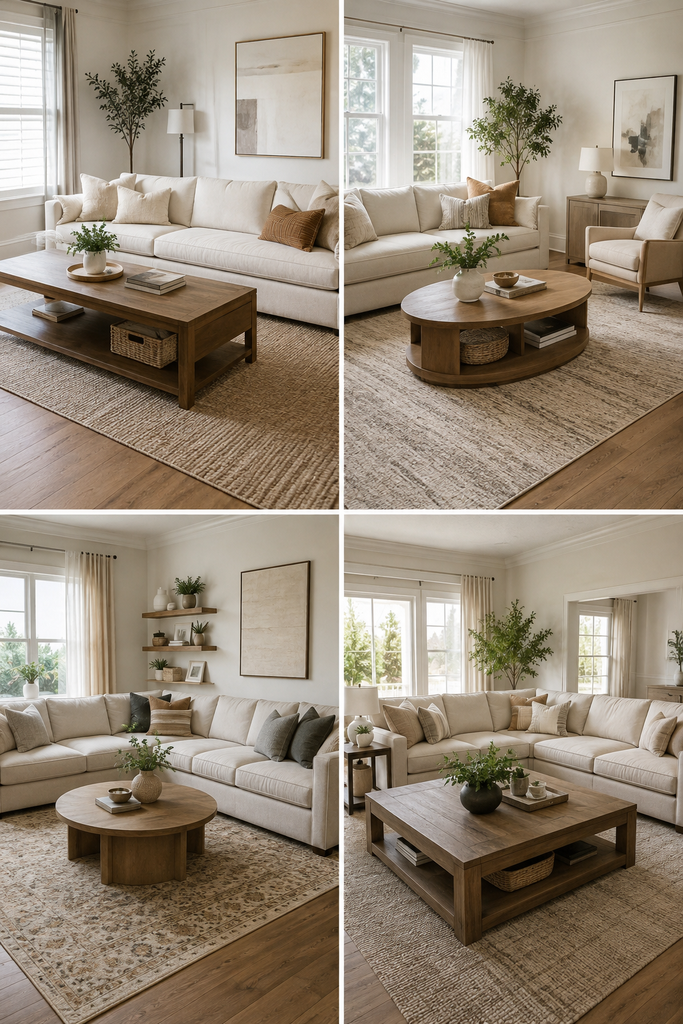
If you’re still undecided, this is a good starting point:
Standard long sofa: Rectangular or oval
Small sofa or loveseat: Small rectangular, oval, or round
L-shaped sectional: Round, square, or rectangular depending on proportions
Large U-shaped sectional: Large square or round
Sofa with two conversational chairs: Round or square
Long, narrow living room: Oval or narrow rectangular
Small room with tight walkways: Round or oval
These aren’t hard rules. They’re starting points.
The best coffee table is ultimately the one that makes the entire seating arrangement feel connected while still leaving enough breathing room around it.
Final Thoughts
Learning how to choose the right coffee table shape for your sofa really comes down to looking at the room as a whole instead of shopping for one piece in isolation.
Start with your sofa’s size and shape. Then look at the open space created by the rest of your seating, check your walking paths, and finally decide whether a rectangular, oval, round, or square table fits that space naturally.
And please measure before ordering.
Even better, grab some painter’s tape and outline the table on your floor. Ten minutes of testing can tell you more than an hour of staring at product photos.