

Curtains are one of those decorating decisions that seem easy until you actually have to make them. You find a fabric you like, hang it over the window, and somehow the whole living room suddenly looks shorter, darker, or just slightly off.
I’ve seen this happen most often when people choose curtains as an accessory instead of treating them as part of the room’s architecture. The fabric matters, of course, but so do the length, width, hanging height, light filtration, and how the curtains relate to everything else in the space.
Here’s the thing: good curtains usually aren’t the ones demanding the most attention. They make the windows look larger, soften all the hard edges in a living room, control glare, and help the furniture feel more connected.
If you’re trying to figure out how to choose curtains for a living room, don’t start by scrolling through colors and patterns. Start with what your room actually needs.
Start With What You Need the Curtains to Do
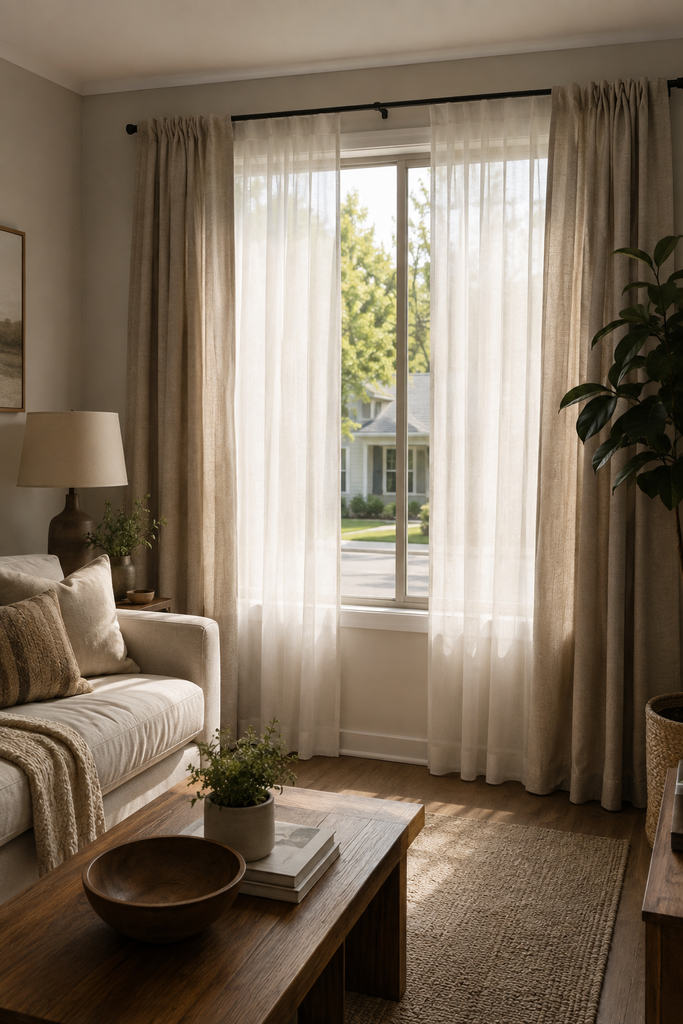
Before thinking about style, decide what problem your curtains need to solve.
Think About Light Before Fabric
Look at your living room at different times of day. A north-facing room may already feel somewhat dim, while a west-facing room can get intense afternoon sun.
For a darker living room, heavy curtains can make the problem worse. Lightweight linen-look panels, cotton blends, or light-filtering curtains usually make more sense because they soften the window without blocking too much daylight.
If afternoon glare hits your television or seating area, slightly heavier lined curtains may be more practical.
Privacy matters too. A street-facing living room might need sheer curtains combined with heavier outer panels, giving you privacy during the day without making the room feel closed off.
What actually works is choosing function first and narrowing down fabrics afterward.
Get the Curtain Size Right
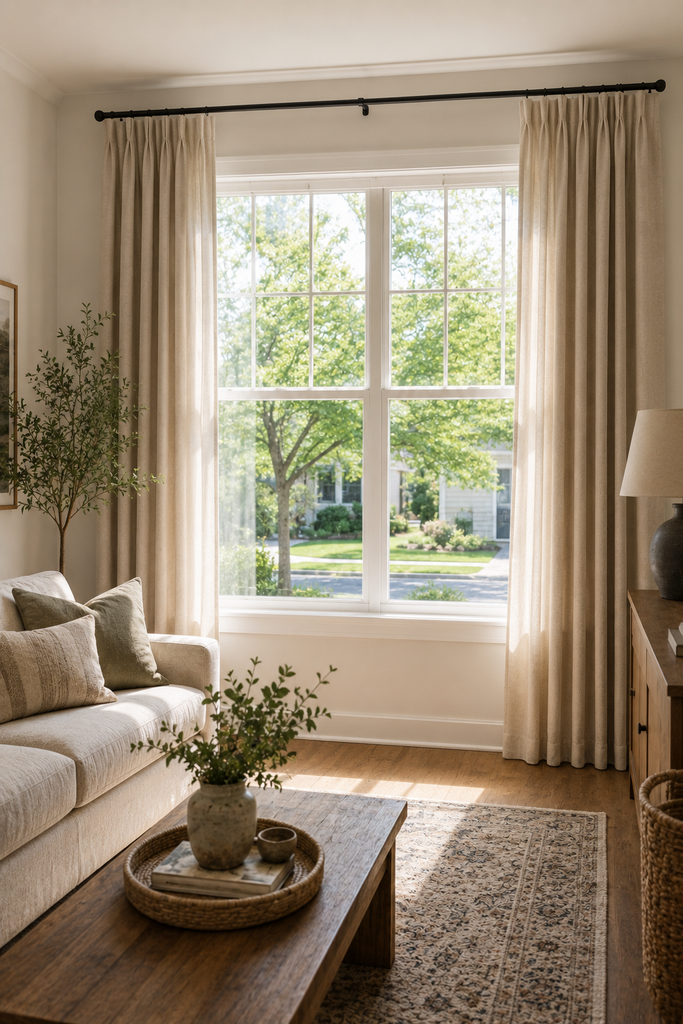
Most people get this wrong because they measure only the window itself.
Hang the Rod Higher
Curtain rods generally look better when installed several inches above the window frame rather than directly on top of it. If there’s enough wall space, hanging the rod closer to the ceiling can visually stretch the room upward.
That small adjustment can make an ordinary eight-foot ceiling feel noticeably taller.
You don’t necessarily need to go all the way to the ceiling. The goal is simply to create a stronger vertical line instead of outlining the exact dimensions of the window.
Extend Curtains Beyond the Window
The rod should also extend beyond both sides of the window frame.
Why? Because when open curtains sit mostly in front of the wall rather than the glass, you expose more of the window. That makes the opening appear wider and allows more daylight into the room.
This is especially useful for smaller living rooms where every visual trick that creates openness helps.
Don’t Skimp on Curtain Width
A pair of skinny panels stretched almost flat across a large window rarely looks finished.
Curtains need enough fullness to form soft folds even when closed. As a practical starting point, the combined panel width should generally be around 1.5 to 2 times the width you’re covering.
Fullness is what gives inexpensive curtains a more substantial, custom-looking appearance.
Choose the Right Curtain Length
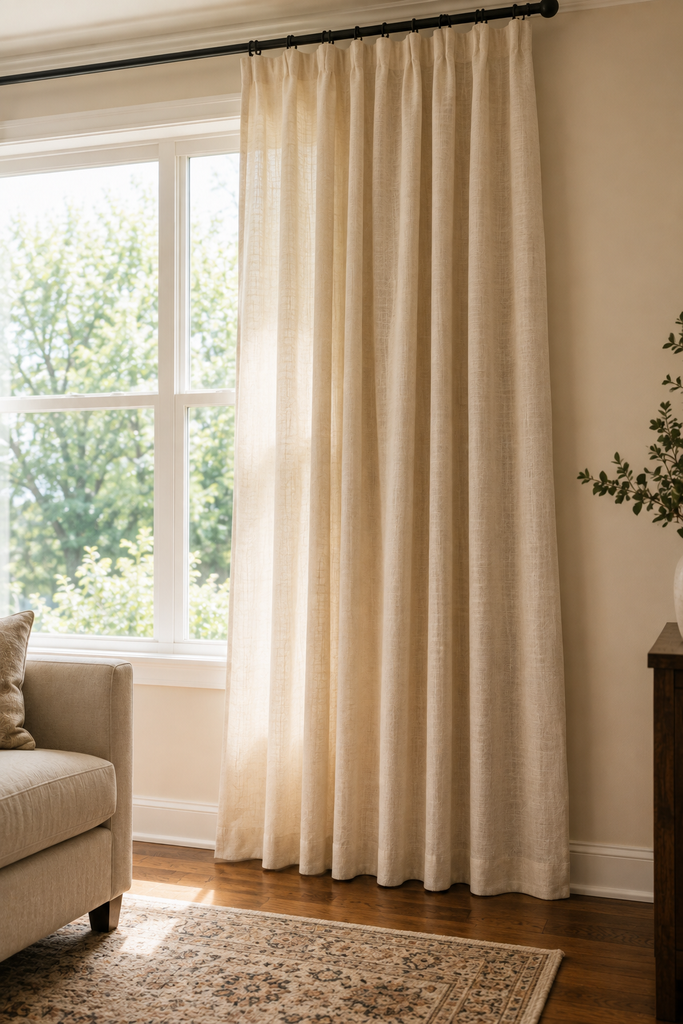
For most living rooms, floor-length curtains are the safest choice.
Panels that stop several inches above the floor often make windows look shorter. Ideally, curtains should just touch the floor or hover very slightly above it.
A small break at the floor can work in relaxed or traditional rooms, while perfectly tailored floor-skimming curtains usually suit contemporary spaces better.
I’d avoid dramatic puddling unless you genuinely love that romantic look. It photographs beautifully, but in an everyday living room, extra fabric collects dust and gets pushed around by pets, kids, and vacuum cleaners.
For a practical home, clean floor-length panels usually win.
Pick a Fabric That Matches the Room
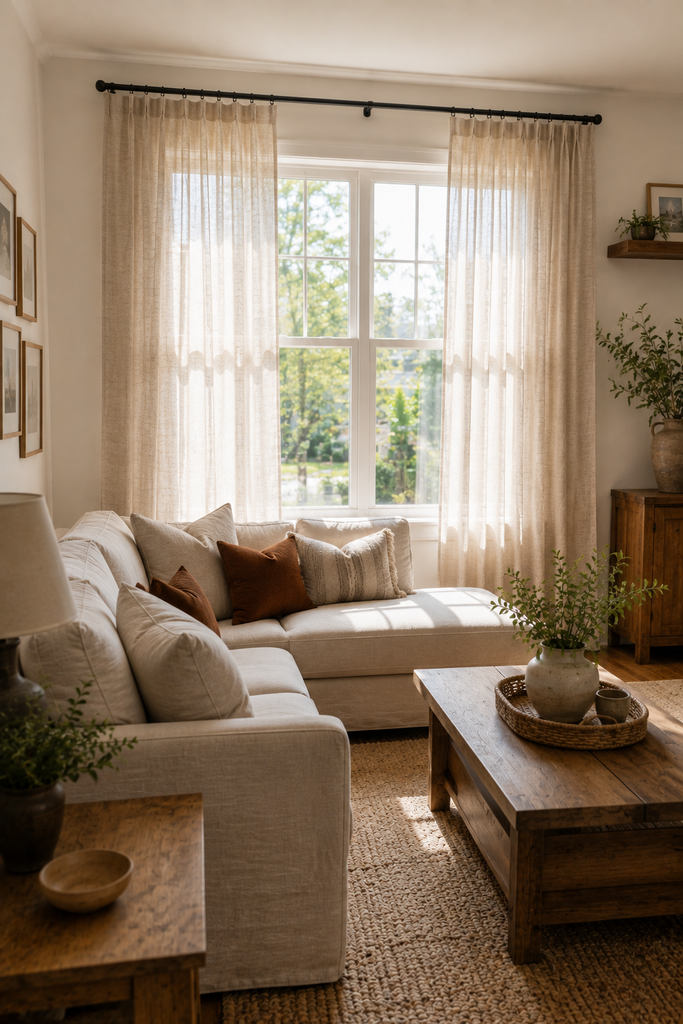
Fabric determines more than how curtains look. It changes how they hang and how much visual weight they add.
Use Lighter Fabrics for an Airier Look
Linen, linen blends, lightweight cotton, and soft woven fabrics work particularly well in casual living rooms.
They add texture without creating a heavy wall of fabric.
If your room already contains substantial furniture—a chunky sectional, dark wood coffee table, large bookcase—lighter curtains can provide some visual relief.
Use Heavier Fabric Intentionally
Velvet, thick woven fabrics, and lined drapes can be beautiful, especially in traditional or cozy rooms. But they carry much more visual weight.
In a small living room, dark heavy curtains surrounding every window can quickly make the walls feel crowded.
Save heavier materials for situations where you actually want extra insulation, privacy, light control, or a more formal appearance.
Choose a Curtain Color Without Overthinking It
You don’t need to match your curtains exactly to your sofa, rug, or wall color.
In fact, exact matching can make a room feel overly coordinated.
A reliable approach is choosing curtains within the same general color family as the walls but slightly lighter or darker. Warm white walls, for example, can look beautiful with oatmeal, natural linen, soft taupe, or creamy curtains.
This keeps the windows visually quiet while still adding depth.
If your living room is mostly neutral, curtains can introduce muted color. Dusty blue, olive, clay, or soft rust can work without becoming the entire focus of the room.
Be Careful With Patterns

Patterned curtains aren’t bad. They’re just much less forgiving.
If your living room already has a patterned rug, decorative pillows, artwork, and noticeable upholstery, adding another large pattern around the windows can create competition.
Here’s the thing: curtains cover a surprisingly large amount of visual space.
If you want patterned curtains, let them be one of the room’s primary patterns. Keep nearby elements quieter.
For rooms that already have plenty happening, textured solid curtains are often more interesting than completely plain fabric without introducing another competing motif.
Avoid These Common Living Room Curtain Mistakes
One of the biggest mistakes is buying curtains before measuring properly. Another is choosing two standard panels simply because they came as a pair, even though the window needs considerably more fabric.
Also watch the hardware.
A tiny rod with oversized curtains looks under-scaled, while bulky decorative hardware can overwhelm a modest window. Choose a rod that feels proportional to the window and the weight of the fabric.
And don’t forget what happens when the curtains are open. Ideally, the panels should frame the window rather than covering a large portion of the glass.
That detail alone can make a living room feel brighter.
A Simple Formula That Works in Most Living Rooms
If you’re overwhelmed by choices, keep it simple.
Choose floor-length curtains in a soft woven fabric. Hang the rod several inches above the window and extend it beyond both sides. Use enough panels to create generous folds, then choose a color that relates to the walls or another existing tone in the room.
Finally, check the curtains in daylight and at night before deciding they’re right.
Curtains can look completely different once artificial lighting comes on.
Conclusion
Learning how to choose curtains for a living room is really less about finding the perfect fabric and more about getting the proportions and function right.
Start with light and privacy. Then concentrate on hanging height, rod width, curtain fullness, and length. Once those pieces are correct, choosing the color and fabric becomes much easier.
And if you’re deciding between a slightly trendy curtain and a simple one that fits beautifully, I’d choose the better fit almost every time.
Measure your windows carefully, look at how daylight moves through the room, and choose curtains that support the space rather than fight with it. When curtains are doing their job well, the whole living room simply feels taller, softer, brighter, and more finished.