
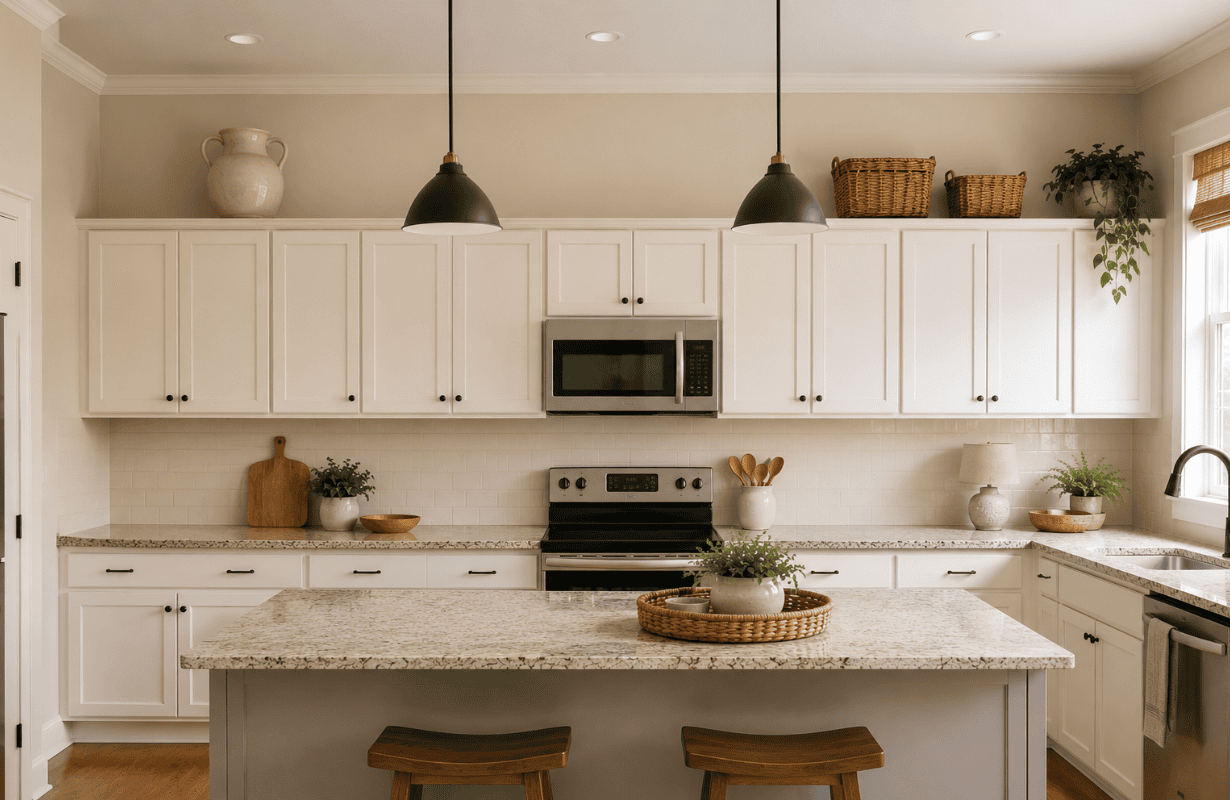
That empty space above kitchen cabinets can be surprisingly annoying. Leave it completely bare, and the kitchen can sometimes feel unfinished. Fill it with baskets, signs, plants, pitchers, and every decorative object you own, and suddenly you’ve created a dusty little storage shelf hovering over your kitchen.
I’ve seen both extremes, and neither is automatically right.
The trick with how to decorate above kitchen cabinets without creating clutter is realizing that you don’t need to fill the entire gap. In fact, the empty space around whatever you put up there is usually what makes the decorating look intentional.
You also have to consider something that Pinterest photos conveniently ignore: kitchen grease and dust. Anything displayed near the ceiling eventually needs cleaning.
So instead of treating the tops of your cabinets like another shelf that needs to be filled, think of them as a few carefully chosen opportunities to add height, texture, or personality. Here’s how to do that without making your kitchen feel busier.
First, Decide Whether the Space Actually Needs Decorating
Here’s the thing: you do not have to decorate above your kitchen cabinets.
That sounds obvious, but most people get this wrong because they see empty space and immediately assume something belongs there.
Before buying anything, look at the kitchen as a whole.
If you already have patterned backsplash tile, pendant lights, countertop appliances, open shelving, colorful accessories, and visible cookware, leaving the cabinet tops empty may actually give your eyes somewhere to rest.
On the other hand, a kitchen with simple white cabinets, neutral walls, and very little happening above eye level can sometimes benefit from a few decorative pieces.
Pay Attention to the Size of the Gap
The amount of space between your cabinets and ceiling matters.
A narrow 6- or 8-inch gap usually isn’t worth decorating. Objects squeezed into that space often look cramped and collect dust.
If you have 12, 18, or even 24 inches above the cabinets, you have much more room to create something intentional.
But more room does not mean you need more stuff.
It usually means you can use fewer, larger objects.
The Biggest Mistake: Using Too Many Small Decorations
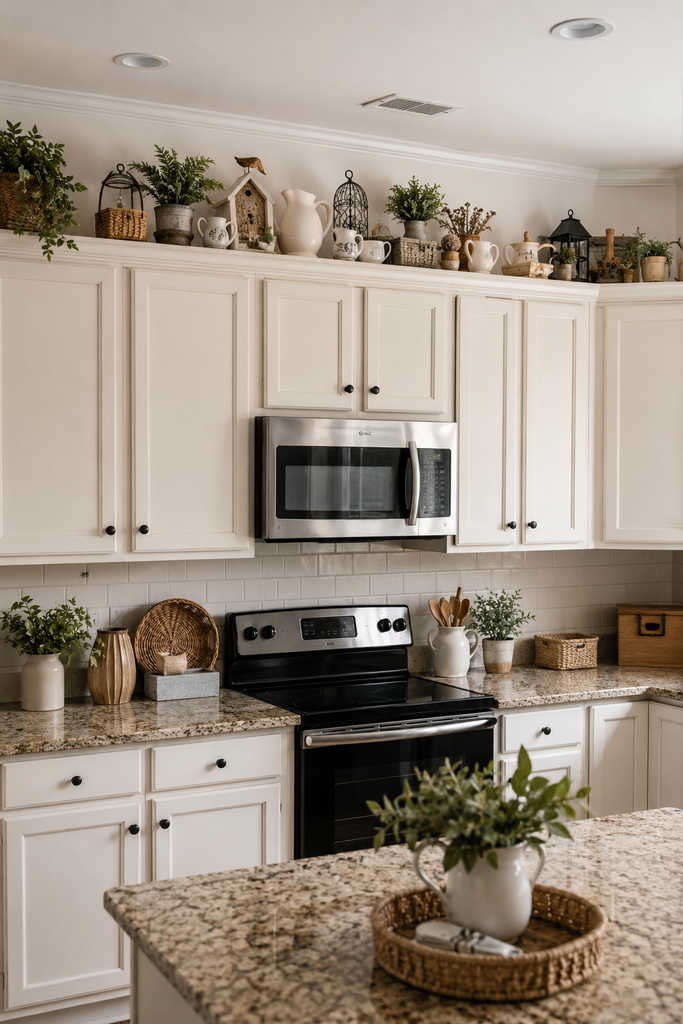
One of the fastest ways to make cabinet tops look cluttered is lining them with lots of small objects.
Think tiny plants, little signs, miniature baskets, small jars, decorative bottles, pitchers, figurines, and random thrift-store finds spread across every cabinet.
Individually, they may be cute. Together, they create visual noise.
Choose Scale Over Quantity
What actually works is using larger pieces that can be appreciated from across the room.
For example, instead of five small baskets, try one substantial woven basket.
Instead of displaying six small ceramic pieces, use one large pottery vase and perhaps one smaller companion piece.
Decorations above cabinets are viewed from several feet away and from below. Larger shapes register much better from that distance.
A simple rule I like is this: if you need to walk closer to understand what the object is, it’s probably too small for this location.
Create Small Groups Instead of Decorating the Entire Cabinet Run
You don’t need a continuous line of décor running from one end of the kitchen to the other.
Actually, I’d avoid it.
Continuous decorating turns the cabinet tops into a display shelf. Leaving intentional gaps makes individual pieces feel more important.
Think in Visual “Moments”
Imagine you have a long run of upper cabinets.
You might place:
- A large ceramic vase near one end
- A basket or pair of baskets above a wider cabinet section
- A simple piece of greenery near the opposite end
Then stop.
The empty areas between those groups are doing useful work. They prevent the eye from having to process twenty different objects at once.
If you’re creating a small grouping, odd numbers can work nicely—such as one taller object with two lower pieces—but don’t treat this as a strict decorating rule. Two well-proportioned objects can look better than three pieces added just to satisfy a formula.
Stick With a Limited Color Palette
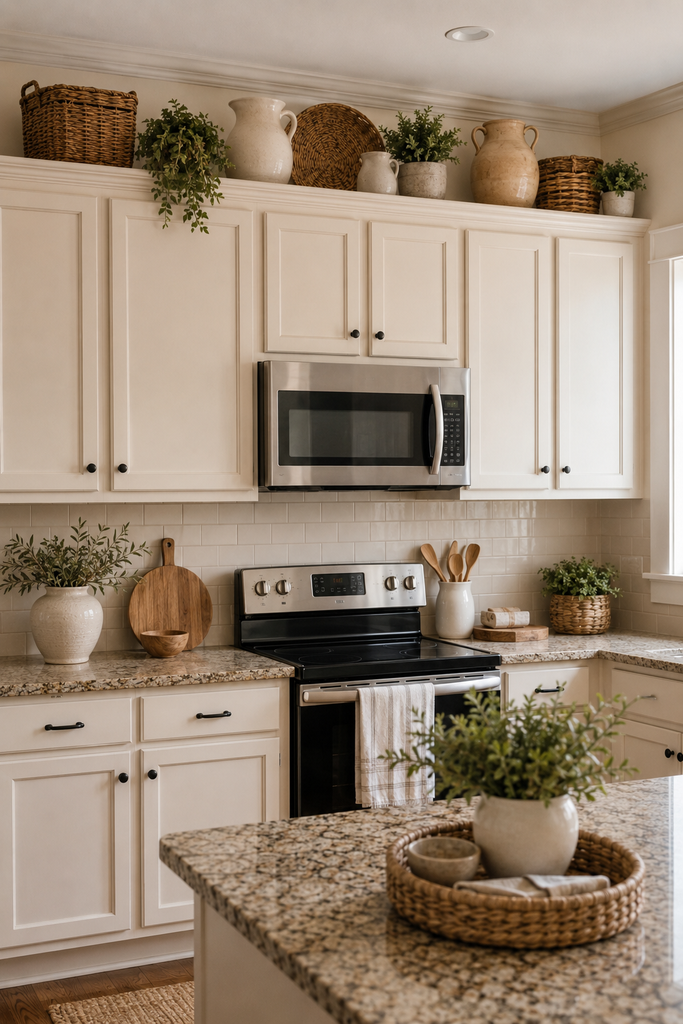
Another reason above-cabinet decorating becomes messy is that every object introduces another color.
A blue vase, red cookbook, green plant, brown basket, white pitcher, black sign, and colorful artwork might individually work elsewhere. Put all of them along one horizontal line and the kitchen suddenly feels much busier.
Instead, borrow colors that already exist in the room.
Repeat What the Kitchen Already Has
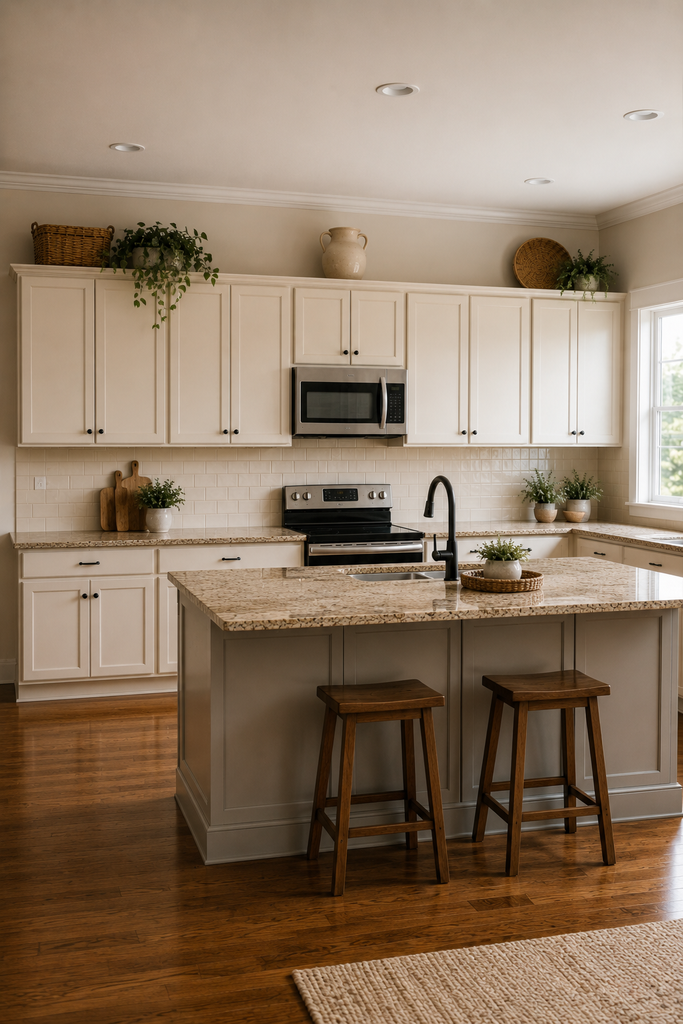
If your kitchen has warm wood floors and cream cabinets, you could use natural woven baskets, warm pottery, and muted greenery.
For a kitchen with white cabinets and black hardware, black accents mixed with natural wood or neutral ceramics can feel connected to the rest of the room.
You aren’t trying to create a separate decorating theme above the cabinets.
You’re extending the palette that’s already there.
That repetition is what makes the arrangement feel intentional rather than like leftover decorations were placed wherever they fit.
Use Texture When You Don’t Need More Color
If your kitchen already has enough color, texture is one of the easiest ways to make the cabinet tops interesting without making them loud.
Woven materials are especially useful because they’re visible from a distance without demanding too much attention.
Think large seagrass baskets, aged pottery, wood bowls, simple ceramic vessels, or restrained faux greenery.
A combination like woven basket + neutral ceramic + greenery can provide plenty of interest without adding six competing colors.
Just be careful with texture too. Five different basket styles lined across the cabinets can become just as cluttered as a collection of small decorations.
Be Careful With Greenery
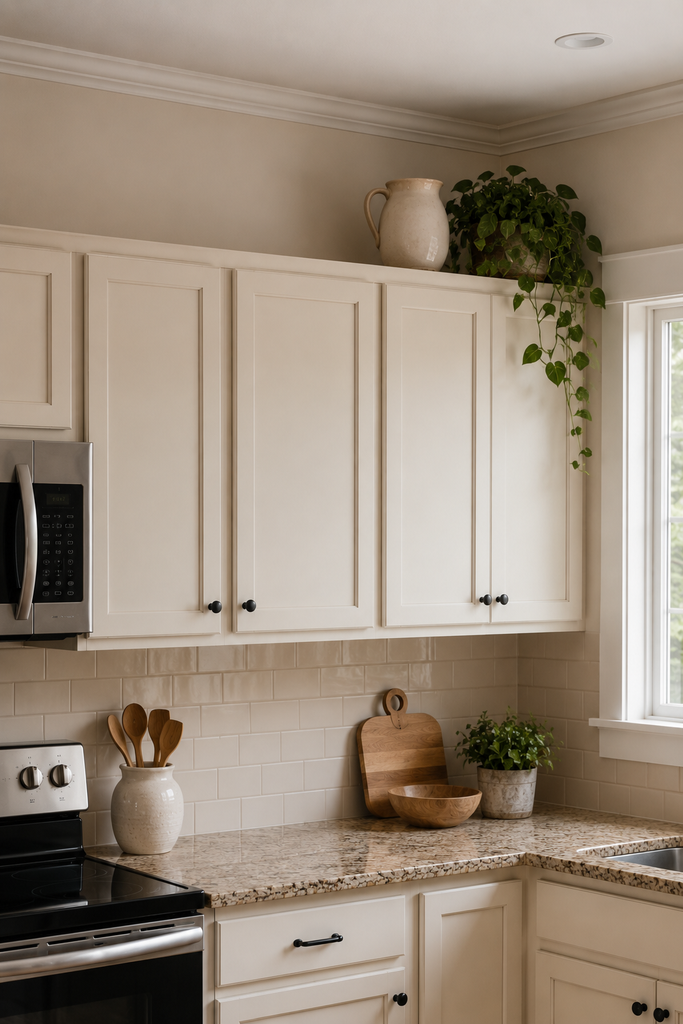
Plants are probably one of the most common things people put above kitchen cabinets.
They can work beautifully, but this is another area where restraint matters.
Long artificial vines draped across every cabinet can quickly make the space look dated. And real plants aren’t automatically practical either.
Consider Light and Accessibility
Ask yourself how you’re going to water a real plant that’s seven feet off the floor.
If the cabinet tops receive good indirect light and you can reach them easily, a real trailing plant may work.
Otherwise, a convincing faux plant is often more practical.
Choose one substantial plant rather than scattering little pots everywhere. And if you’re using faux greenery, keep it relatively simple. You want a touch of organic softness, not an artificial jungle running around the kitchen ceiling.
Make Practical Storage Look Decorative
Sometimes the space above cabinets actually needs to provide storage, especially in a smaller kitchen.
That’s completely fine.
The key is hiding the visual clutter.
Instead of putting rarely used appliances, packages, serving pieces, and miscellaneous kitchen supplies directly on top of the cabinets, place them inside matching or coordinating baskets.
Choose Containers You Can Actually Maintain
Large baskets or attractive lidded boxes can hide items you only use occasionally, such as holiday serving pieces or specialty cookware.
But don’t create twelve storage categories up there.
Remember, anything stored above kitchen cabinets is inconvenient to access. This area is best for lightweight, rarely used items rather than things you need every week.
Also consider cleaning. Open baskets with complicated woven surfaces can trap kitchen dust and grease, so simpler shapes are usually easier to maintain.
Step Back Before Adding the Next Piece
This might be the most useful decorating habit of all.
Don’t stand directly underneath your cabinets while arranging everything.
Put one or two pieces in place, then walk across the kitchen and look at the entire wall.
Ask yourself:
Does this area actually need another object?
Often, the answer is no.
Check whether one side feels unusually heavy, whether your tallest pieces are all clustered together, and whether there is enough breathing room between groups.
You can even take a quick photo with your phone. Clutter is strangely easier to notice in a photo than when you’re standing inside the room.
And don’t be afraid to remove something. Decorating isn’t always about finding what else to add. Quite often, the final step is taking one thing away.
A Simple Formula That Works in Most Kitchens
If you’re unsure where to begin, keep your first attempt extremely simple.
Choose two or three areas along the cabinet run rather than decorating every section.
Use one larger object or a small coordinated grouping in each area. Repeat one or two materials—perhaps pottery and woven texture—and keep the colors connected to the rest of your kitchen.
Then leave plenty of open space.
For example, you might have one oversized neutral ceramic vessel, two natural baskets grouped farther down, and one restrained plant at the opposite end.
That’s enough.
The goal isn’t for someone to walk into the kitchen and immediately notice everything sitting above your cabinets. The goal is for the entire kitchen to feel balanced.
Final Thoughts
Learning how to decorate above kitchen cabinets without creating clutter mostly comes down to resisting the urge to fill every available inch.
Use fewer pieces, but make them large enough to suit the scale of the room. Create separated groupings instead of one continuous display, repeat colors and materials already found in your kitchen, and remember that every object you add is another object you’ll eventually have to clean.
Most importantly, give yourself permission to leave some—or even all—of the space empty.