
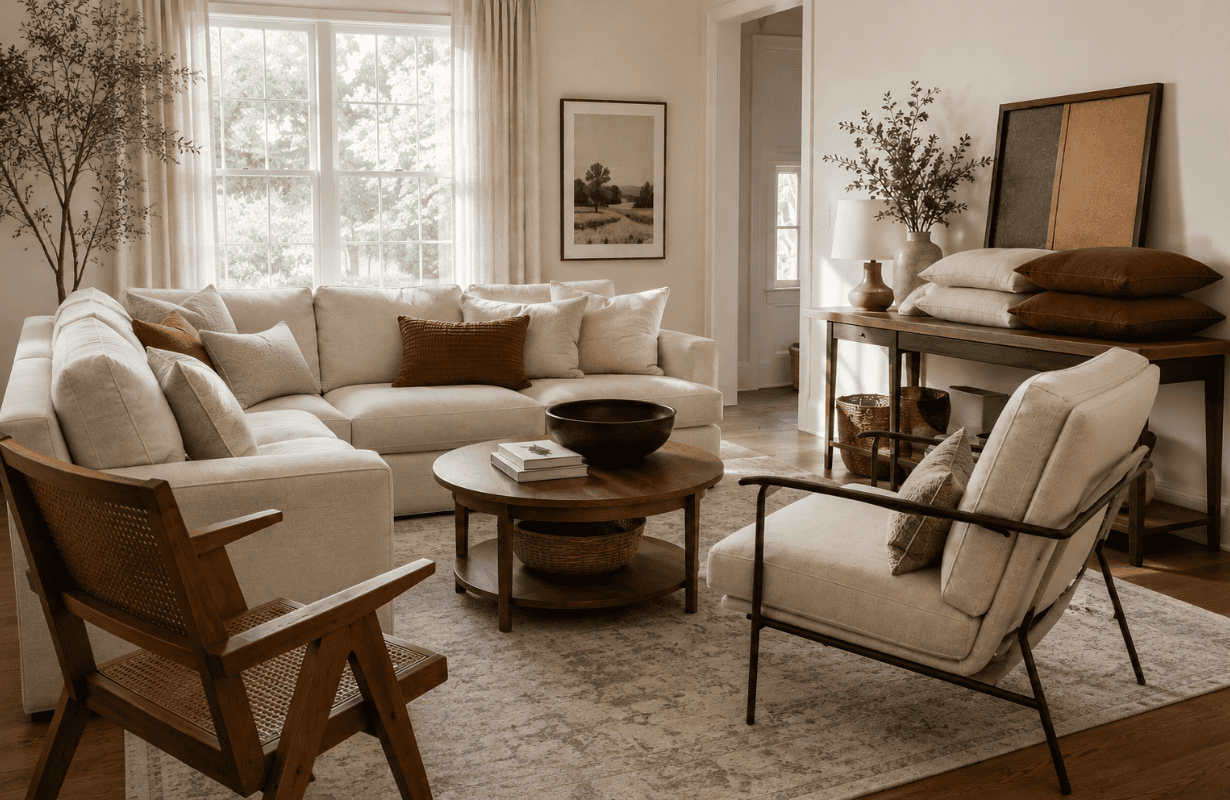
You buy a sofa you genuinely love. A few months later, you find a vintage side table that’s too good to pass up. Then there’s the modern media console, the traditional armchair you already owned, and maybe a coffee table that doesn’t seem to belong to any particular style at all.
Suddenly, your living room feels less “collected” and more like a furniture store clearance section.
If that sounds familiar, the problem usually isn’t that your furniture styles are too different. It’s that there isn’t enough connecting them visually.
Here’s the thing: learning how to mix different furniture styles in one living room isn’t about finding pieces that match. In fact, rooms where everything comes from the same collection can feel surprisingly flat. The goal is to make different pieces look like they were chosen intentionally.
That comes down to repetition, proportion, color, materials, and knowing which pieces should lead the room.
Let’s get into how I’d actually approach it.
Why Mixed Furniture Styles Sometimes Look Wrong
Before changing anything, it helps to understand why a room can feel disconnected.
Usually, the problem isn’t simply “too many styles.”
Every Piece Is Competing for Attention
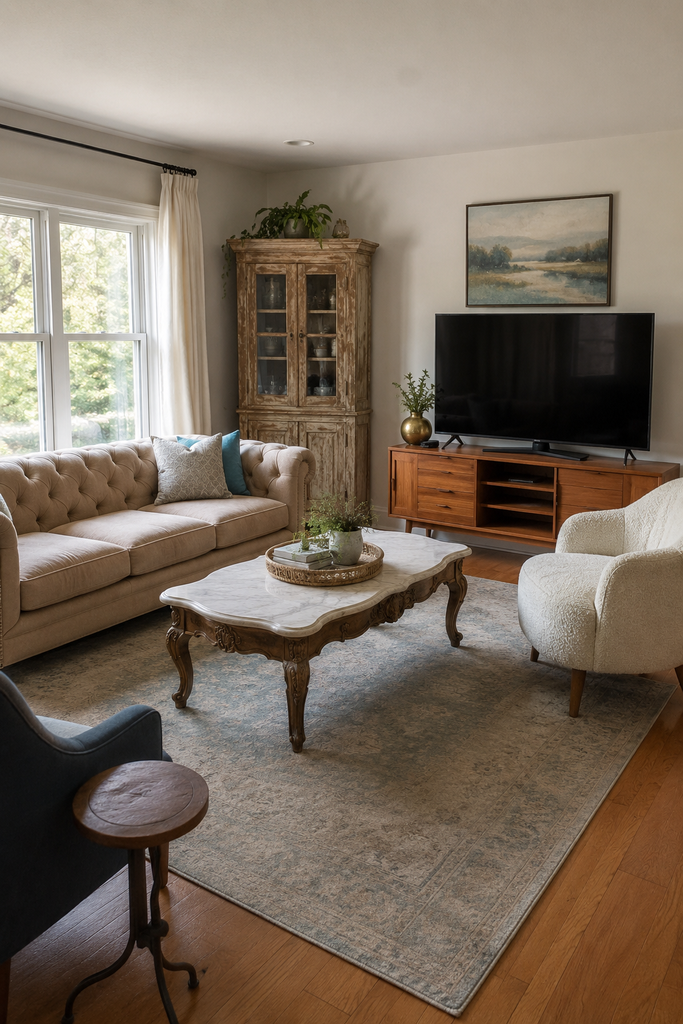
Imagine a tufted Chesterfield sofa, an ornate French coffee table, a mid-century credenza, a boucle accent chair, and a very rustic farmhouse cabinet.
Individually? Great pieces.
Together? Possibly exhausting.
When every major item has a strong personality, your eye doesn’t know where to settle.
A mixed-style living room still needs quieter pieces. If your sofa has dramatic tufting, for example, pairing it with a relatively simple coffee table gives it some breathing room.
Think of furniture as having different visual volumes. Not everything should be turned up to ten.
There’s Nothing Connecting the Styles
You can absolutely put a vintage chair beside a contemporary sofa.
But give them something in common.
Maybe the chair’s warm walnut frame relates to the wood coffee table. Perhaps its cream upholstery connects with the sofa pillows. Maybe both pieces have similarly curved silhouettes.
Those small connections are what make an eclectic room feel intentional rather than accidental.
Start With One Dominant Style
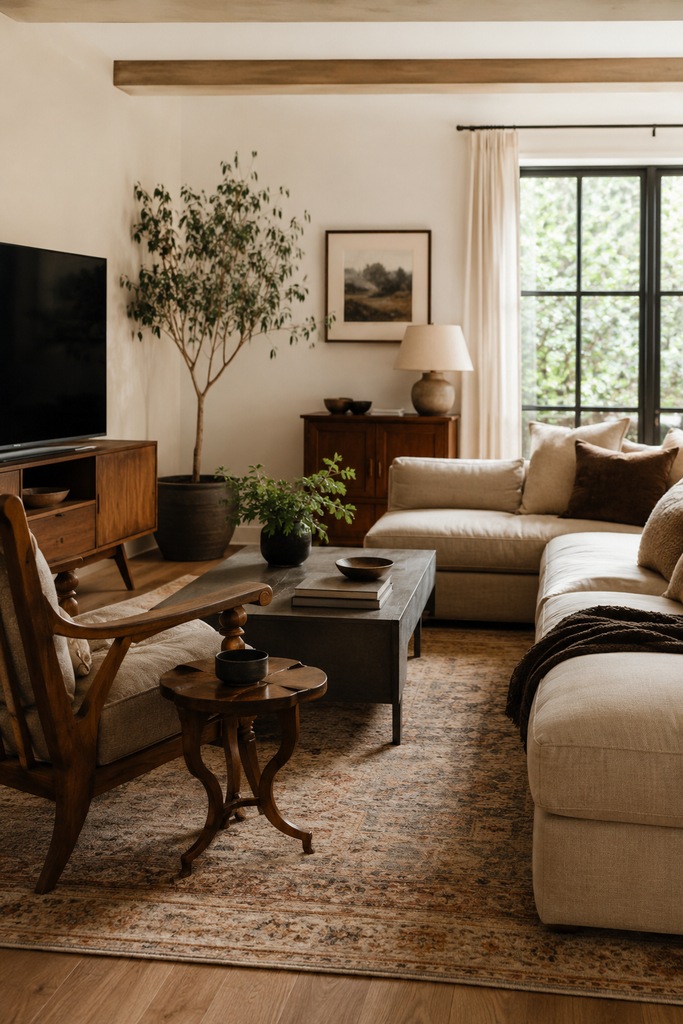
One of the easiest ways to mix furniture styles successfully is to avoid giving every style equal weight.
Choose one style to form the foundation of the room.
Maybe your living room is roughly:
- 60–70% contemporary
- 20–30% vintage or traditional
- 10% something unexpected
You don’t need to calculate percentages while shopping. The point is simply to establish a visual hierarchy.
If you already have a clean-lined modern sofa, simple media cabinet, and contemporary rug, you’ve established your base. Now an antique side table or traditional armchair becomes an interesting contrast instead of something you need to “fix.”
This is especially useful if you’re slowly decorating rather than buying everything at once.
Build Around Your Largest Furniture First
When figuring out how to mix different furniture styles in one living room, start with the pieces that take up the most visual space.
Usually that’s your sofa, sectional, large chairs, media unit, or substantial storage furniture.
Let the Sofa Establish the Direction
Your sofa doesn’t necessarily have to determine the style of everything else, but its scale and visual weight affect almost every decision afterward.
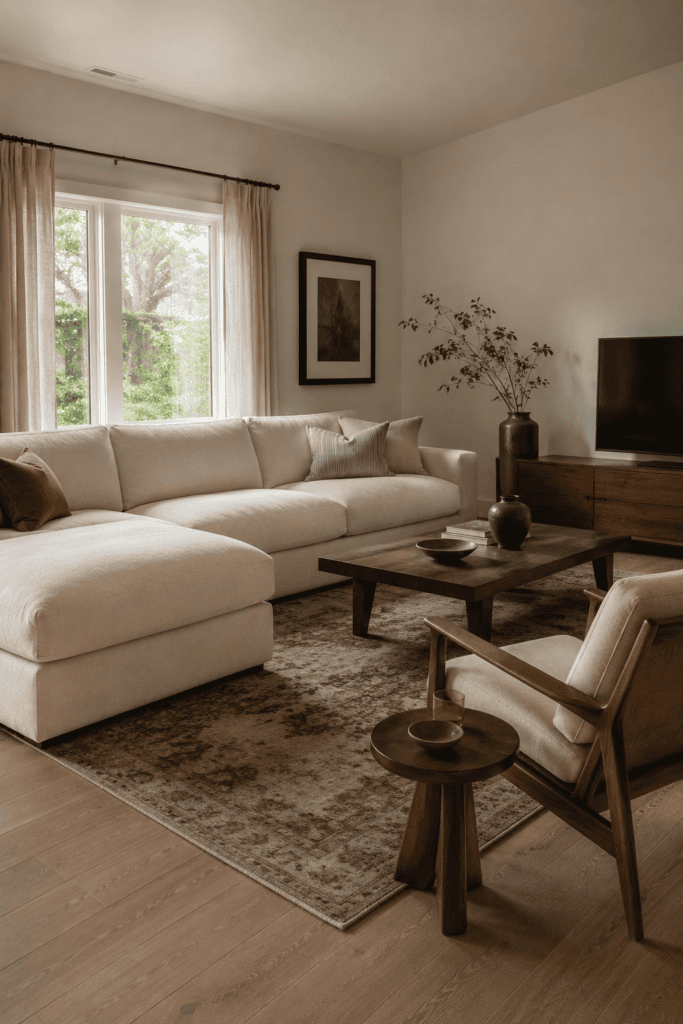
Say you have a large, low-profile contemporary sofa.
Instead of adding another equally heavy modern chair, you could introduce contrast with a lighter vintage wooden armchair.
Now you have variation in both style and visual weight.
On the other hand, if your sofa is traditional with rolled arms and a skirted base, a simple modern coffee table can stop the room from feeling overly formal.
Contrast works best when it feels deliberate.
Find a Common Color Thread
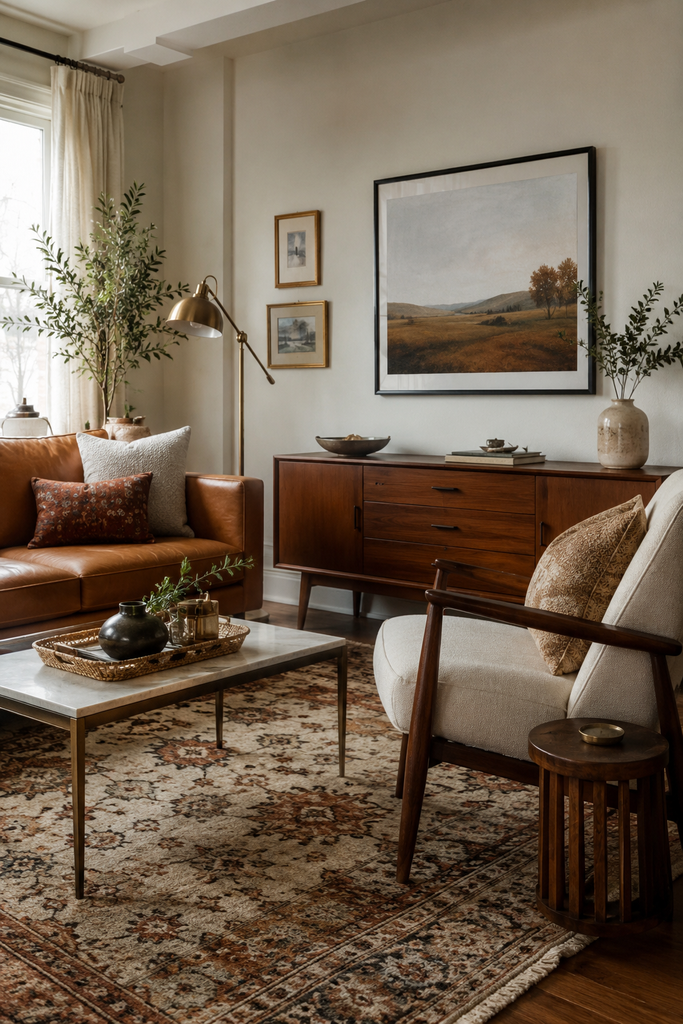
This is probably the easiest way to make mismatched furniture cooperate.
You don’t need everything to be beige—or any other single color. You simply need colors to repeat enough that the eye recognizes a pattern.
For example, imagine you have:
- a camel leather sofa
- a walnut mid-century console
- an antique brass lamp
- a cream contemporary chair
- a patterned traditional rug
At first glance, those pieces represent several styles.
But the warm brown sofa relates to the walnut. The warm metal relates to both. The cream chair picks up lighter tones from the rug.
Suddenly, the room makes sense.
Repeat Colors Instead of Matching Them Exactly
Most people get this wrong by trying to find exact matches.
You don’t need the exact same shade of brown five times.
Actually, slight variation usually looks better.
Think walnut, cognac leather, aged brass, warm oak, and tan linen rather than trying to match one specific brown throughout the entire room.
Repeated color families create cohesion without making the room feel overly coordinated.
Pay More Attention to Shape Than Style Labels
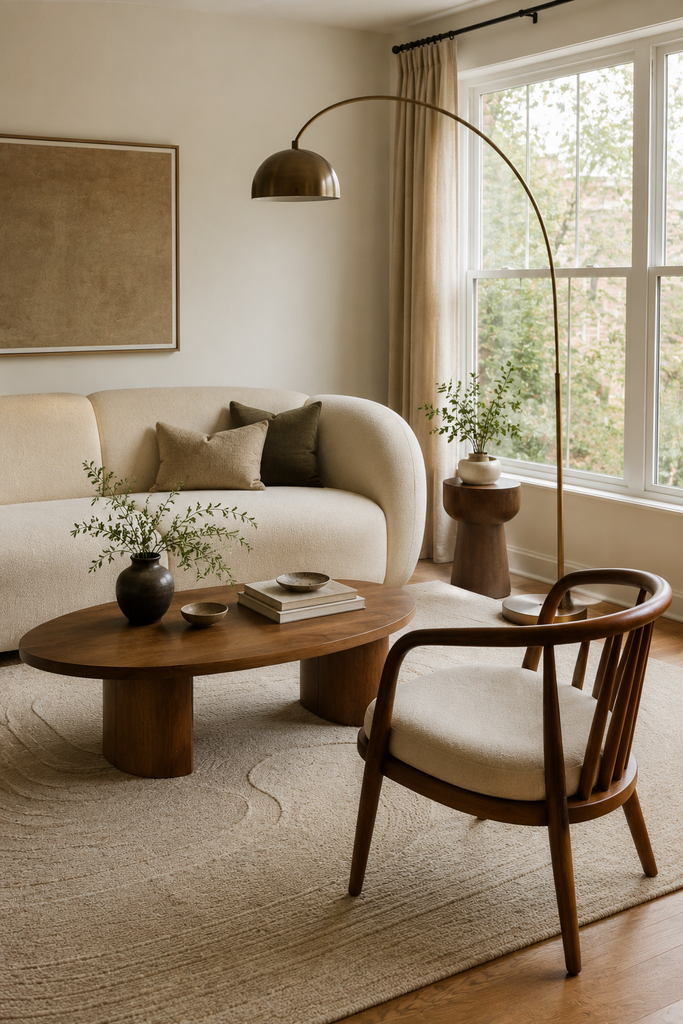
This is one of the most useful tricks when mixing furniture.
Stop asking:
“Is this mid-century or traditional?”
Start asking:
“Does this shape work with what I already have?”
Repeat Curves or Straight Lines
Suppose you have a contemporary sofa with softly rounded arms.
You could repeat those curves through:
- an oval coffee table
- a rounded vintage chair
- an arched floor lamp
Those pieces might come from completely different design periods, but the repeated curves quietly connect them.
The same principle works with straight lines.
A traditional cabinet with strong rectangular paneling can actually work beautifully beside a modern boxy sofa because their underlying geometry relates.
Style labels matter less than people think.
Mix Wood Tones Instead of Trying to Match Them
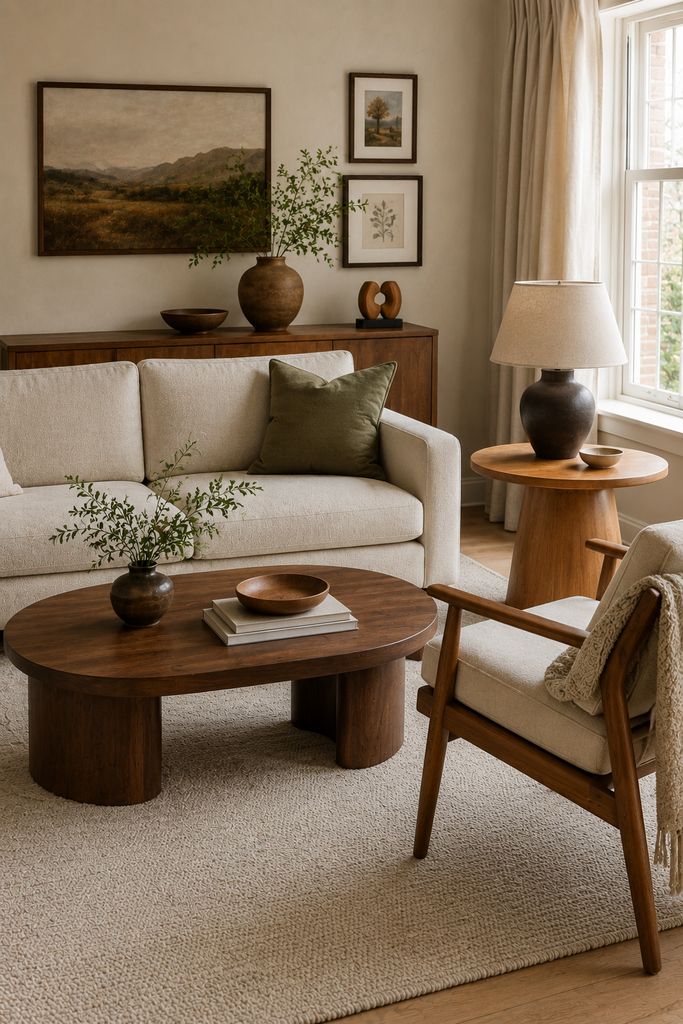
A common mistake is assuming all wood furniture in the living room needs to be the same finish.
It doesn’t.
In fact, matching every wood tone can make a room look like you bought a complete furniture set.
What actually works is creating repetition.
If you have a walnut coffee table, for instance, you don’t necessarily need walnut side tables. You could use medium oak, then repeat the darker walnut somewhere smaller—perhaps a picture frame, chair legs, or decorative box.
Watch the Undertones
The bigger issue is usually undertone rather than darkness.
Warm woods with golden, reddish, or brown undertones generally cooperate easily. Cooler gray-washed woods can work too, but introducing one random cool-gray piece into an otherwise warm room can feel awkward.
When possible, keep your wood finishes within a reasonably compatible temperature.
They can still vary significantly from light to dark.
Use Textiles to Bridge Different Furniture Styles
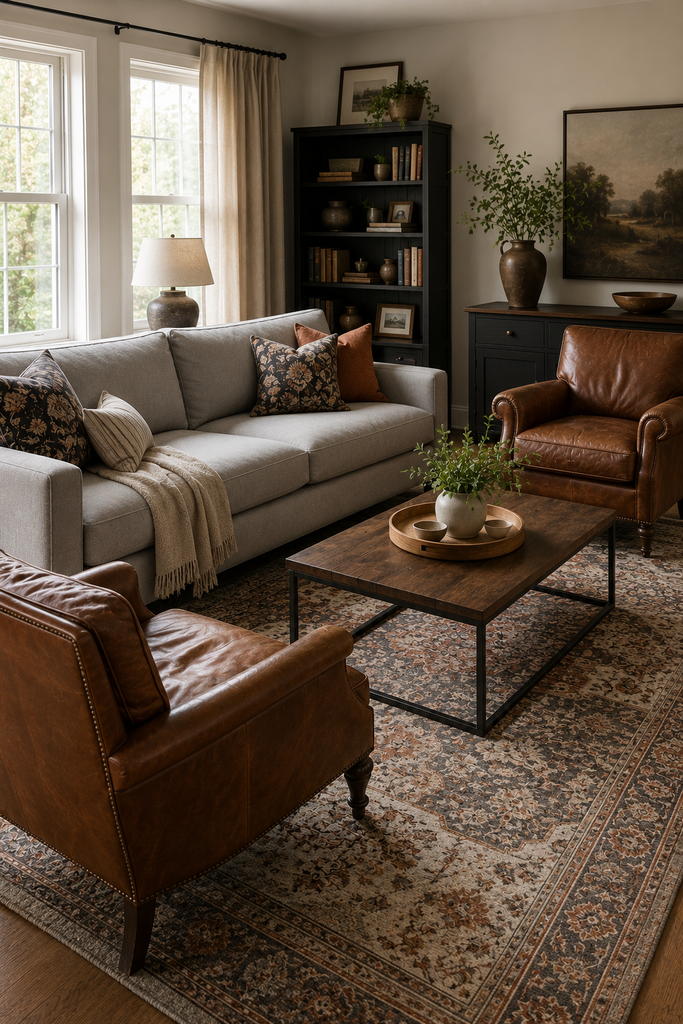
If your room already contains several furniture styles and replacing things isn’t realistic, textiles are your best friend.
A rug can connect furniture that otherwise feels unrelated.
Say you’ve got a modern gray sofa and two vintage brown leather chairs. A patterned rug containing gray, cream, rust, and brown can visually pull everything together.
Now those furniture colors don’t look random—they look like part of the room’s palette.
Pillows and throws can do the same thing on a smaller scale.
Just don’t go overboard trying to “tie everything together” with twenty decorative pillows. A few strategic repetitions are enough.
Balance Visual Weight Around the Room
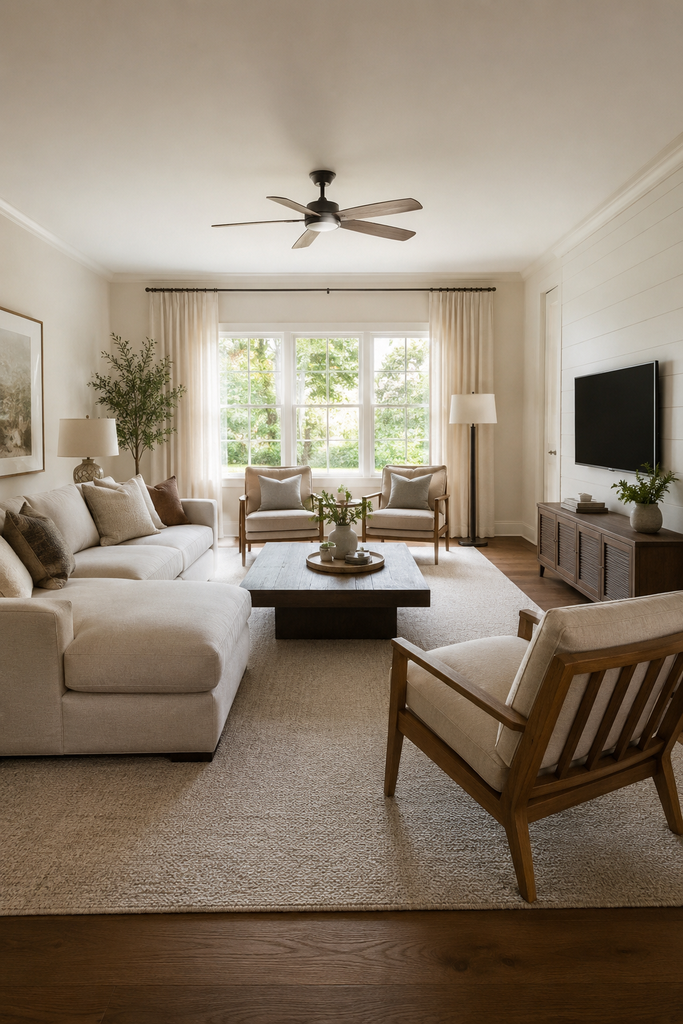
Furniture can match beautifully in color and still make a room feel wrong because the visual weight is uneven.
Imagine a huge sectional occupying one side of the room and one tiny accent chair sitting opposite it.
Technically, the styles might work.
Spatially, something feels off.
Look at Height, Mass, and Leg Style
Furniture with exposed legs generally feels lighter. Furniture sitting directly on the floor feels heavier.
Dark pieces often carry more visual weight than light ones.
Tall cabinets naturally command more attention than low consoles.
Try distributing those characteristics around the room.
For example, if you have a chunky sofa, a substantial coffee table may balance it better than a tiny delicate table. You can then introduce lighter furniture through side tables or an open-frame chair.
You’re not matching styles—you’re balancing mass.
Add One Unexpected Piece
Rooms become much more interesting when something doesn’t quite follow the formula.
Maybe your mostly modern living room gets an antique carved side table.
A traditional space could get a sculptural contemporary lamp.
A mid-century room might have one relaxed slipcovered chair.
That little bit of friction is often what makes the room feel personal.
The key word is one.
If you’re introducing five unrelated statement pieces, you’re back to everything competing for attention.
Let unusual pieces actually be unusual.
A Step-by-Step Way to Mix Furniture You Already Own
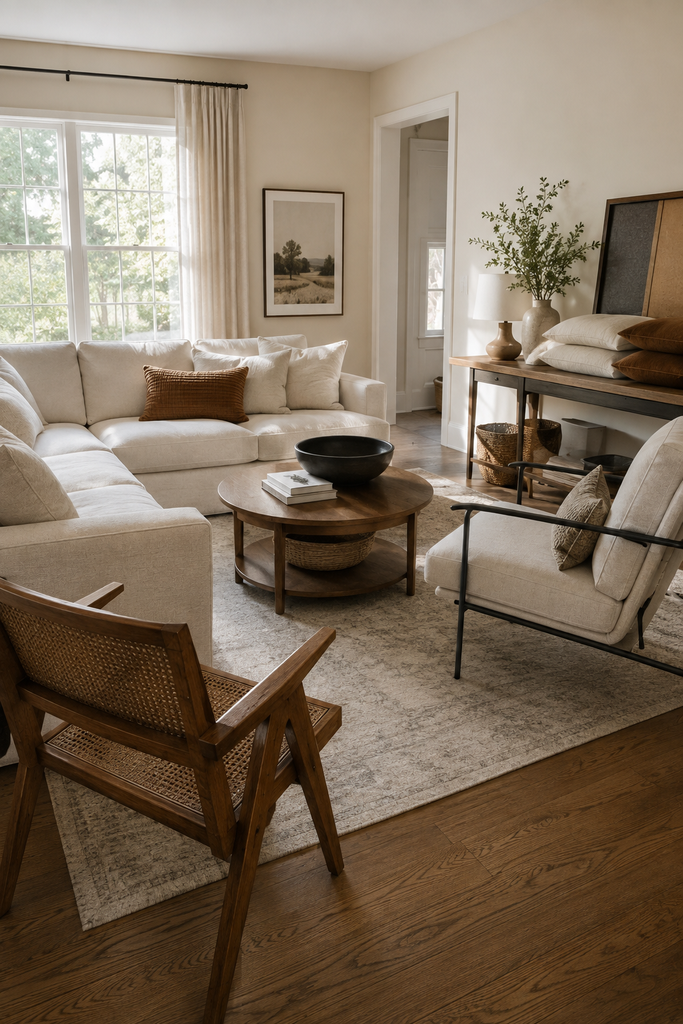
You don’t need to start over. If your living room currently feels mismatched, I’d work through it in this order.
Step 1: Identify Your Anchor Pieces
Choose the two or three largest or most important pieces that are definitely staying.
Usually this means your sofa plus another major item.
Ignore accessories for now.
Step 2: Decide Which Style Is Dominant
Look at those anchor pieces and the architecture of your home.
Ask yourself which overall direction already feels strongest: modern, traditional, transitional, farmhouse, mid-century, coastal, vintage, or something else.
That’s your foundation—not a rule you have to follow perfectly.
Step 3: Find Three Repeating Elements
Look for connections you can deliberately repeat.
They might be:
- warm wood
- black metal
- curved shapes
- cream upholstery
- brass finishes
- a particular accent color
Three repeating visual ideas are often enough to make a surprisingly mixed room feel cohesive.
Step 4: Check Your Furniture Scale
Stand in the doorway and look at the room as a whole.
Does one side feel significantly heavier?
Is your coffee table too delicate compared with your sofa?
Are all your furniture pieces roughly the same height?
Correcting proportion can improve the room more dramatically than buying something in the “right” style.
Step 5: Add the Rug and Textiles
Once the furniture arrangement works, use the rug, curtains, pillows, and throws to reinforce your palette.
This is where separate styles start visually becoming one room.
Step 6: Add Accessories Last
Don’t use accessories to rescue furniture that isn’t working together yet.
Get the major pieces right first.
Then add lamps, artwork, books, ceramics, trays, and smaller objects that repeat the colors and materials already established.
Common Mistakes to Avoid
The biggest mistake is trying too hard to make everything match.
Another is going in the opposite direction and assuming an “eclectic” room means anything goes.
Good mixed-style rooms sit somewhere in between.
You want repetition without duplication, contrast without chaos, and enough consistency that your eye understands the room.
Also, don’t introduce a furniture style only once unless you’re intentionally creating a statement. If you bring in an industrial black-metal coffee table, for example, repeating black metal in a lamp or small side table makes that choice feel much more deliberate.
And don’t underestimate negative space. Sometimes the piece making your living room feel chaotic isn’t the wrong piece—there are simply too many pieces.
Putting It All Together
Learning how to mix different furniture styles in one living room gets much easier once you stop trying to make every piece match.
Start with a dominant direction, let your biggest furniture establish the room, and then create connections through color, wood tones, shapes, materials, and scale. Those repeated details are what allow a modern sofa, vintage chair, traditional rug, and contemporary coffee table to live together without looking random.
And don’t be afraid of a little contrast. That’s usually where the personality comes from.
If your living room currently feels mismatched, don’t immediately start replacing furniture. Remove a few accessories, identify your strongest pieces, and look for the visual threads already connecting them. You may be much closer to a cohesive room than you think.