
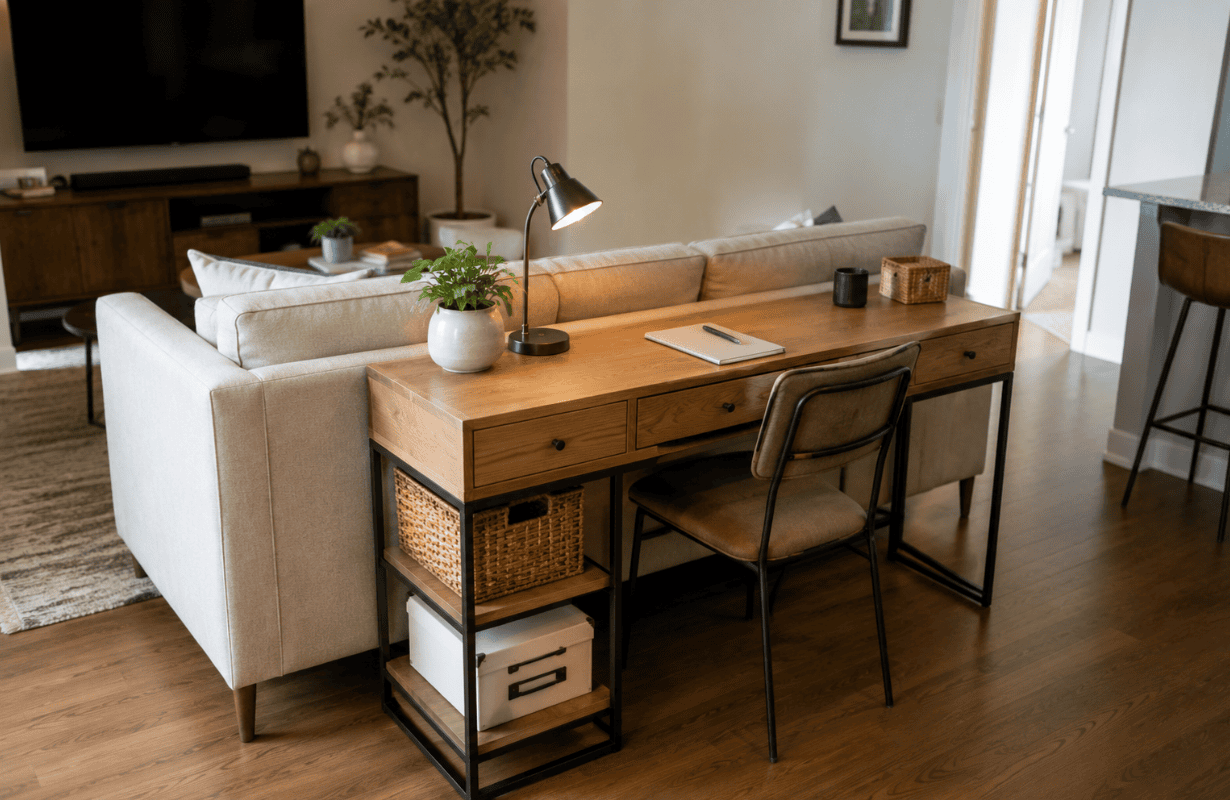
When your sofa floats in the middle of the room instead of sitting neatly against a wall, the space behind it can feel surprisingly awkward. You finally get the furniture layout right, but then you turn around and realize there’s just… a big empty strip behind the couch.
I’ve seen people solve this by immediately pushing a console table behind the sofa and covering it with lamps, baskets, books, and decor. Sometimes that works. Sometimes it makes the entire room feel more crowded than it did before.
Here’s the thing: how to decorate behind a sofa that isn’t against a wall depends less on filling the empty space and more on understanding what that space needs to do.
In an open-concept living room, the back of your sofa might need to create a visual boundary. In a small room, it may need to stay completely clear for circulation. And in another layout, that little area could become useful storage, a workspace, or even extra seating.
The goal isn’t to decorate every inch. It’s to make the floating sofa look intentional.
First, Figure Out Why Your Sofa Is Floating
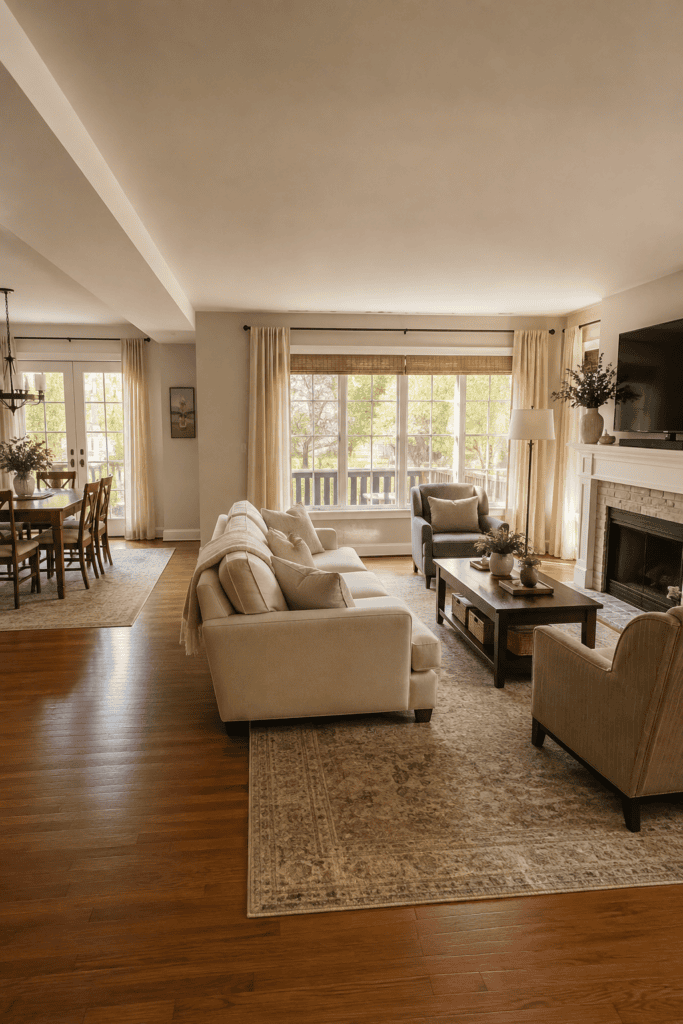
Before buying anything for the space behind your couch, look at the overall furniture arrangement.
A floating sofa usually works because it creates a better conversation area, faces a fireplace or TV correctly, or separates the living room from another part of an open floor plan.
That means the empty area behind it isn’t necessarily a problem.
Think About the Room From Both Directions
When a sofa sits against a wall, you mostly see its front and sides. Once it floats, the back becomes part of the room.
Walk into the space from your kitchen, dining room, hallway, or entryway. What do you see?
If you’re looking directly at a large upholstered sofa back, adding something behind it can help soften that view. But if the sofa already has a beautiful low-profile back and the room feels open, leaving it alone might actually look better.
Most people get this wrong because they start decorating the empty spot before deciding whether it needs anything.
Use a Console Table When You Need Definition
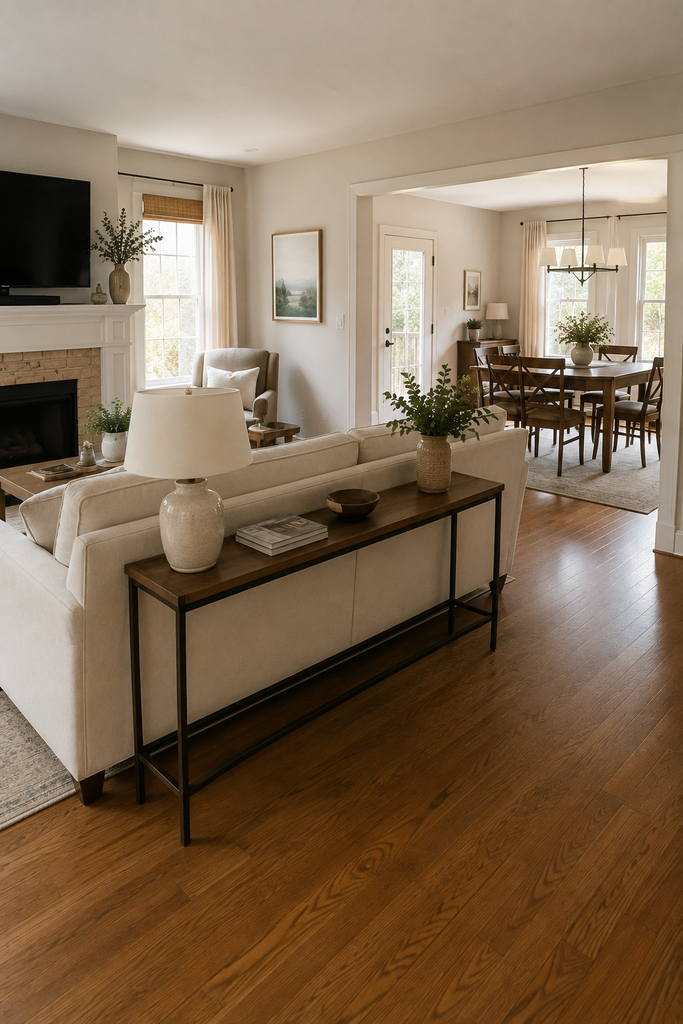
There’s a reason sofa tables are such a common solution: they create a transition between spaces without building an actual wall.
This is especially useful in open-concept homes.
For example, imagine a living room that opens directly into a dining area. A console behind the sofa creates a subtle stopping point. The living room visually ends at the table, while the dining space begins on the other side.
Get the Proportions Right
The table should generally be lower than, or roughly level with, the sofa back. A console sticking several inches above a low sofa can create a strange visual barrier.
Length matters too.
You don’t necessarily need a console that spans the entire couch. Something around two-thirds to three-quarters of the sofa’s width often feels balanced without looking overly matched.
Depth is particularly important in smaller rooms. A narrow console around 10–14 inches deep can provide a useful surface without eating up your walkway.
Don’t Turn the Console Into a Display Shelf
Once people have a long empty surface, there’s a temptation to decorate every inch.
Resist it.
A lamp, a small stack of books, a decorative bowl, or one simple plant may be enough. You want a few objects with different heights rather than ten tiny accessories lined up across the table.
The console should make the sofa look finished, not create another area you have to constantly declutter.
Make the Space Behind the Sofa Functional
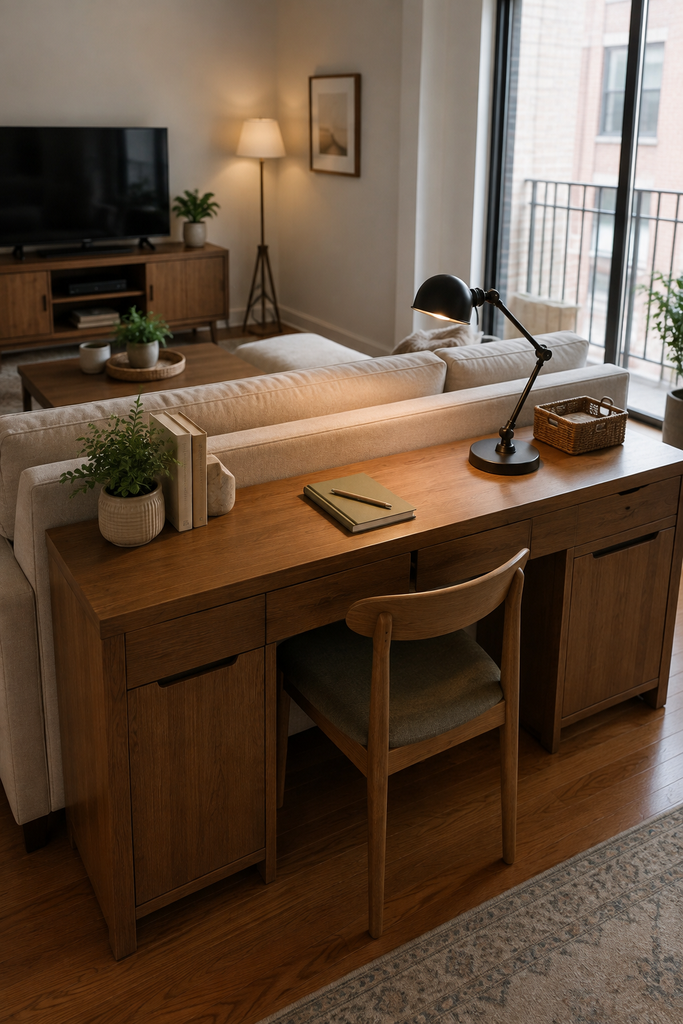
What actually works is asking yourself whether the area could solve another problem in the room.
If your home is short on usable space, the back of a floating sofa can do much more than hold decorative objects.
Create a Small Work Zone
A slim desk or console-height table behind the sofa can double as a compact workspace.
This works particularly well in apartments where you don’t have a dedicated home office. Add a chair that tucks completely underneath when you’re finished, and the setup takes up surprisingly little visual space.
The important part is maintaining enough room behind the chair to comfortably pull it out.
If squeezing in a desk means everyone has to turn sideways to walk through the room, it isn’t worth it.
Add Hidden Storage
Closed storage can also work beautifully behind a sofa.
Instead of a traditional open console, consider a shallow cabinet with doors or drawers. You can use it for board games, chargers, extra candles, paperwork, or all those random living room items that never seem to have a home.
Closed storage usually looks calmer than open shelving because you aren’t staring at the contents from the neighboring room.
In a small home, that’s a much better use of the footprint than adding furniture purely for decoration.
Try Extra Seating Behind the Sofa
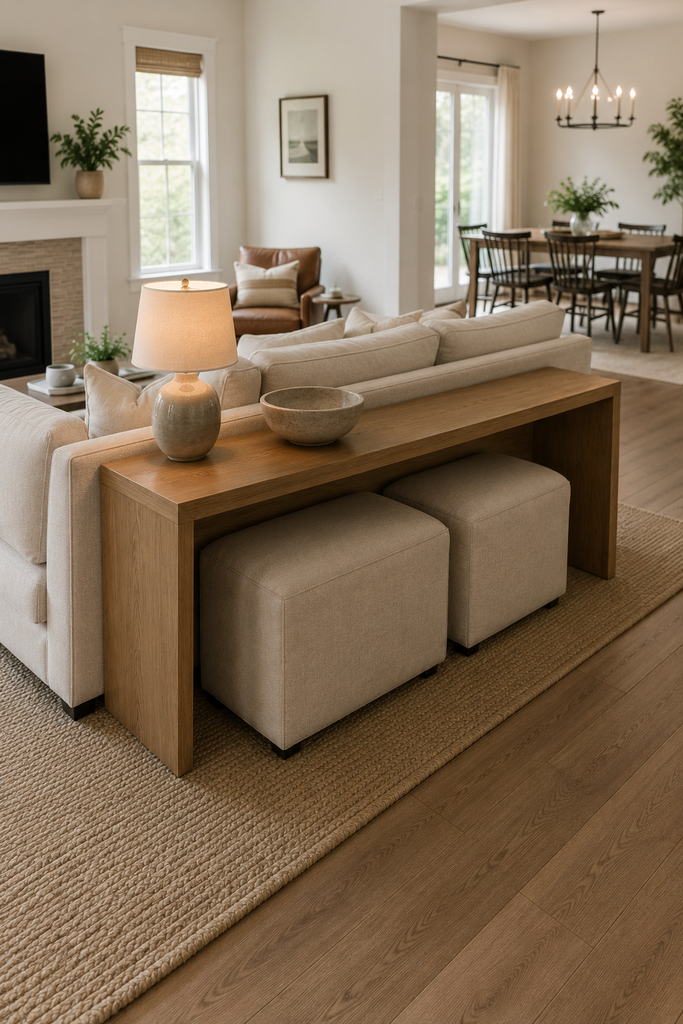
This is one of my favorite options when you have enough room.
Instead of putting a decorative console behind the sofa, use a pair of compact stools, ottomans, or benches.
You gain extra seating without permanently crowding the main conversation area.
Tuck Seating Under a Console
A narrow console with two stools tucked beneath it is particularly practical.
Most days, the stools disappear visually. When guests come over, pull them into the living room.
This also fills the space underneath the console, which can otherwise look a little empty when viewed from behind.
Choose stools or ottomans that are fully or mostly able to tuck underneath. If they’re sticking halfway into the walkway all the time, the setup becomes annoying fast.
Use the Sofa to Divide an Open Floor Plan
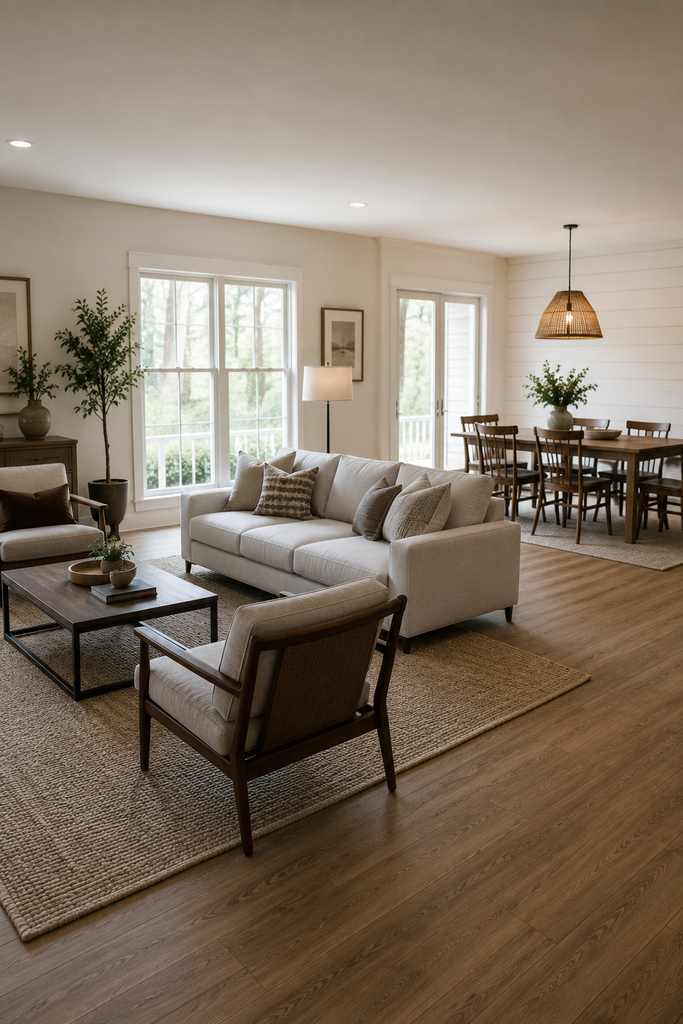
If your couch backs onto a dining room, kitchen, or entryway, think of it as a room divider.
You don’t necessarily need another piece of furniture behind it.
Sometimes the sofa itself provides exactly enough separation.
Let the Rug Reinforce the Living Zone
A properly sized area rug underneath the living room furniture can make the floating sofa feel much more intentional.
Ideally, the front legs of the sofa and surrounding chairs should have a clear relationship with the rug rather than everything looking like separate furniture islands.
Now you have two boundaries working together: the sofa creates one edge of the seating area, while the rug visually connects everything inside it.
That’s often enough.
Use Lighting to Strengthen the Layout
Lighting can reinforce these invisible zones too.
A pendant over the dining table clearly identifies the dining area. A floor lamp beside the sofa anchors the living area.
This sounds like a small detail, but open layouts often feel confusing because there aren’t enough visual cues telling your eye where one space ends and another begins.
Furniture, rugs, and lighting can do that job without adding walls.
Pay Attention to Walkway Space
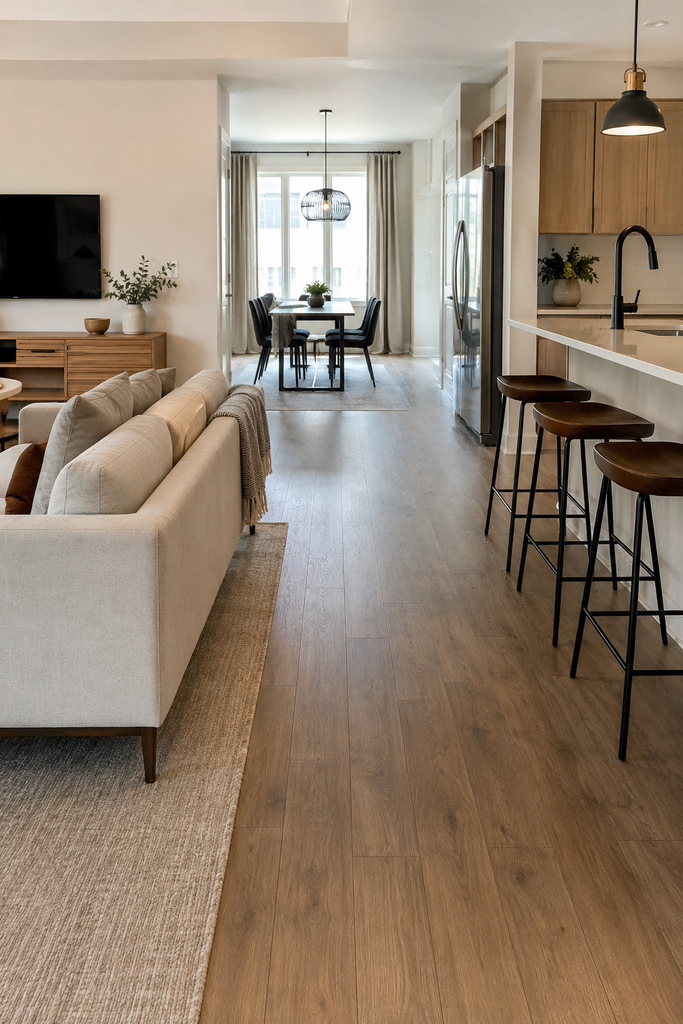
This is probably the least exciting part of decorating behind a floating sofa, but it’s one of the most important.
Don’t sacrifice circulation just because Pinterest convinced you that every sofa needs a console behind it.
Protect Your Main Traffic Paths
A comfortable main walkway generally needs roughly 30–36 inches of clearance, with more space being preferable in heavily traveled areas.
So let’s say you currently have 38 inches between your sofa and kitchen island.
Adding a 12-inch-deep console leaves only 26 inches.
Technically, you can probably walk through it. But you’ll notice that squeeze every single day.
In that situation, leaving the sofa back exposed is the better design decision.
Good rooms aren’t just attractive when photographed. They’re easy to move through.
Decorate the Floor Instead of the Sofa Back
If you want the area behind the couch to feel intentional but don’t have room for another large piece of furniture, work with smaller floor-level elements.
A tall plant positioned near one corner can soften the transition without blocking circulation.
A large basket beside the sofa can hold blankets while visually filling an awkward gap.
A floor lamp can add height and make the seating arrangement feel anchored.
The trick is to avoid creating a row of objects directly behind the couch. One strong element usually looks much more deliberate than several small ones.
Common Mistakes When Decorating Behind a Floating Sofa
The biggest mistake is assuming empty space equals unfinished space.
It doesn’t.
Using Furniture That’s Too Deep
A gorgeous 18-inch-deep console isn’t gorgeous anymore when everyone keeps bumping into it.
Measure your available space before shopping, and measure the actual walking area that will remain afterward.
Choosing Something Taller Than the Sofa
Very tall cabinets or bulky shelving immediately behind a sofa can make the seating area feel boxed in.
If you need substantial storage, it usually works better farther away from the couch rather than pressed directly against its back.
Adding Too Many Small Decorations
A floating sofa already creates several visual lines in a room. Covering the console behind it with frames, candles, books, plants, bowls, sculptures, and lamps adds even more.
Go bigger and simpler.
Ignoring Electrical Cords
This one gets overlooked constantly.
If you’re adding lamps or a charging station to a floating console, figure out where those cords will go before setting everything up.
A beautiful table with a black extension cord stretching across the walkway isn’t exactly the finished look we’re going for.
A Simple Step-by-Step Approach That Actually Works
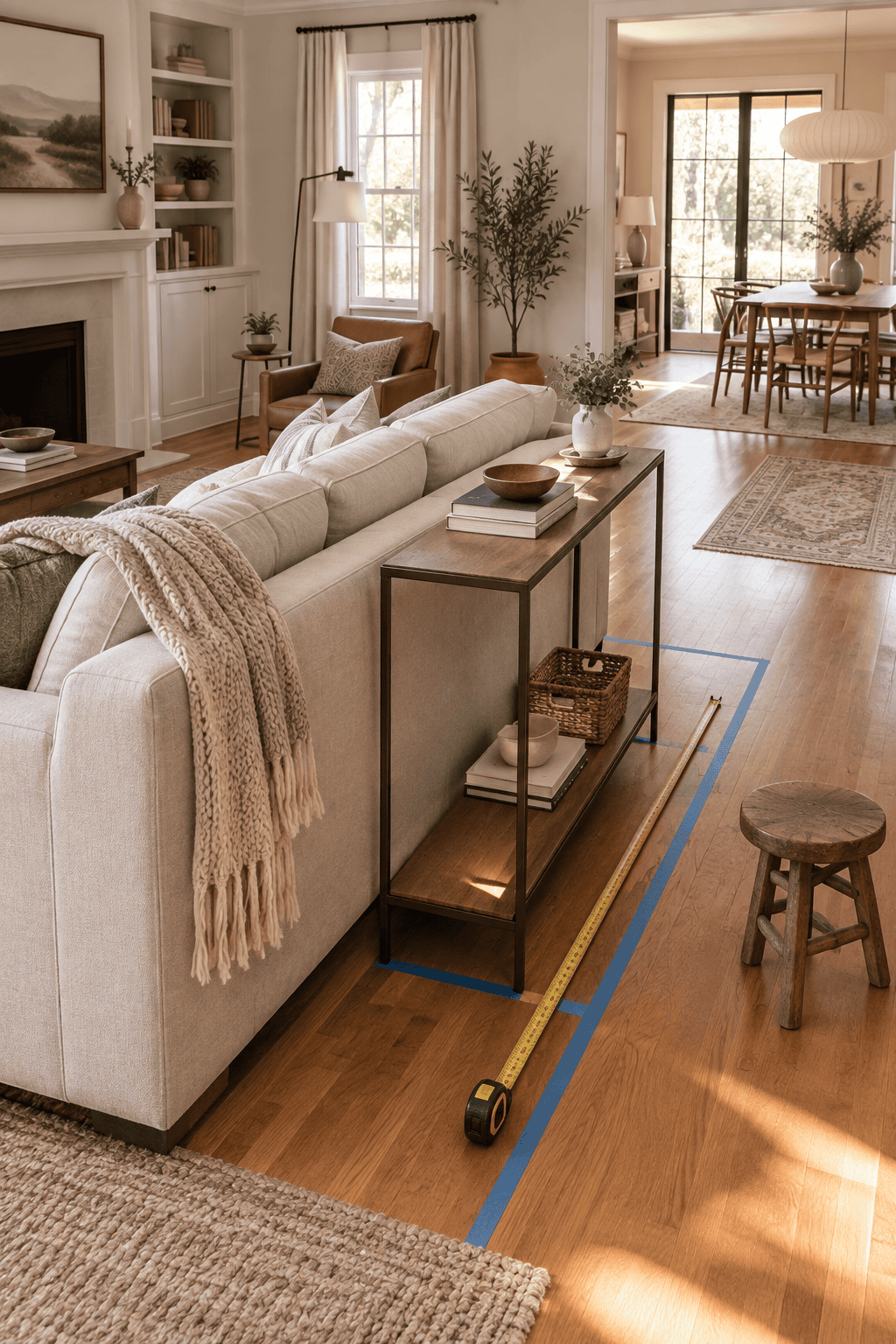
If you’re staring at the back of your sofa wondering what to put there, don’t start shopping yet.
First, measure the distance from the sofa to the next wall, cabinet, table, or traffic path. Determine how much clearance you actually have.
Next, decide what the space needs most.
If you need visual separation, try a slim console.
If you need storage, look for a shallow closed cabinet.
If you need a workspace, consider a console-style desk with a tuck-under chair.
If you entertain frequently, stools underneath a console might be more useful.
And if you need every inch of walkway?
Leave it empty.
Finally, look at the sofa from the adjoining space. You may discover that one plant, a floor lamp, or simply a well-styled sofa is enough.
The Best Behind-the-Sofa Setup Is Usually the Simplest One
Learning how to decorate behind a sofa that isn’t against a wall isn’t really about finding the perfect console table. It’s about making the floating layout feel purposeful.
Start with circulation. Then think about function. Decoration comes last.
If you have plenty of room, a narrow console, hidden storage, a small workspace, or tuck-away seating can make that unused area genuinely useful. If space is tight, don’t force another piece of furniture into the layout just because the sofa isn’t touching a wall.
Sometimes the most polished solution is surprisingly simple: a good rug, thoughtful lighting, one plant, and enough breathing room around the couch.