
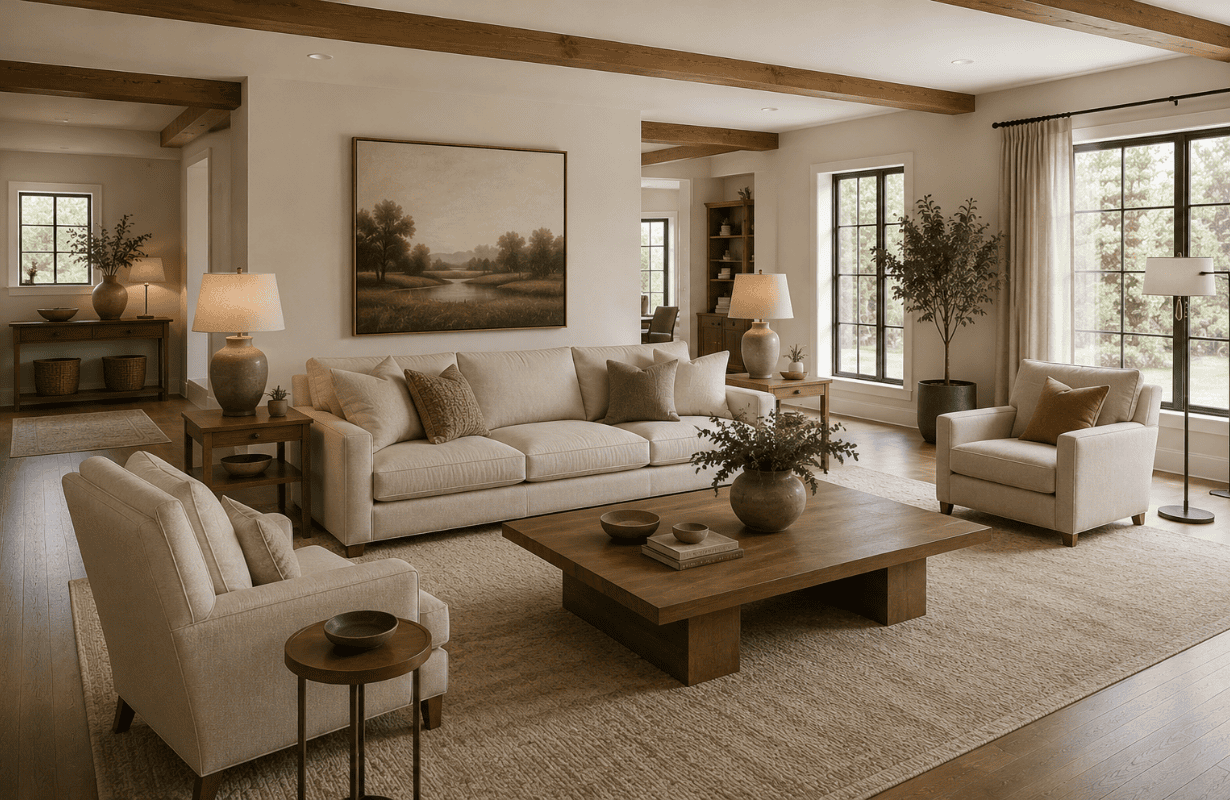
A large living room sounds like a decorating dream until you actually have to furnish one. Suddenly, the sofa looks strangely small, the coffee table feels like it’s floating in the middle of nowhere, and there’s an awkward stretch of empty floor that you have no idea what to do with.
The temptation is usually to start filling space. Bigger sectional. More chairs. Another console. Maybe a giant piece of art.
But here’s the thing: making a large living room feel cozy and connected isn’t really about filling it. It’s about giving the space structure.
Large rooms often feel uncomfortable because the furniture doesn’t relate to each other. Pieces are pushed too far apart, everything hugs the walls, or the room has no obvious place where people naturally want to gather.
What actually works is creating smaller visual relationships inside the larger room conversation areas, repeated materials, properly scaled rugs, layered lighting, and intentional pathways.
If your living room currently feels more like a furniture showroom than somewhere you want to curl up for the evening, these are the changes I’d make first.
Why Large Living Rooms Often Feel Cold and Disconnected
Most people get this wrong because they assume empty space is the problem.
It usually isn’t.
The bigger problem is distance.
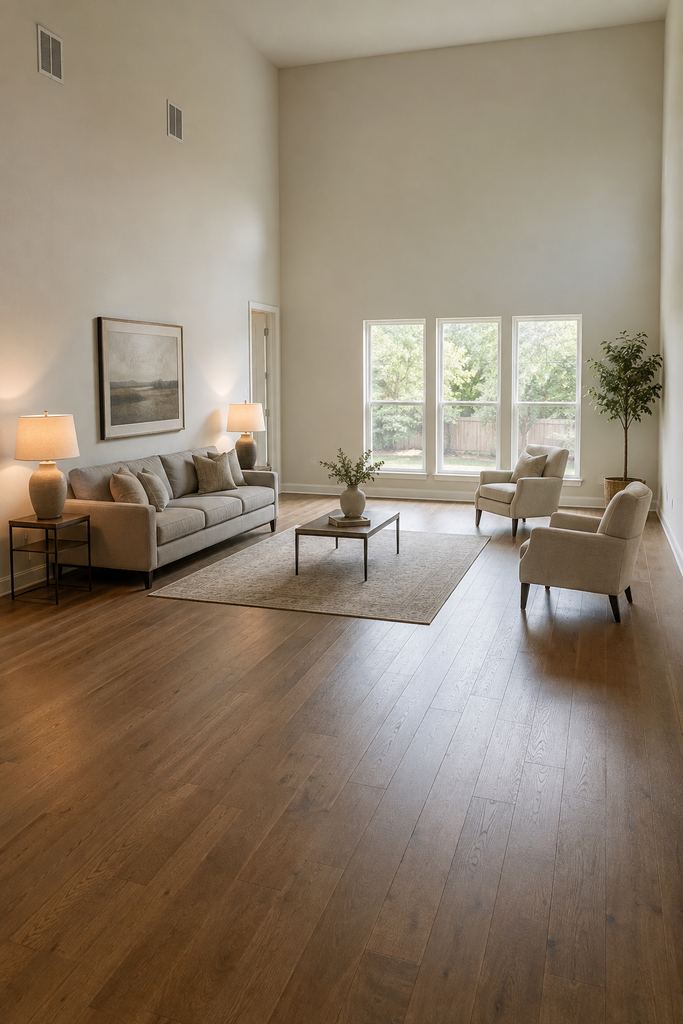
Imagine a sofa sitting against one wall with two chairs pushed against the opposite wall 14 feet away. Technically, you’ve furnished the room. Functionally, nobody sitting there feels like they’re part of the same conversation.
Large rooms exaggerate gaps between furniture.
They also make undersized pieces look even smaller. A 5-by-7-foot rug that worked perfectly well in an apartment can look like a bath mat in a spacious family room.
Before buying more furniture, look at the relationships between the pieces you already have.
Ask yourself:
- Can people comfortably talk from the main seats?
- Does the rug visually connect the seating?
- Is there an obvious focal point?
- Are there huge empty gaps between pieces?
- Does every piece look like it belongs to the same overall room?
Those questions will tell you far more than simply asking whether the room needs more furniture.
Stop Pushing Everything Against the Walls
This is probably the biggest mistake I see in oversized living rooms.
There’s plenty of floor space, so every piece gets pushed outward toward the perimeter. The result is a giant empty area in the middle with furniture orbiting around it.
Instead, float your furniture inward.
Create a Real Conversation Area
Pull the sofa away from the wall and bring chairs closer to it. Arrange the main seating around a coffee table, fireplace, television, or another natural focal point.
You might end up with three or four feet of unused space behind the sofa.
That’s completely fine.
In fact, that space can become useful. Add a narrow console table behind the sofa, create a walkway, place a floor lamp there, or simply leave it open.
Furniture does not need to touch a wall to look intentional.
A large living room usually becomes noticeably cozier the moment the seating starts relating to itself instead of the architecture around it.
Divide the Room Into Smaller Functional Zones
One huge room trying to perform one function often feels empty.
Instead, think of your living room as several smaller areas that happen to share the same space.
Start With the Main Seating Zone
Your primary conversation area should be the visual anchor.
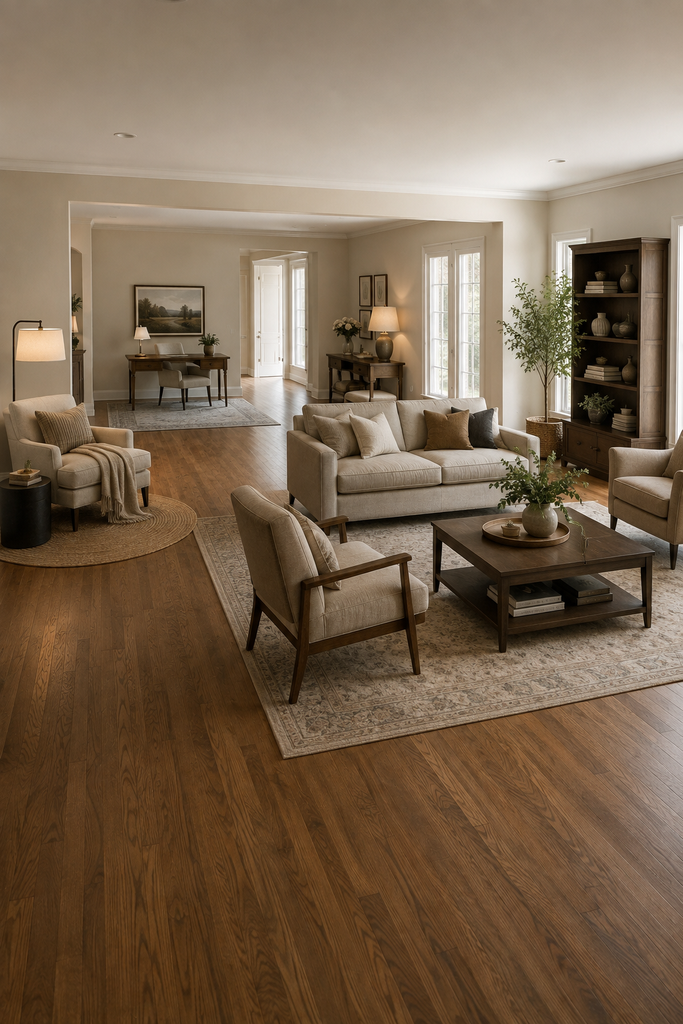
For example, you might have a sofa facing two substantial chairs with a large coffee table in the center. A properly sized rug underneath establishes the boundaries of that area.
Then look at the leftover space.
Maybe one corner becomes a reading area with a comfortable chair, floor lamp, and small side table.
Another section could hold a game table, writing desk, piano, or small secondary conversation area.
The important part is that every zone needs a reason to exist.
Don’t put two random chairs in an empty corner just because the corner looks empty. If nobody would realistically sit there, it will still feel like filler.
Use a Large Rug to Pull the Seating Together
If there’s one purchase that can completely change an oversized living room, it’s often the rug.
A rug visually tells your eye, “This furniture belongs together.”
And in a large room, that connection matters.
Don’t Let the Rug Float Under the Coffee Table
An undersized rug surrounded by large furniture actually emphasizes how big the room is.
Whenever possible, choose a rug large enough for at least the front legs of the major seating pieces to sit comfortably on it. In especially spacious rooms, having all the furniture legs on the rug can look even more grounded.
For many larger living rooms, that may mean moving beyond the common 8-by-10-foot rug and considering something closer to 9-by-12 or 10-by-14 feet, depending on your layout.
Measure your furniture arrangement first rather than buying based purely on room dimensions.
The rug needs to fit the seating zone, not simply the floor.
Choose Furniture With Enough Visual Weight
Large rooms can handle furniture that would overwhelm smaller spaces.
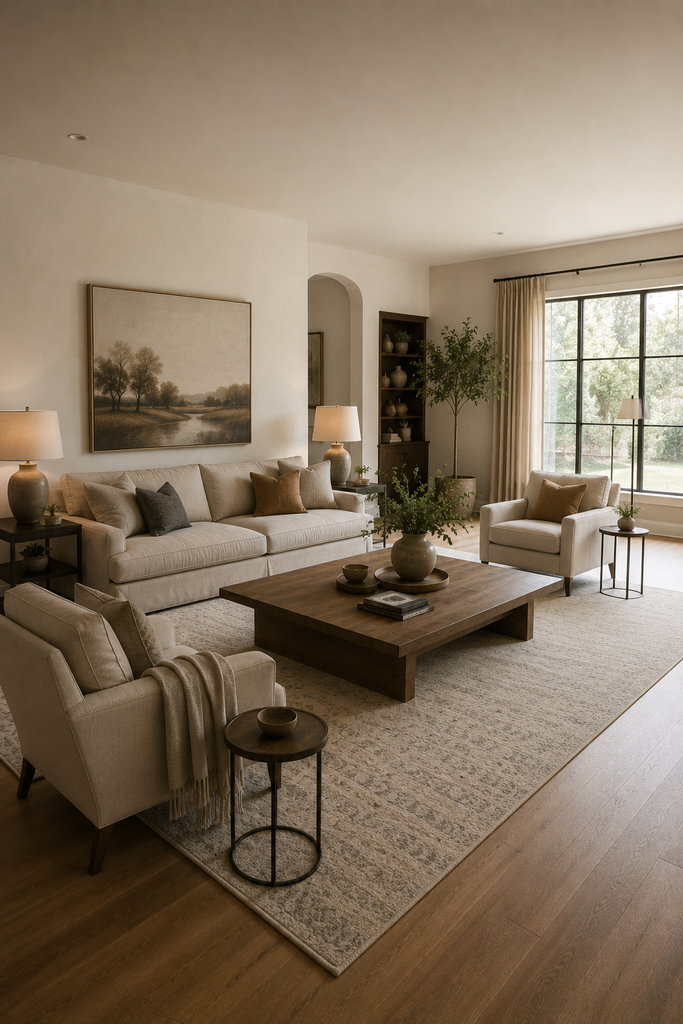
That doesn’t mean everything needs to be enormous. It means your furniture needs enough visual presence to hold its own.
A tiny coffee table surrounded by a large sectional and two substantial chairs will look accidental.
The same goes for skinny floor lamps, miniature side tables, or one small artwork floating on a huge wall.
Mix Scale Instead of Making Everything Oversized
What actually works is choosing a few substantial anchor pieces and balancing them with lighter ones.
You might use:
- A generously sized sofa or sectional
- Two substantial lounge chairs
- A large coffee table or paired coffee tables
- Smaller side tables
- One tall floor lamp
- A large piece of artwork
That creates hierarchy.
If everything is oversized, the room starts feeling bulky. If everything is small, it feels scattered.
You want a few pieces to visually say, “This is where the room begins.”
Repeat Colors and Materials Across the Entire Room
Once you’ve created multiple zones, you need something that prevents them from looking like separate rooms accidentally placed beside each other.
Repetition is the easiest solution.
Say your main seating area includes warm walnut, cream upholstery, muted olive, and aged brass.
If you create a reading corner across the room, repeat one or two of those elements there. Maybe the reading chair is olive, the side table has a walnut finish, or the floor lamp introduces another brass detail.
You don’t need identical furniture.
Actually, I prefer when things aren’t perfectly matched.
Repeating materials, colors, shapes, or finishes gives the eye subtle clues that everything belongs together.
That is how you make a large living room feel connected without turning it into a matching furniture set.
Layer Your Lighting Instead of Relying on the Ceiling
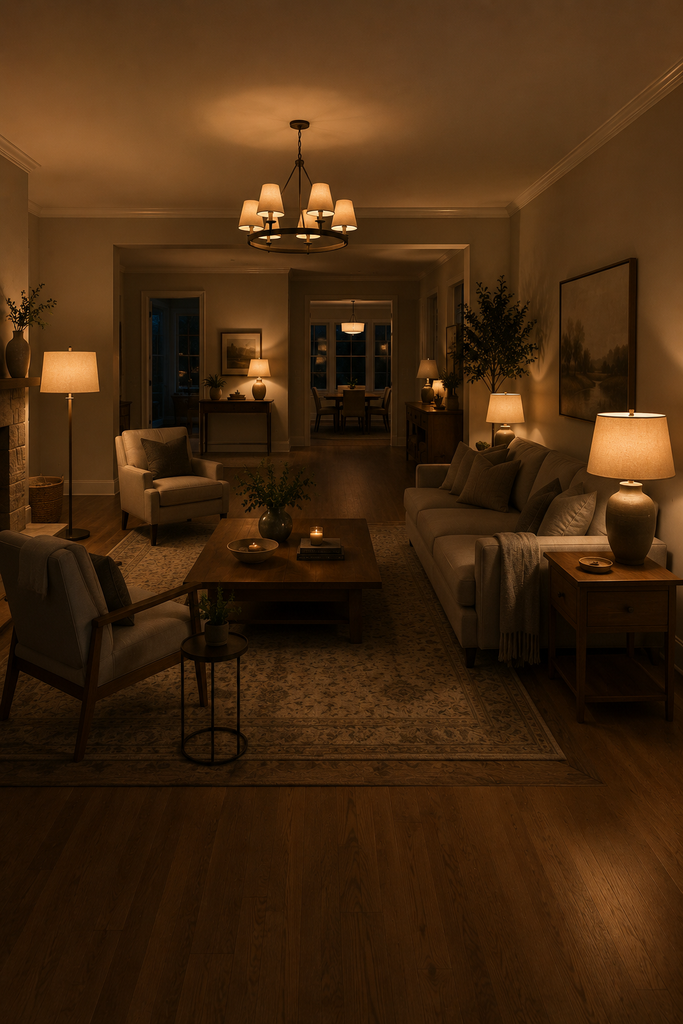
A large room with one overhead fixture almost always feels colder at night.
Why?
Because the light is coming from one high point and spreading evenly across a huge space. There are no smaller pools of warmth.
Cozy rooms usually have lighting at several heights.
Give Each Seating Area Its Own Light Source
Your main sofa area might have table lamps on a console or side tables. A reading corner gets a floor lamp. Another zone might have a small table lamp.
Suddenly, instead of illuminating one giant room, you’re lighting several intimate spaces within it.
Warm bulbs also matter. For living spaces, lighting around 2700K generally creates a much softer atmosphere than cool, bluish light.
And don’t underestimate dimmers.
Being able to lower the overhead lights while keeping lamps glowing around the room can completely change how a large living room feels after sunset.
Fill Large Walls Without Creating Visual Clutter
Large living rooms often come with large walls, and those walls can make the room feel unfinished even when the furniture layout is good.
But covering every inch with small artwork isn’t necessarily the answer.
Go Bigger Before You Add More
One substantial artwork often looks better than six undersized pieces scattered across a large wall.
You could also use a properly scaled gallery wall, oversized mirror, large textile, built-in shelving, or a substantial console with art above it.
Pay attention to furniture width.
Artwork hanging over a large sofa should visually relate to the sofa rather than looking like a tiny object stranded above it.
This is one of those places where scale makes the difference between “cozy” and “cluttered.”
Add Softness Through Texture, Not Just More Stuff
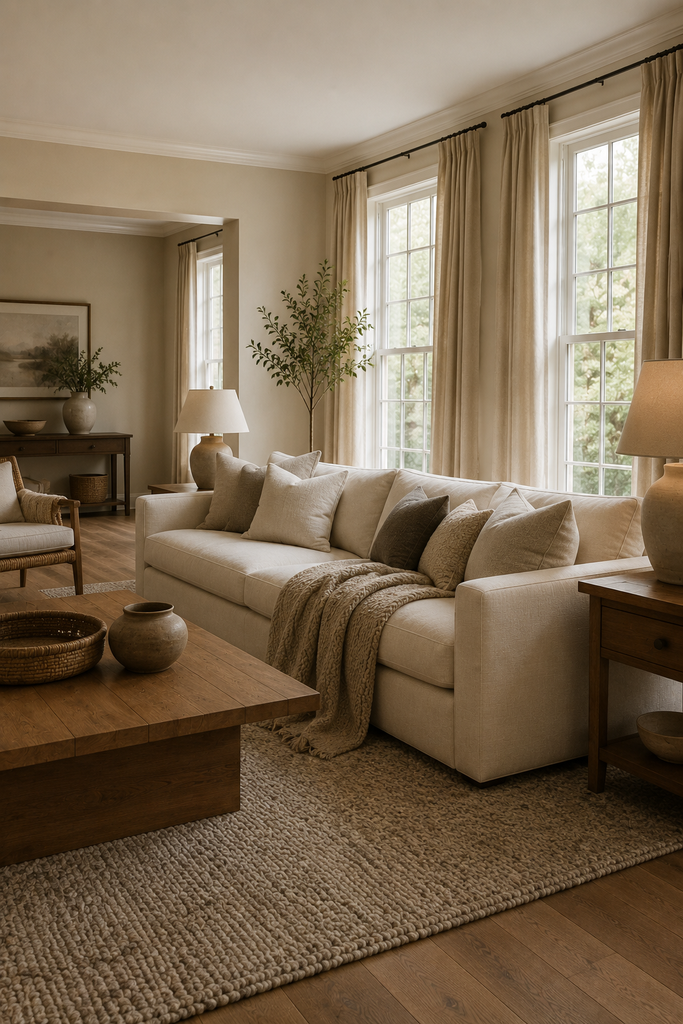
When people want a room to feel cozier, they often start adding decorative objects.
More pillows. More baskets. More candles. More accessories.
That can work—to a point.
But texture usually does a better job.
Try combining materials such as linen, wool, velvet, boucle, woven fibers, wood, and soft upholstery.
A large cream sofa with a wool rug, linen curtains, a chunky woven throw, wood tables, and a few textured pillows can feel incredibly inviting without having 40 decorative objects scattered around.
Curtains are especially useful in large living rooms.
Bare windows can emphasize the scale and hardness of the architecture. Full-length curtains soften those edges and visually frame the room.
Keep Walkways Clear and Intentional
Cozy does not mean cramped.
Once you start floating furniture and creating zones, you still need obvious paths through the room.
Think about how someone actually moves from the entrance to the sofa, from the sofa to another room, or toward the patio door.
You shouldn’t have to zigzag around coffee tables and chair corners.
In many layouts, roughly three feet of clearance works well for major walkways, although your exact space may need more or less.
Here’s the thing: negative space is useful when it becomes circulation space.
A clear walkway behind a floating sofa looks intentional.
A random six-foot gap between a sofa and chair looks disconnected.
That’s an important difference.
Use the Center of the Room as Your Anchor
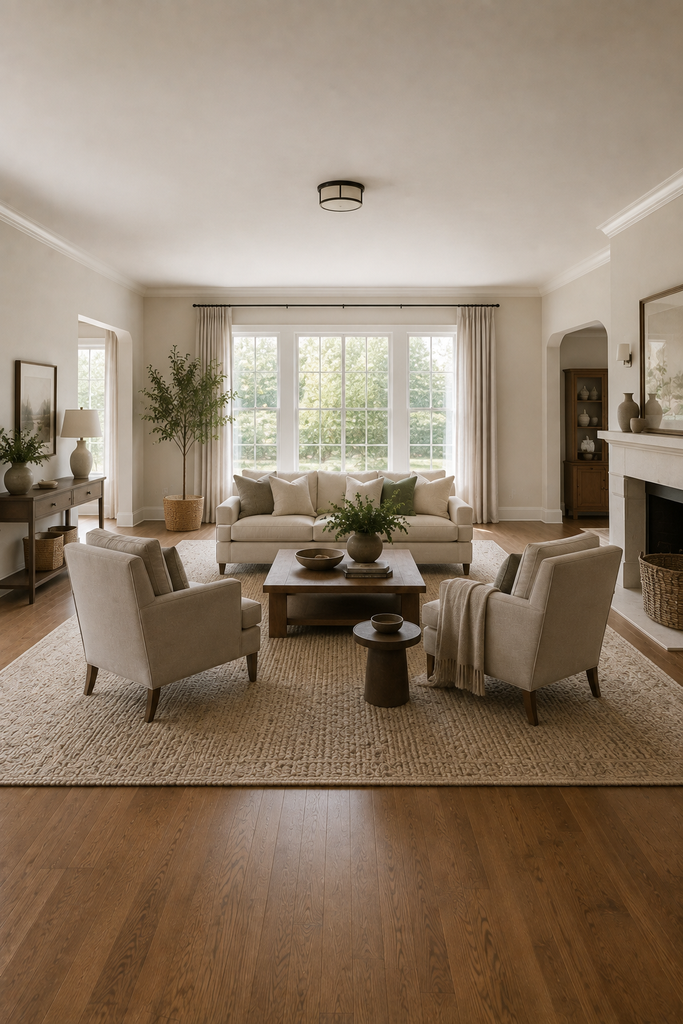
When you’re unsure where to start, stop decorating from the walls inward.
Start from the center outward.
Choose the main function of the room and build that zone first.
Place the rug. Arrange the sofa and chairs. Add the coffee table. Check conversation distances and traffic flow.
Then step back.
Only after the main area works should you decide what the remaining sections need.
This approach prevents one of the most common large-room mistakes: buying individual pieces for individual empty spots without considering how they relate to the room as a whole.
Don’t Try to Fill Every Empty Corner
This might be the most important finishing tip.
Some empty space is good.
You need breathing room around furniture for the individual pieces—and the room itself—to feel intentional.
If you have an empty corner and can’t immediately identify a useful purpose for it, leave it alone for a while.
Live with the layout.
You may eventually realize it’s the perfect place for a tall plant or reading chair. Or you might discover that keeping it empty makes the rest of the room feel calmer.
A large living room doesn’t need to look full.
It needs to look connected.
A Simple Formula for Making a Large Living Room Cozy
If your room currently feels overwhelming, don’t try to redesign everything at once.
Start with the main seating arrangement. Pull furniture away from the walls and create a comfortable conversation zone around a properly sized rug.
Then build outward.
Create one or two useful secondary zones, repeat colors and materials between them, add lighting at different heights, and introduce softness through curtains, rugs, upholstery, and natural textures.
Most importantly, resist the urge to fill every blank area.
Learning how to make a large living room feel cozy and connected is really about changing how you think about space. Instead of treating the room as one giant box that needs filling, create smaller areas that relate to each other.