
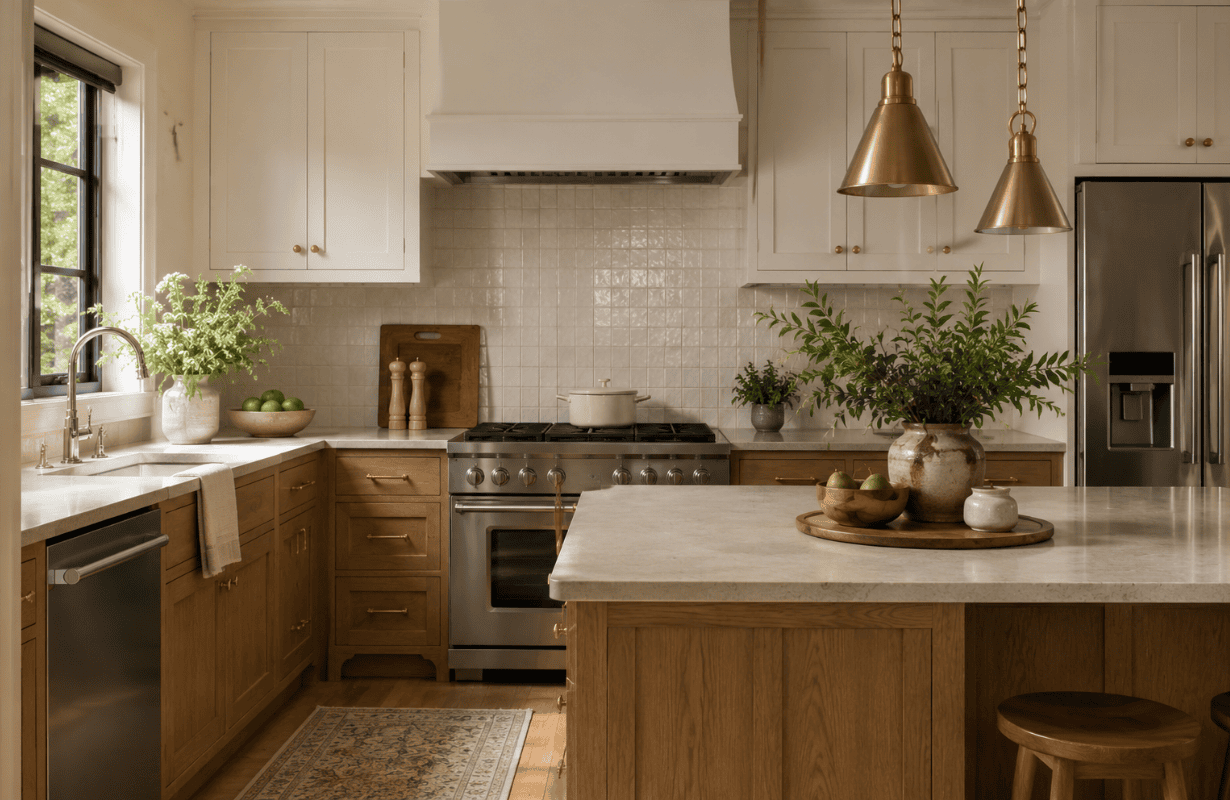
Mixing metals sounds easy until you’re standing in your kitchen wondering whether the brass cabinet pulls are fighting with the stainless-steel appliances. Then you notice the black faucet. And the chrome light fixture in the next room. Suddenly, every metal finish in your house feels like it needs to match.
It doesn’t.
In fact, trying to make every metal finish identical can make a home feel more like a builder package than a space that developed naturally over time. The trick is learning how to mix metals throughout your home so the different finishes feel intentional instead of random.
Here’s the thing: successful mixed-metal interiors usually aren’t using a huge variety of finishes. They’re using two or three metals strategically, repeating them enough to create a connection from room to room.
Once you understand that distinction, mixing brass, black metal, chrome, nickel, bronze, and stainless steel becomes much less intimidating.
Start With a Dominant Metal Instead of Treating Every Finish Equally
Most people get this wrong because they start by asking, “Which metals can I mix?”
A better question is: Which metal should lead the room?
Every room benefits from having one dominant metal finish. This is the finish you see most often, and it creates a visual baseline for everything else.
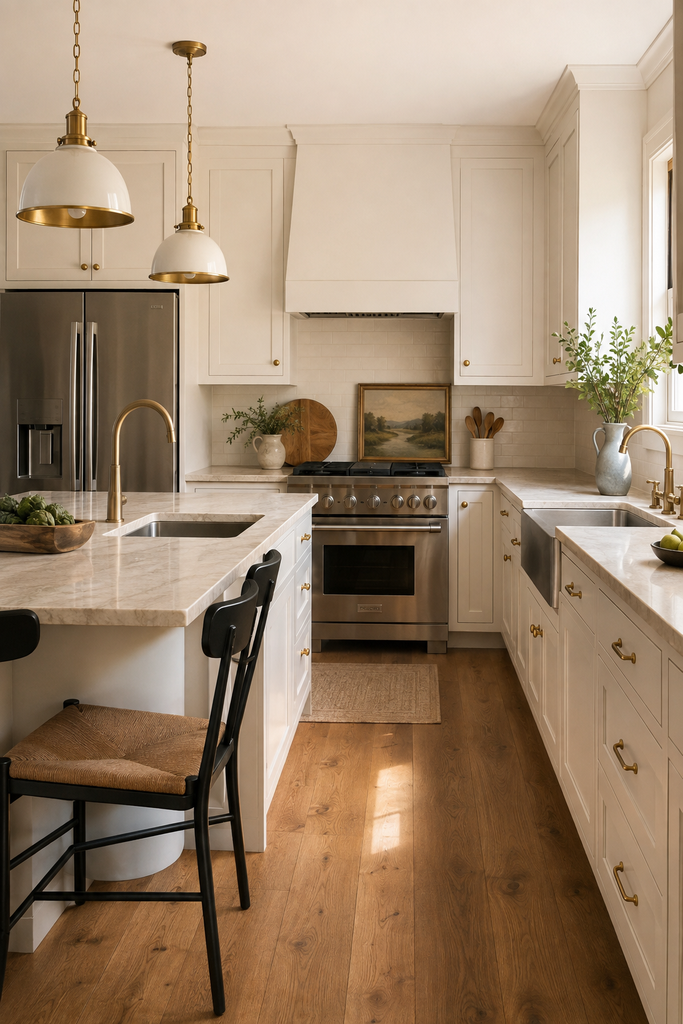
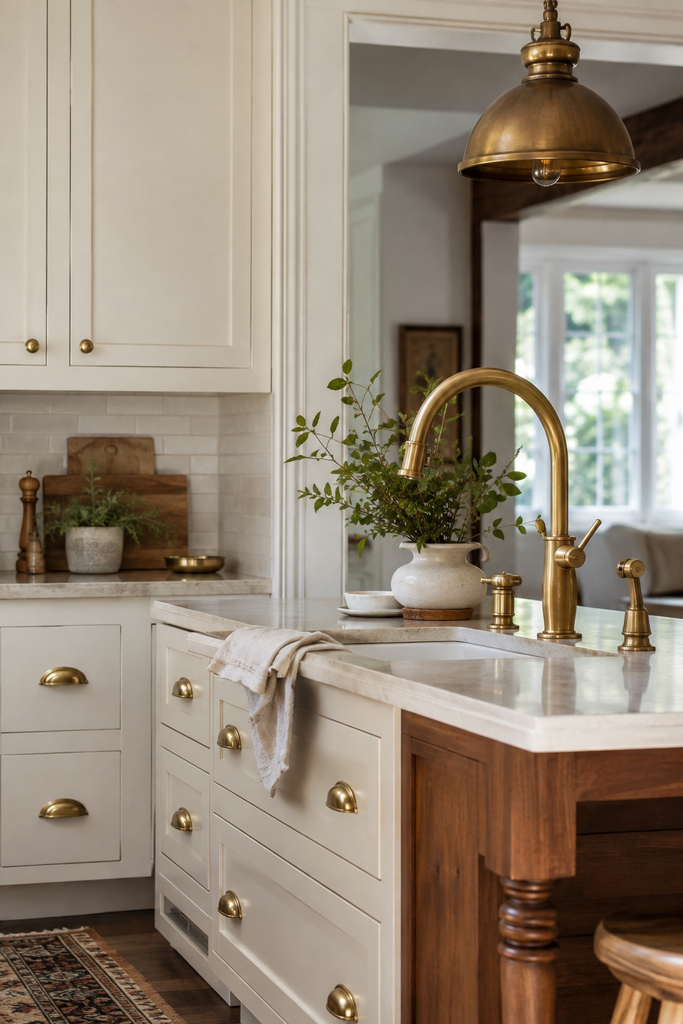
For example, imagine a kitchen with:
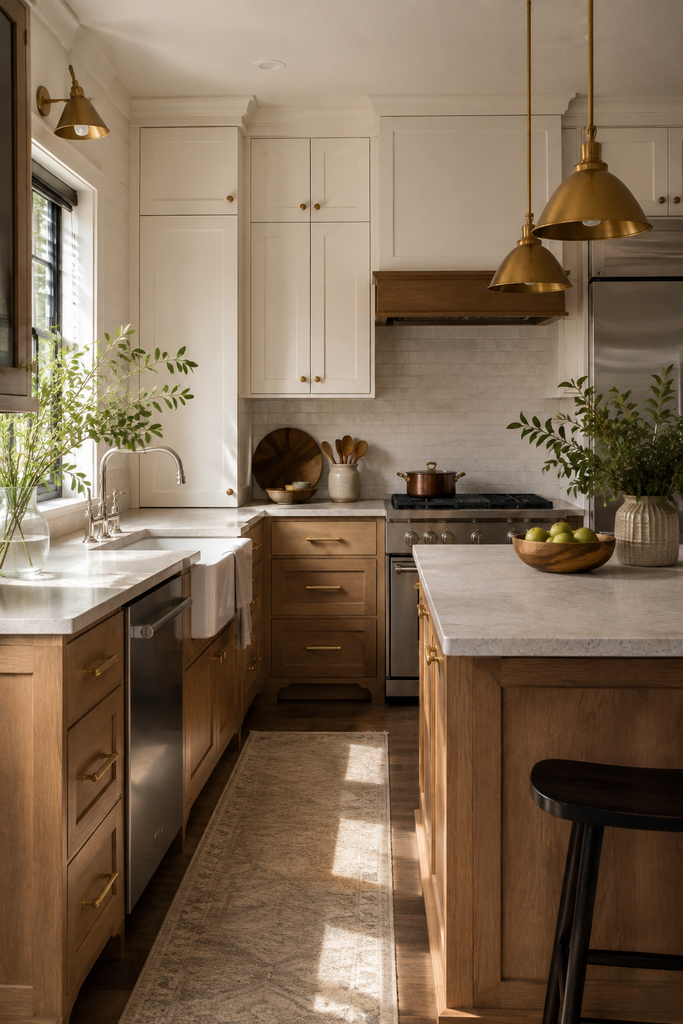
- Brushed brass cabinet hardware
- Stainless-steel appliances
- A stainless sink
- Two brass pendant lights
- A small amount of black metal on stools
Brass might still be the dominant decorative metal because it appears repeatedly across the cabinets and lighting. Stainless steel becomes the secondary finish, while black is simply an accent.
That hierarchy matters.
When three finishes are competing equally for attention, the room can feel busy. When one clearly dominates, the other finishes look like deliberate contrast.
Let Permanent Features Influence Your Choice
Before buying new hardware or fixtures, look at what you’re realistically not replacing.
Stainless-steel appliances, an existing fireplace surround, expensive plumbing fixtures, metal window frames, and large lighting fixtures should all influence your metal palette.
Don’t design as though these things aren’t there.
If your kitchen already has plenty of stainless steel, for instance, you don’t necessarily need more stainless hardware to “match.” You could introduce aged brass cabinet pulls and allow the stainless appliances to function as your cooler secondary metal.
That usually creates more depth than matching everything.
Mix Warm and Cool Metals on Purpose
One of the easiest ways to make mixed metals interesting is combining different temperatures.
Warm metals include finishes such as:
- Brass
- Antique brass
- Copper
- Bronze
- Gold-toned finishes
Cooler metals include:
- Chrome
- Polished nickel
- Stainless steel
- Silver-toned finishes
And then you have finishes like matte black that are relatively neutral and can bridge the two.
What actually works is contrast with repetition.
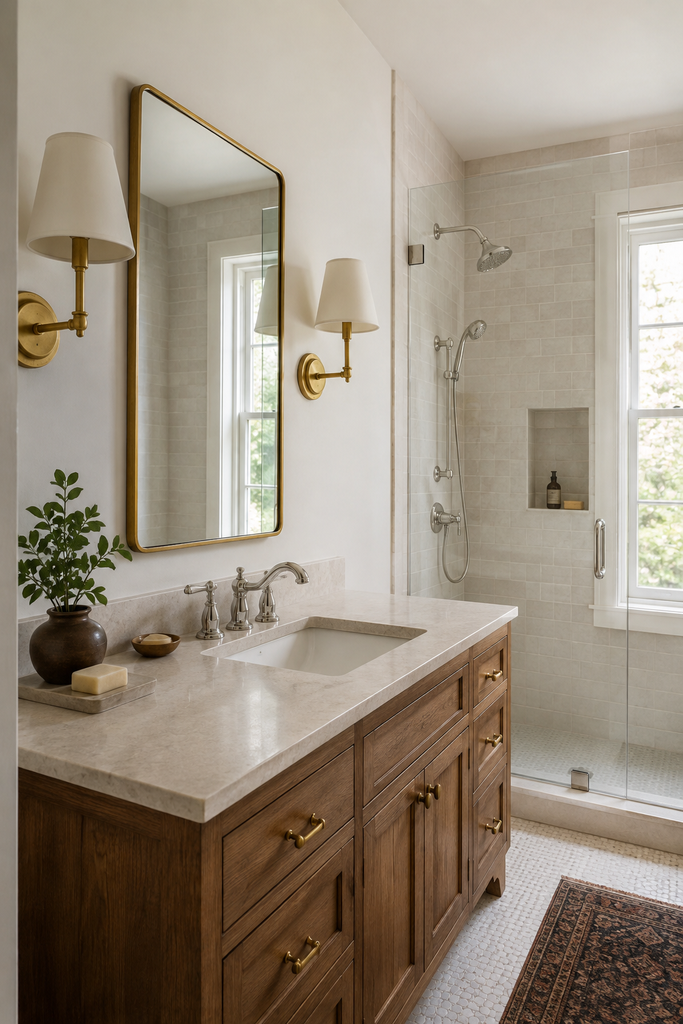
A polished nickel faucet next to one random brass cabinet knob might look like a mistake. A polished nickel faucet surrounded by brass hardware and brass lighting looks like a design choice because the brass has been repeated.
That’s a small distinction, but visually it’s huge.
Pay Attention to the Rest of the Room
Metal temperature shouldn’t be chosen in isolation.
If you have warm white walls, walnut cabinetry, cream countertops, and warm oak flooring, brass or bronze may naturally complement those materials. Adding some stainless steel or nickel can keep the room from becoming overly warm.
On the other hand, a room filled with cool gray stone, crisp white paint, and blue undertones might benefit from brass because it adds warmth.
Think of metal as part of your color palette rather than a separate decorating category.
Limit How Many Metal Finishes You Use in One Room
Technically, you can mix five different metals.
That doesn’t mean you should.
For most homes, two main metal finishes per room is plenty, with a third used sparingly if there’s a good reason for it.
This becomes especially important in smaller spaces.
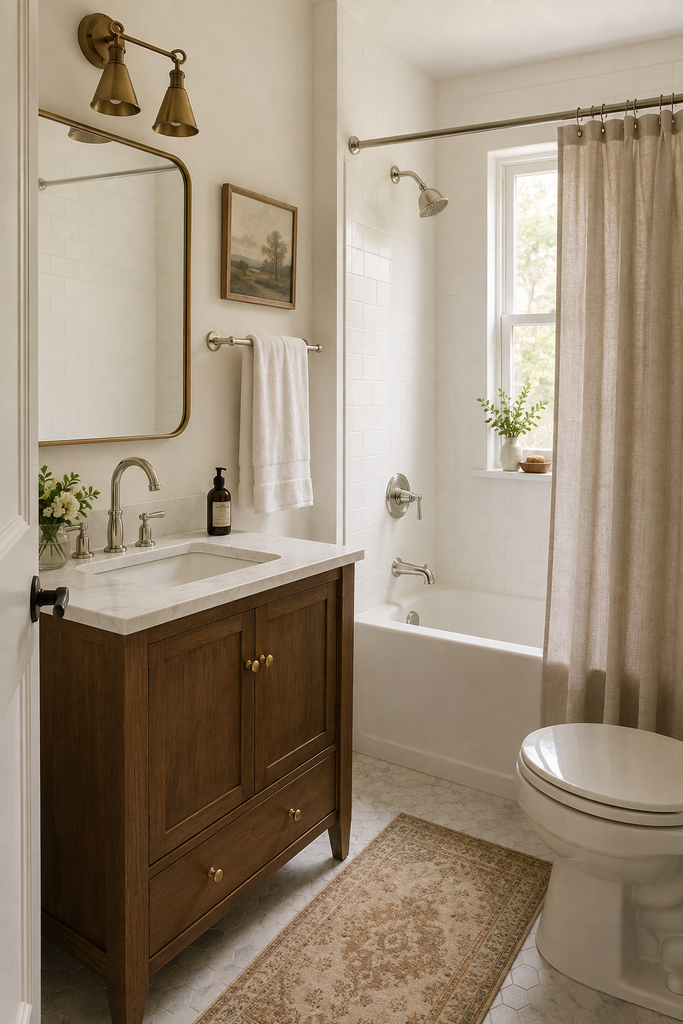
Imagine a small bathroom containing chrome faucets, brass cabinet hardware, matte black towel bars, brushed nickel shower hardware, and bronze lighting.
Every individual piece could be attractive, but together they may create too many visual interruptions.
A cleaner version might use polished nickel plumbing fixtures, aged brass lighting and hardware, and stop there.
Larger open-plan rooms can handle more variation because there is more physical space between finishes.
Don’t Mix Too Many Versions of the Same Metal
This is one of the less obvious mistakes.
Mixing brass and nickel is usually easier than mixing four slightly different brass finishes.
Why?
Because obviously different metals look intentional. Nearly matching metals can look accidental.
You might have cabinet hardware that’s yellow polished brass, lighting that’s muted aged brass, a mirror that’s rose-gold brass, and furniture legs that lean almost bronze.
Individually, they’re all “brass.” Together, the undertones may clash.
You don’t need every brass item to be manufactured by the same company, but try to keep the finishes within the same general family.
A little variation creates character.
Too much makes it look like you tried to match and missed.
Repeat Metals Across the Room
If you remember one rule about mixing metal finishes in home decor, make it this:
Don’t introduce an important finish only once.
Repetition is what turns an isolated choice into part of the design.
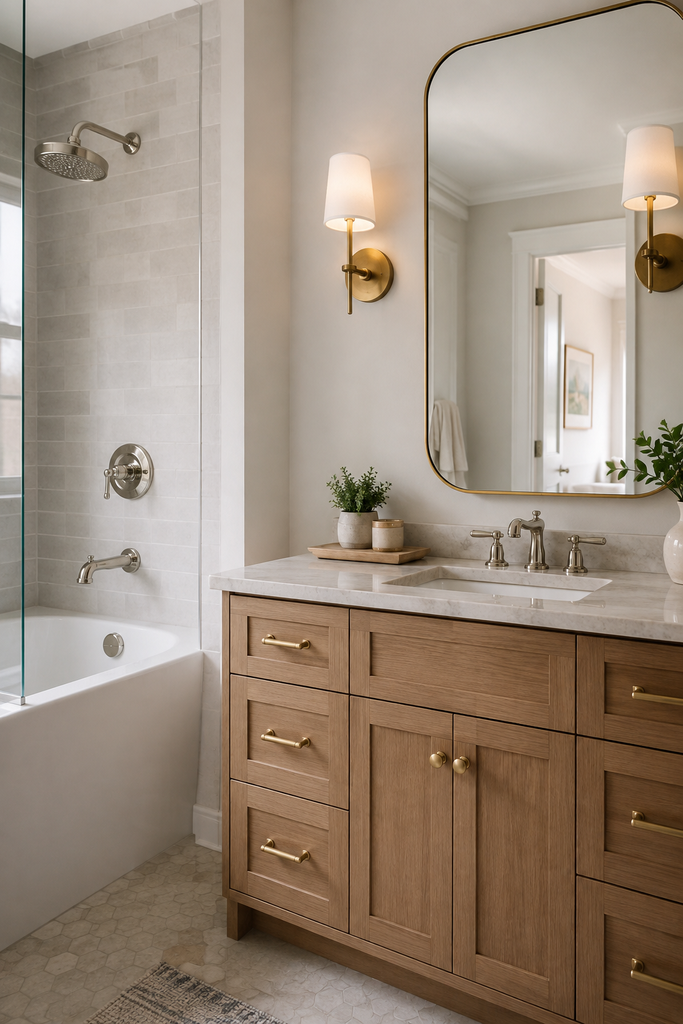
Say your bathroom has polished nickel plumbing fixtures. You decide to add aged brass sconces above the vanity.
Instead of stopping there, repeat that brass somewhere else. Maybe it’s the vanity hardware or the mirror frame.
Now the brass sconces don’t look random.
The same principle works in kitchens, living rooms, bedrooms, and entryways.
Repetition Doesn’t Have to Be Exact
You don’t need three identical brass objects lined up around the room.
The repetition can happen through completely different elements.
For example:
Kitchen: brass cabinet pulls + brass pendants
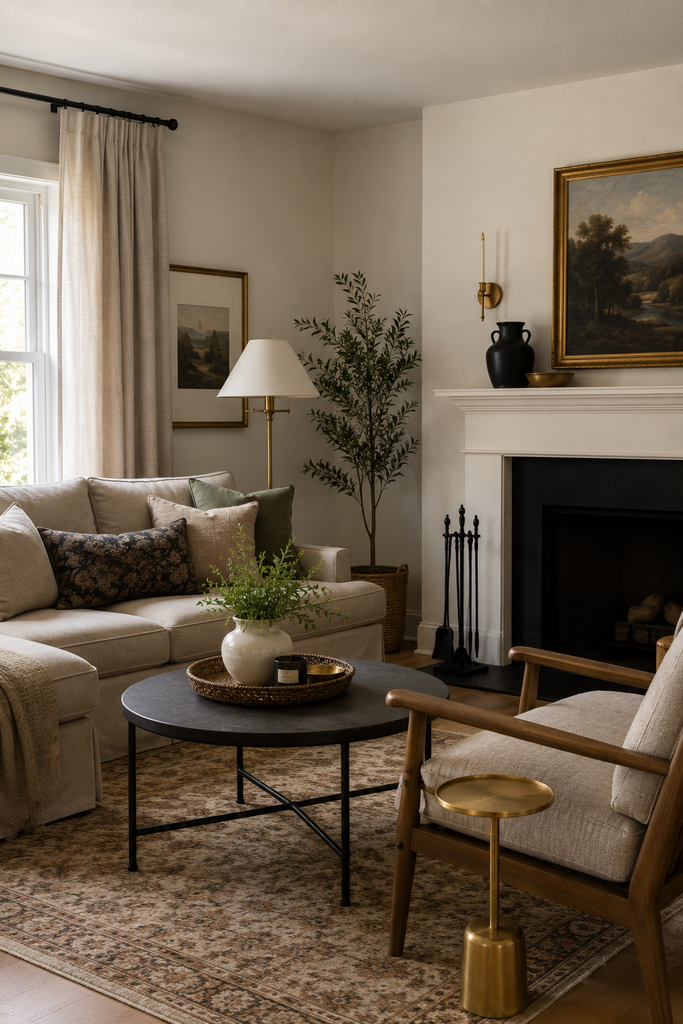
Living room: brass floor lamp + small brass table detail
Entryway: brass mirror frame
The objects change, but the material creates continuity.
That’s how a home starts feeling connected without feeling overly coordinated.
Create a Metal Palette That Continues Through the House
Mixing metals throughout an entire home is slightly different from mixing them within one room.
You don’t need every room to use exactly the same combination.
Actually, I wouldn’t recommend it.
Instead, create a loose whole-home metal palette and let different rooms emphasize different finishes.
For example:
Kitchen: aged brass + stainless steel
Dining room: aged brass + black
Living room: black + small brass accents
Primary bathroom: polished nickel + brass
Bedroom: black + brass
Notice what happens here.
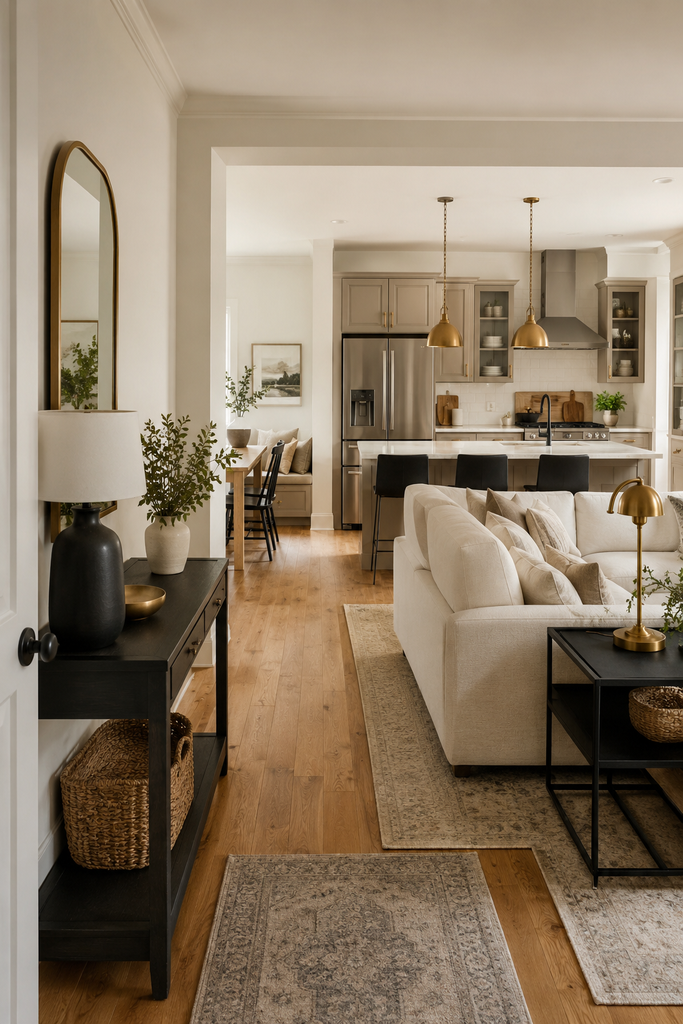
No room contains every finish, but brass and black keep appearing throughout the house. That repetition creates a visual thread.
This works especially well in open floor plans where you can see several rooms at once.
Use Transitional Areas to Connect Rooms
Hallways and entryways are useful places to repeat finishes.
If your kitchen contains brass but your living room leans heavily toward black metal, an entry console with a black lamp and small brass detail can quietly connect the two palettes.
You don’t need to consciously notice this for it to work.
Your eye simply registers that the materials belong together.
Know Where Matching Actually Looks Better
Mixing metals doesn’t mean you should deliberately make every fixture different.
Sometimes matching is cleaner.
For example, keeping the showerhead, shower controls, tub filler, and nearby plumbing components in the same finish often makes sense because they’re visually grouped together.
Similarly, cabinet pulls on the same run of cabinetry generally look better in one finish.
Think in terms of visual groups.
Elements that function together can match. Separate groups within the room can introduce another metal.
In a bathroom, that could mean nickel plumbing fixtures with brass lighting and vanity hardware.
In a kitchen, stainless appliances and sink fixtures could form one group while brass hardware and lighting form another.
That’s much easier on the eye than alternating finishes randomly.
Watch the Finish, Not Just the Metal
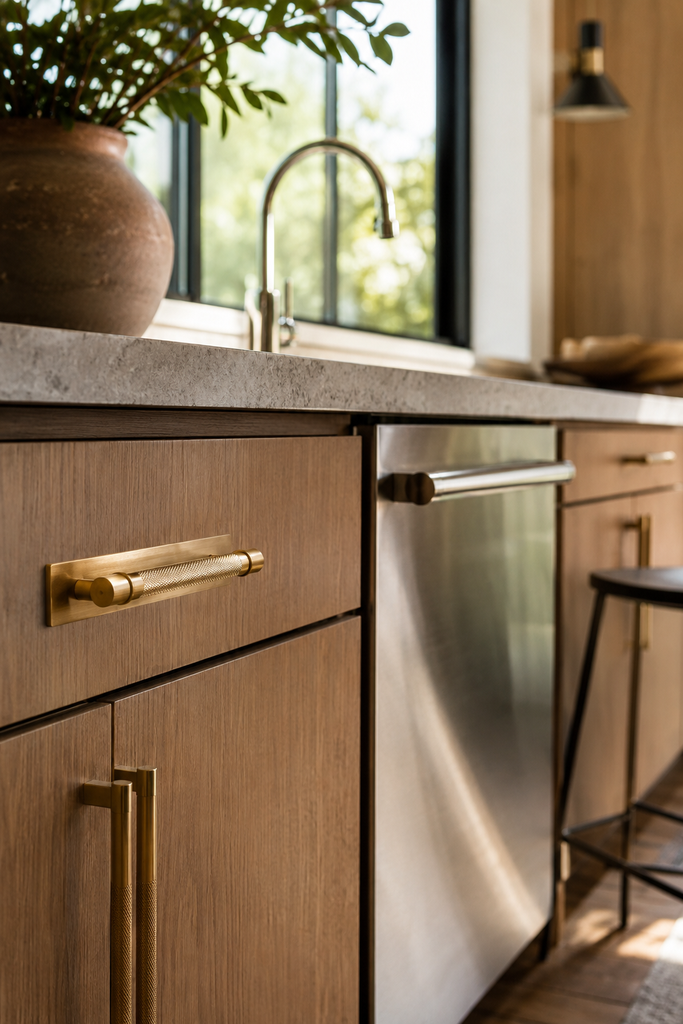
Metal type isn’t the only thing that affects how finishes interact.
Sheen matters too.
Polished chrome is shiny and reflective. Brushed nickel is softer. Unlacquered brass develops patina. Matte black absorbs light rather than reflecting it.
You can use those differences intentionally.
In a kitchen with glossy stone countertops and stainless appliances, for example, brushed or aged brass may work better than highly polished brass because it adds a softer texture.
This is also why samples are worth ordering.
Online product photos can make antique brass look almost identical across brands when the actual pieces have completely different undertones.
Put samples in the room and look at them during daylight and at night before committing.
Common Metal-Mixing Mistakes That Make a Home Feel Disconnected
There are a few mistakes I see repeatedly.
The first is introducing every trendy finish you like. Brass hardware, black faucets, chrome lighting, copper accessories, and bronze furniture don’t automatically create an “eclectic” room. Sometimes they’re simply too much.
The second is refusing to mix anything.
Matching every hinge, faucet, light fixture, doorknob, and furniture leg throughout an entire home can flatten the design.
Another mistake is forgetting architectural sightlines. If you can stand in your living room and see the kitchen and entryway simultaneously, those spaces aren’t completely separate from a design standpoint.
Look at them together.
Your metals don’t need to match, but there should be some repeated finish that connects the spaces.
A Simple Step-by-Step Method for Mixing Metals
If you’re updating your home and don’t know where to begin, don’t start shopping yet.
Step 1: Inventory What’s Already There
Walk through the room and write down every noticeable metal finish.
Include faucets, appliances, cabinet hardware, lighting, furniture legs, mirrors, curtain rods, and major decorative pieces.
You may already have a clearer palette than you think.
Step 2: Choose Your Dominant Finish
Pick the metal that will appear most often or have the strongest visual presence.
Existing expensive fixtures can make this decision for you.
Step 3: Add One Contrasting Metal
If your dominant finish is warm, try introducing something cooler or neutral.
Brass + polished nickel
Brass + black
Bronze + stainless steel
Chrome + aged brass
You don’t have to follow a formula, but visible contrast usually looks more deliberate than almost-matching finishes.
Step 4: Repeat the Secondary Finish
Use it at least a couple of times when possible.
This doesn’t mean buying unnecessary decor just to satisfy a rule. Look for functional places where repetition naturally makes sense.
Step 5: Check the View From the Next Room
Stand in adjoining spaces and look back.
Does one finish suddenly appear nowhere else? Does one room feel significantly warmer or cooler than everything around it?
Make small adjustments rather than redesigning the entire palette.
How to Mix Metals Without Making Your Home Feel Trendy
Metal trends change constantly.
For a while everything was brushed nickel. Then brass came back. Matte black became huge. Polished nickel started appearing again.
Trying to replace your hardware every time a finish becomes popular gets expensive fast.
Instead, use trendy finishes in places that are relatively easy to change.
Cabinet knobs, lamps, mirrors, small furniture, and decorative hardware are much easier to update than plumbing or major appliances.
For permanent fixtures, choose something you genuinely like and that works with the architecture of your home.
A well-balanced mix of metals usually ages better than a room where every single fixture reflects one very specific trend.
Let’s Wrap Up
Learning how to mix metals throughout your home is less about memorizing which finishes “go together” and more about creating a clear visual hierarchy.
Choose a dominant metal, introduce one or two complementary finishes, repeat them intentionally, and consider what you can see from adjoining rooms. That’s really the foundation.
And don’t worry about making every brass finish perfectly identical. Homes usually look better when they have a little variation. The goal is consistency, not showroom-level matching.