
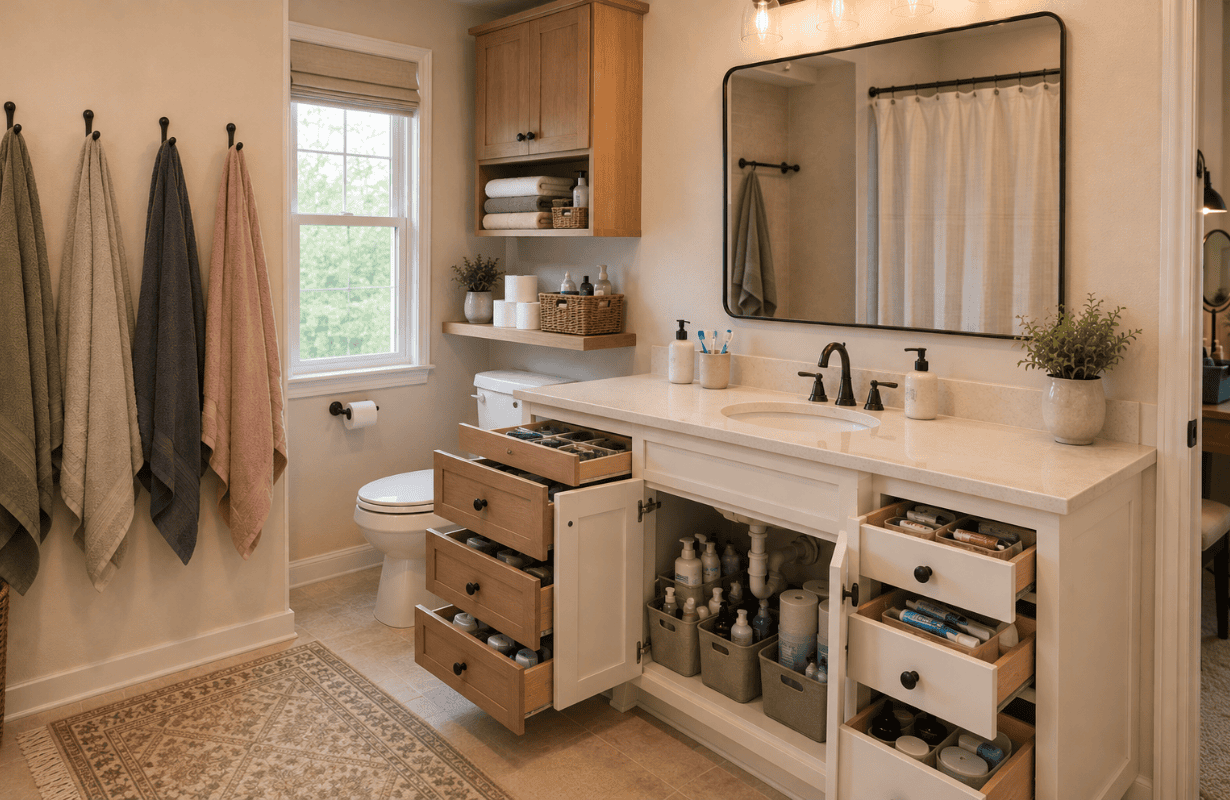
Sharing a bathroom sounds manageable until three people need the sink at the same time, nobody knows whose towel is whose, and the countertop somehow collects six half-empty bottles overnight.
And honestly, the problem usually isn’t that the bathroom is too small. It’s that the space was never organized around multiple people actually using it.
When one person uses a bathroom, you can get away with keeping skincare on the counter, tossing a hair dryer under the sink, and hanging your towel wherever there’s room. Add a partner, kids, roommates, or several family members, and those casual habits start creating daily friction.
Here’s the thing: learning how to organize a shared bathroom for multiple people isn’t really about squeezing in more storage. It’s about giving belongings clear homes, separating personal items from shared ones, and making the things everyone uses ridiculously easy to put away.
You don’t need a bathroom renovation or a matching collection of expensive organizers. You need a system that still works on a rushed Monday morning.
Here’s how I’d set it up.
Why Shared Bathrooms Get Messy So Quickly
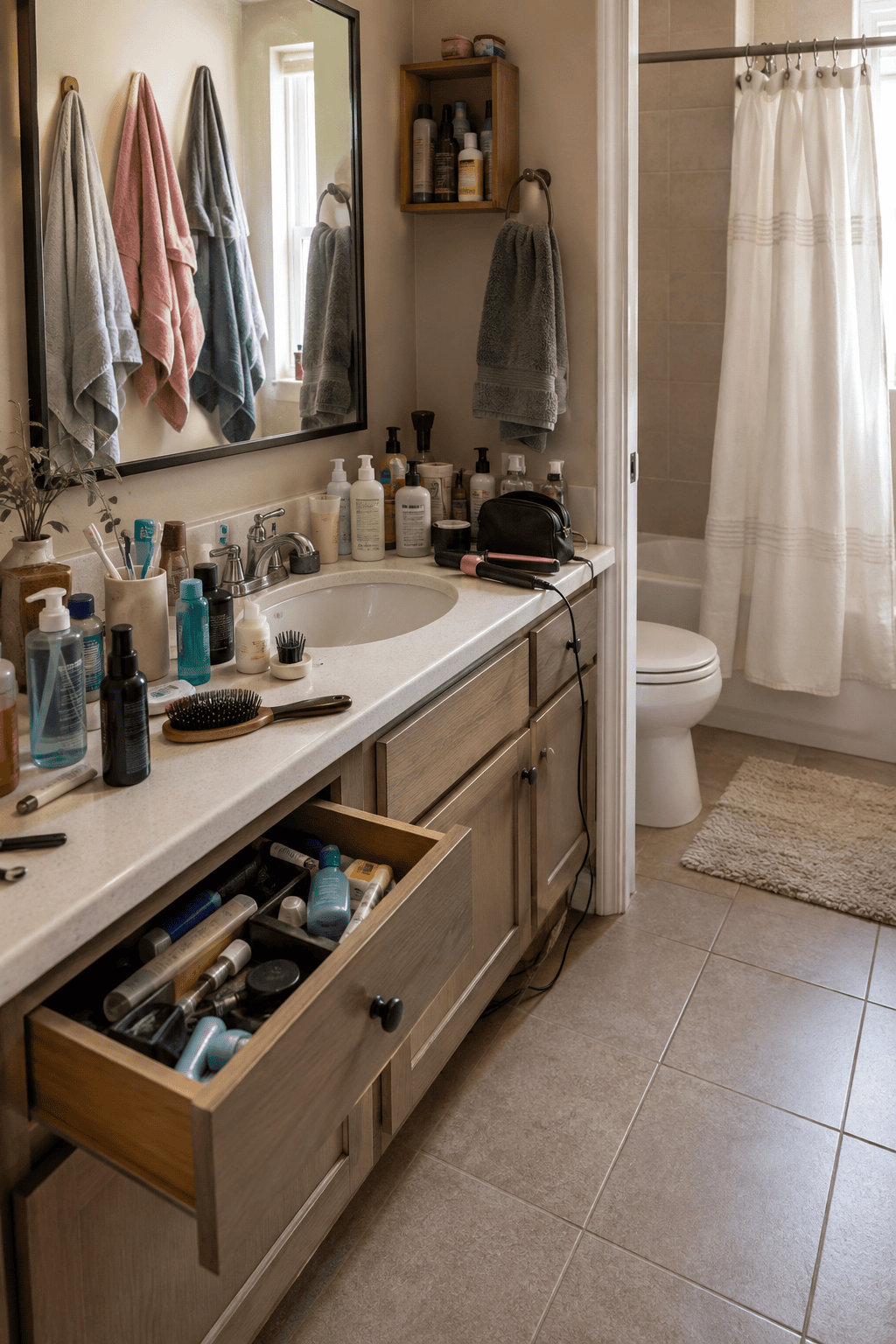
Before buying another basket, it’s worth figuring out why the bathroom keeps becoming cluttered.
Everyone Uses the Same Prime Storage Areas
Most bathrooms have a handful of convenient storage spots: the countertop, medicine cabinet, top vanity drawers, and easiest-to-reach cabinet shelves.
Naturally, everyone wants those spaces.
That’s where things go wrong.
If four people are constantly digging through one drawer filled with toothpaste, razors, brushes, cosmetics, and hair products, even a perfectly organized drawer won’t stay organized for long.
The problem isn’t necessarily the amount of stuff. It’s overlapping territory.
There’s No Difference Between Personal and Shared Products
Toothpaste might be communal. A prescription isn’t. Hand soap is shared. Skincare probably isn’t.
When everything is stored together, people have to search through other people’s belongings every time they need something.
That creates clutter because products get pulled out and don’t always make it back where they belong.
What actually works is separating the bathroom into two categories: personal storage and household storage.
That one distinction makes almost every other organizing decision easier.
Start by Giving Every Person a Defined Zone
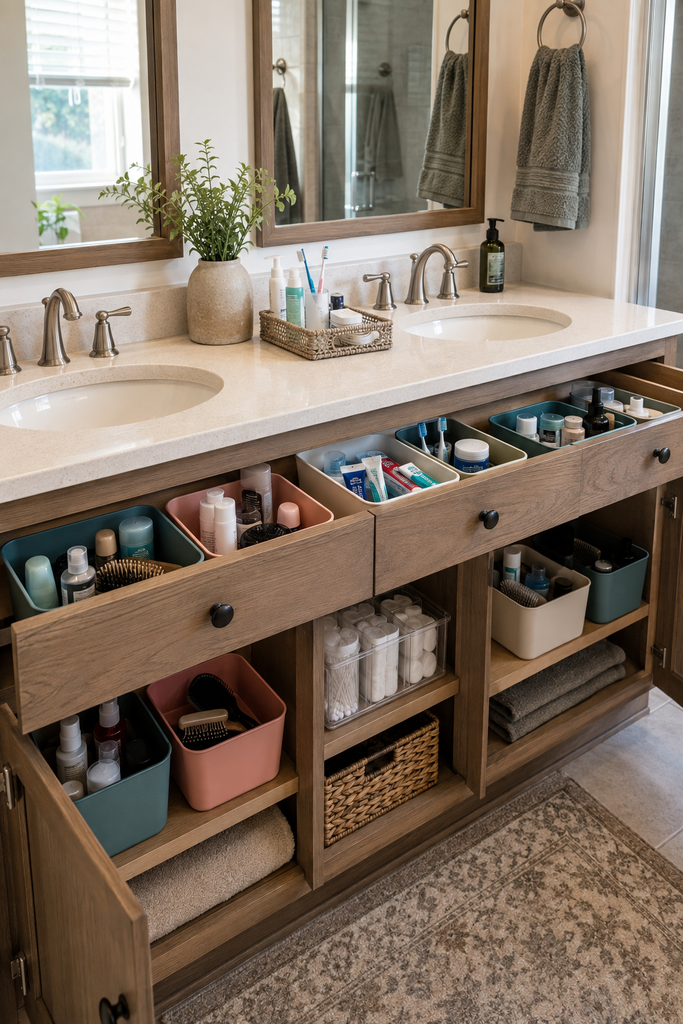
If you’re trying to organize a bathroom shared by a family or several roommates, start with ownership rather than containers.
Every regular bathroom user should have a clearly defined place for their everyday belongings.
Assign Drawers, Bins, or Shelves by Person
You don’t necessarily need equal amounts of space. You need clearly assigned space.
In a vanity with four drawers, for example, two people might each receive a drawer while shared supplies occupy the remaining two.
Inside a cabinet, give each person a basket or section of a shelf.
For children sharing a bathroom, simple color-coded bins can work surprisingly well. One child gets blue, another gets green, and nobody has to remember complicated labels.
The important part is that belongings don’t migrate.
When someone takes out deodorant, moisturizer, or a hairbrush, there should be exactly one obvious place to return it.
Keep Daily Products in the Best Locations
Not every product deserves prime bathroom real estate.
This is where most people get this wrong. They organize according to product category rather than frequency of use.
A backup bottle of shampoo doesn’t need to occupy the easiest vanity drawer just because it’s a bathroom product.
Reserve your most accessible storage for things used every morning and evening:
- Toothbrushes and dental products
- Daily skincare
- Deodorant
- Frequently used hair products
- Razors
- Basic grooming items
Occasional products can move farther down, higher up, or even outside the bathroom.
Get Personal Products Off the Counter
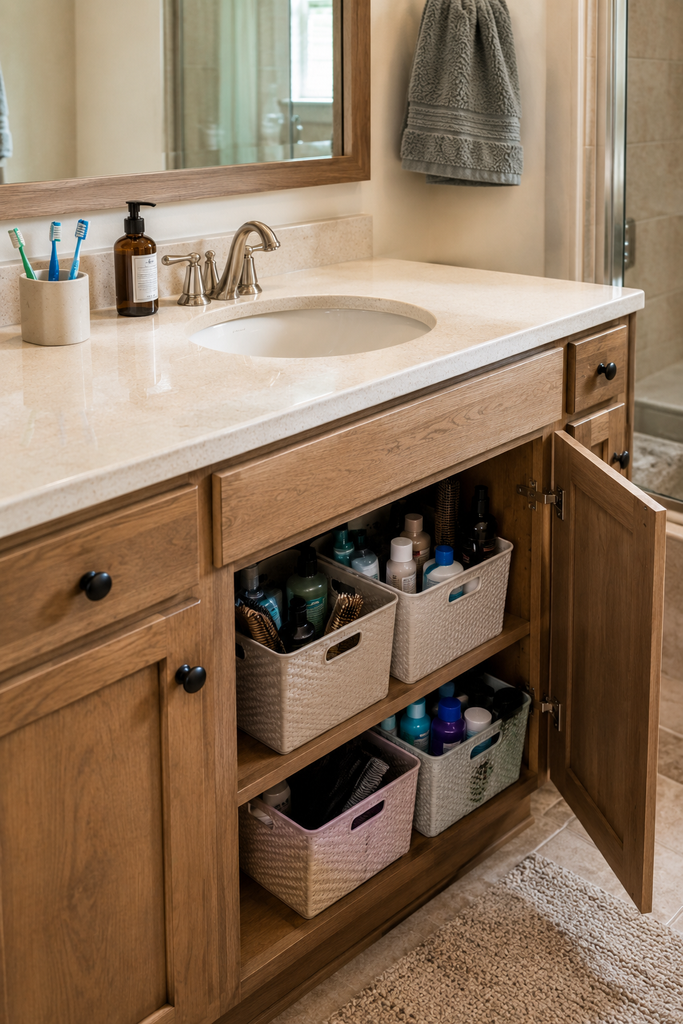
A shared bathroom countertop becomes messy incredibly fast because you’re multiplying everyone’s daily routine.
One person’s moisturizer, toothbrush, perfume, and hairbrush might look harmless. Multiply that by four people and suddenly there’s no room around the sink.
Use Grab-and-Go Routine Bins
One of my favorite solutions for a busy shared bathroom is giving each person a small routine bin or caddy.
Instead of permanently displaying ten personal products, someone can pull out their caddy, complete their routine, and put the entire thing away.
This is especially useful when storage is limited.
A bathroom shared by teenagers, for example, might have separate caddies containing each person’s skincare, deodorant, hairbrush, and grooming products. The caddies can live inside the vanity or on a shelving unit.
It also makes cleaning the bathroom dramatically easier because you aren’t moving dozens of bottles before wiping down the counter.
Be Strict About What Stays Beside the Sink
I’d keep countertop storage surprisingly minimal.
Hand soap obviously stays. A toothbrush holder may make sense depending on your setup. Beyond that, I’d question almost everything.
Decorative trays filled with everybody’s products might photograph nicely, but they’re usually not practical in a genuinely busy shared bathroom.
Clear counter space is more valuable.
Divide Vanity Drawers Into Smaller Zones
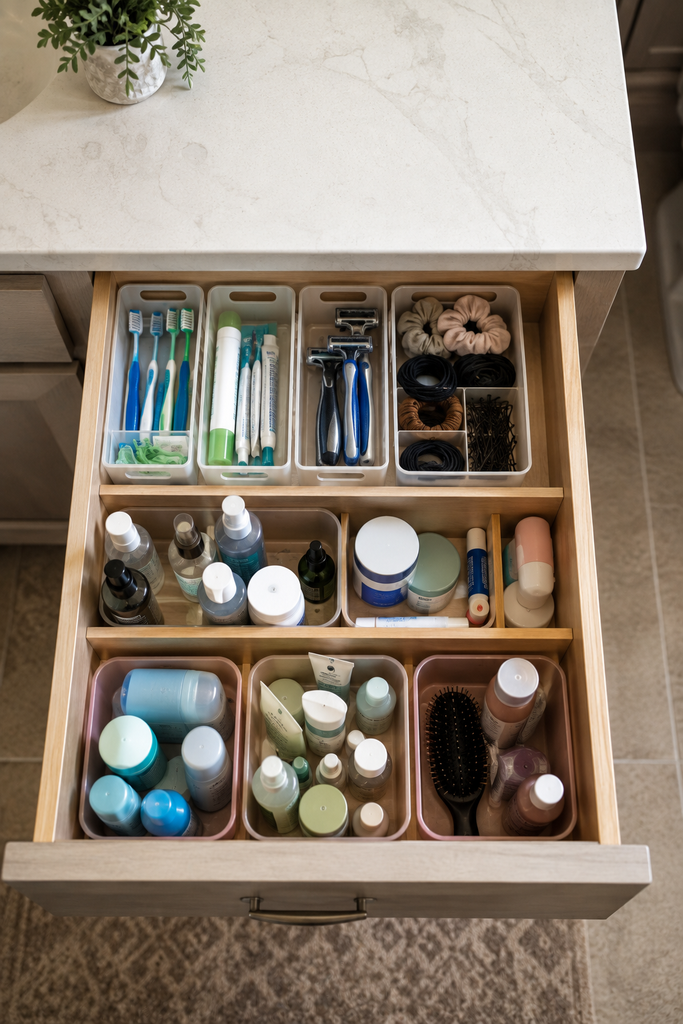
Large bathroom drawers look useful until they become giant junk drawers.
Most people get this wrong by putting several categories into one open drawer and assuming they’ll somehow stay separated.
They won’t.
Create Boundaries Inside Each Drawer
Use shallow dividers or small existing containers to separate things like dental care, shaving supplies, skincare, and hair accessories.
The goal isn’t to create a Pinterest-perfect drawer. It’s to prevent items from sliding into one another.
If one person owns the entire drawer, organize it around their routine.
If the drawer is shared, divide it physically. Left side belongs to one person, right side belongs to another.
Clear boundaries eliminate the little daily question of, “Where am I supposed to put this?”
Make the Under-Sink Cabinet Actually Useful
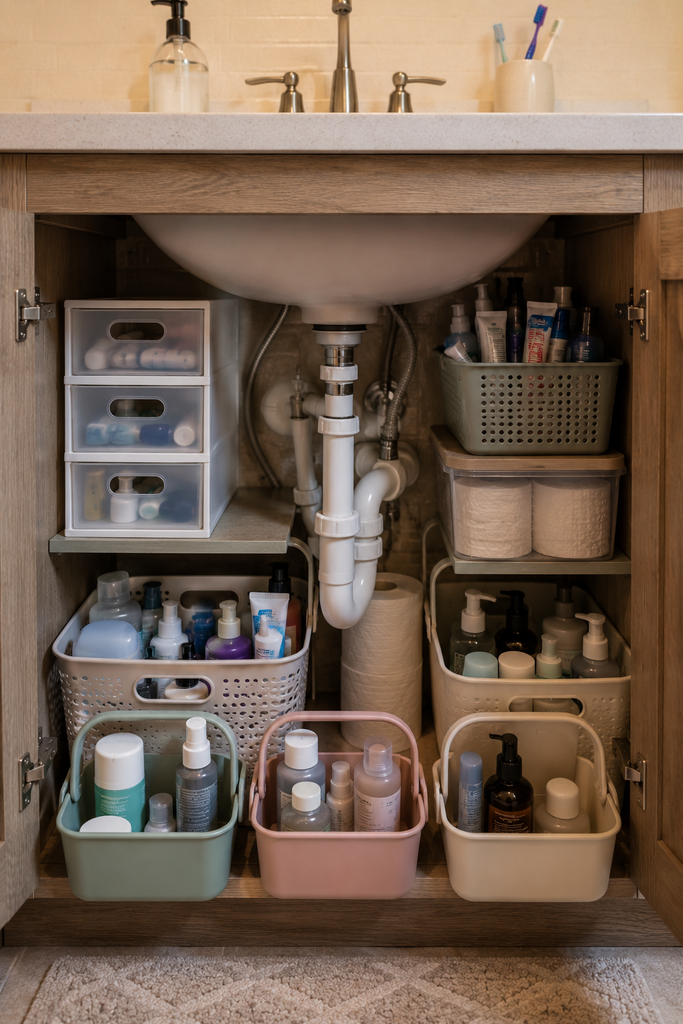
Under-sink storage is awkward because plumbing steals the most useful part of the cabinet.
Still, there’s usually much more potential there than people realize.
Store Backups Separately From Everyday Products
Don’t mix unopened toothpaste, extra shampoo, toilet paper, and cleaning products with everybody’s daily toiletries.
Create a dedicated backup zone.
A simple bin containing extra toothpaste, soap, shampoo, and other household supplies works well because you can quickly see what you’re running low on.
This also prevents each person from keeping their own random backup products throughout the vanity.
Work Around the Plumbing
Instead of trying to fit one giant organizer beneath the sink, use smaller containers on either side of the pipes.
Stackable drawers can work on one side while taller bottles sit on the other.
If you’re organizing a family bathroom, you might use one section for cleaning supplies, another for backups, and the remaining accessible area for personal caddies.
Measure first. Bathroom cabinets have an impressive ability to make storage products look smaller online than they are in real life.
Solve the Towel Problem Before It Starts
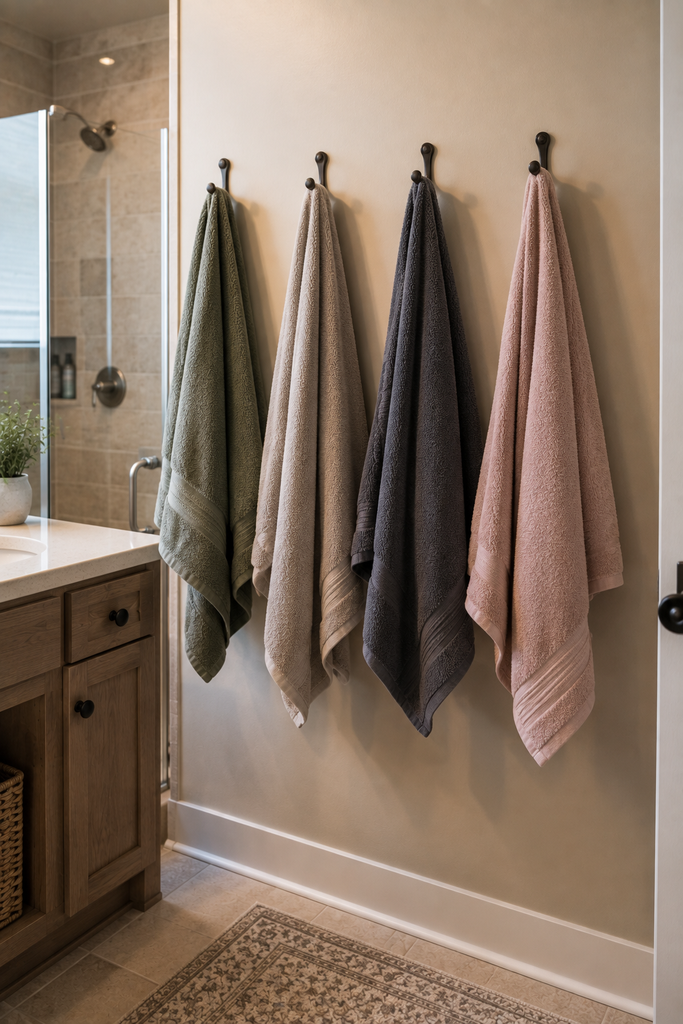
Towels are one of those boring details that can make a shared bathroom feel permanently chaotic.
One towel bar isn’t enough for four people.
Give Every Person a Towel Hook
Hooks are usually much more practical than bars in a heavily shared bathroom.
They’re faster to use, require less wall space, and make it easier to give each person a designated spot.
Install individual hooks behind the door, along an empty wall, or wherever towels have enough airflow to dry properly.
The important thing is spacing them adequately rather than cramming damp towels together.
You can also assign towel colors if people constantly forget which towel belongs to them.
It’s not glamorous, but it works.
Use Vertical Space Without Making the Bathroom Feel Crowded
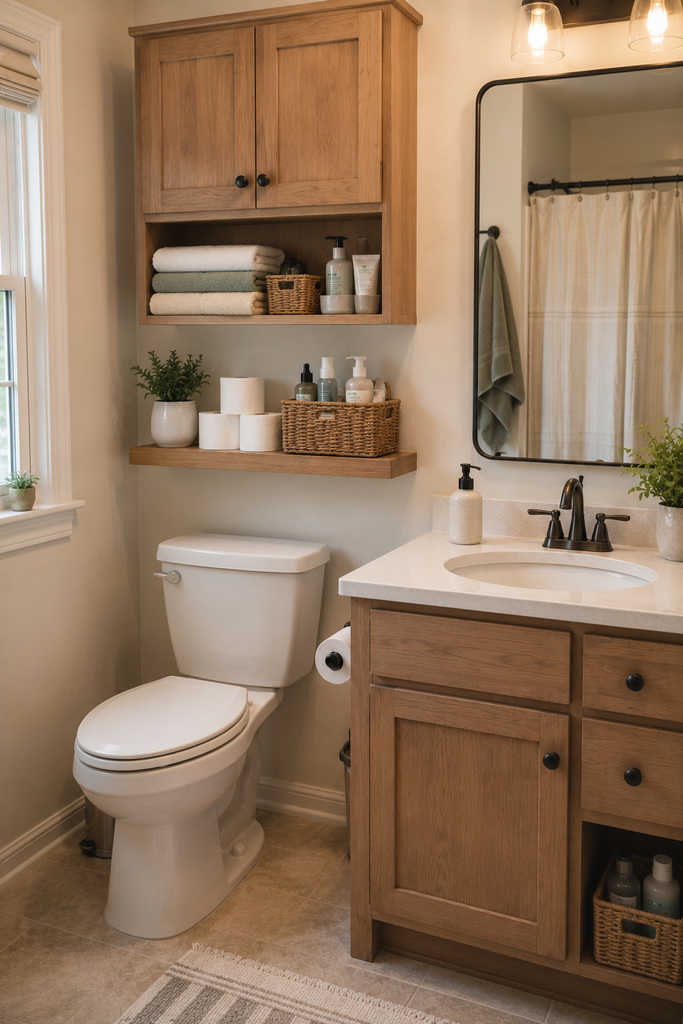
Once vanity storage is full, people often start adding freestanding cabinets and carts.
Sometimes that’s necessary. But in a small shared bathroom, adding more furniture can make the room harder to use.
Look upward first.
Add Storage Above the Toilet or Door
A shallow wall cabinet or shelving above the toilet can hold extra toilet paper, towels, and backup toiletries.
The area above the bathroom door can also work for rarely used supplies if you can safely reach them.
Keep frequently used products lower.
You don’t want someone climbing onto the toilet every morning to retrieve hairspray.
Don’t Fill Every Wall With Storage
More storage isn’t automatically better.
A tiny bathroom covered in shelves, hooks, baskets, and hanging organizers can feel more cluttered than one with slightly less storage.
Leave some visual breathing room.
I’d rather relocate rarely used items to a nearby linen closet than turn every available wall into a storage system.
Create a Morning-Rush Setup

A good shared bathroom should work when everyone is tired, late, and slightly irritated.
That’s the real test.
Think about which activities genuinely require the bathroom.
Brushing teeth? Probably.
Applying makeup? Not necessarily.
Drying or styling hair? Often not.
If several people compete for the bathroom every morning, consider creating a small grooming station elsewhere.
A bedroom vanity with a mirror and outlet can handle makeup and hair styling. Personal skincare caddies can even travel between spaces.
This reduces bathroom traffic without changing the bathroom itself.
For families with kids, it can make mornings noticeably less stressful.
Common Shared Bathroom Organization Mistakes
There are a few systems I’d avoid because they tend to look organized initially but create more work later.
Buying organizers before decluttering is probably the biggest one. You’ll simply end up organizing products nobody uses.
Another is giving everyone access to every storage area. Shared space doesn’t mean every drawer has to be communal.
Then there’s excessive labeling. Labels can help with backup supplies and personal bins, but you shouldn’t need instructions for every cotton swab.
And finally, avoid complicated systems.
If putting away a hair dryer requires wrapping the cord perfectly, opening two containers, and rearranging three products, someone will eventually leave it on the counter.
The easier the reset, the more likely people are to maintain it.
Do a Five-Minute Bathroom Reset Each Week
Shared bathroom organization isn’t something you finish once.
Products multiply. Toilet paper runs out. Empty bottles somehow remain in cabinets for weeks.
A quick weekly reset keeps small problems from becoming big ones.
Throw away empties, return wandering products to their zones, refill shared supplies, check backups, and clear the countertop.
You don’t need to reorganize everything.
The system should already tell you where things belong.
That’s the whole point.
Final Thoughts
Figuring out how to organize a shared bathroom for multiple people becomes much easier once you stop treating the bathroom as one big communal storage space.
Give each person a defined zone. Separate personal products from shared supplies. Keep everyday items accessible, move backups out of prime storage, and make countertops easy to clear.
Most importantly, build the system around how people actually behave.
If everyone naturally drops their towel near the door, that’s probably where the hooks belong. If teenagers keep leaving skincare beside the sink, give them caddies that take five seconds to put away.